Agentic Verification Layer
Built at Meta Global AI Developer Hackathon · Oct 26, 2026 · Remote
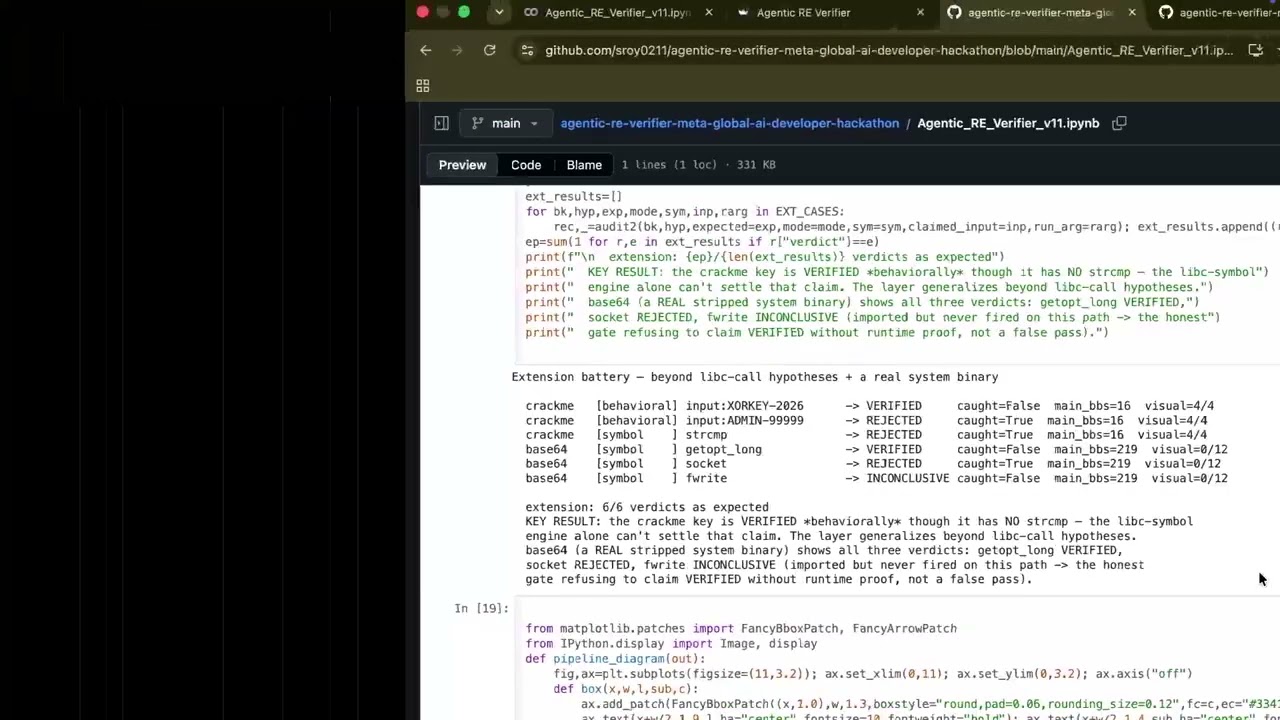
LLM agents hallucinate, and the usual fix — having a second LLM check the first — fails, because the verifier hallucinates too. The Agentic Verification Layer puts a deterministic oracle between the agent and ground truth: the model (Muse Spark) proposes a claim and explains the outcome, but the accept/reject verdict is a pure function of executable evidence, and when evidence can't settle it the gate returns INCONCLUSIVE instead of guessing. I demonstrate it on the hardest domain to fake — stripped x86-64 binaries — with three verdict modes: symbol (static imports + live Frida PLT-stub firing), behavioral (differential execution, verifies a crackme key with no comparison symbol), and semantic (differential testing vs a reference, catching a binary claimed to compute factorial that really computes (n-1)!). On 44 ground-truth RE questions, Muse Spark hallucinated 20% of the time and the layer caught 100%. Then I prove the pattern generalizes: the same gate, refactored into one core with thin adapters, runs across four recognized benchmarks — HumanEval+/MBPP+, GSM8K, BFCL, and BIRD — on real data. Across all four it caught 19 of 19 Muse Spark hallucinations. One pattern, five domains, nothing faked.