Teesra Kaan
Built at Meta Global AI Developer Hackathon · Oct 26, 2026 · Remote
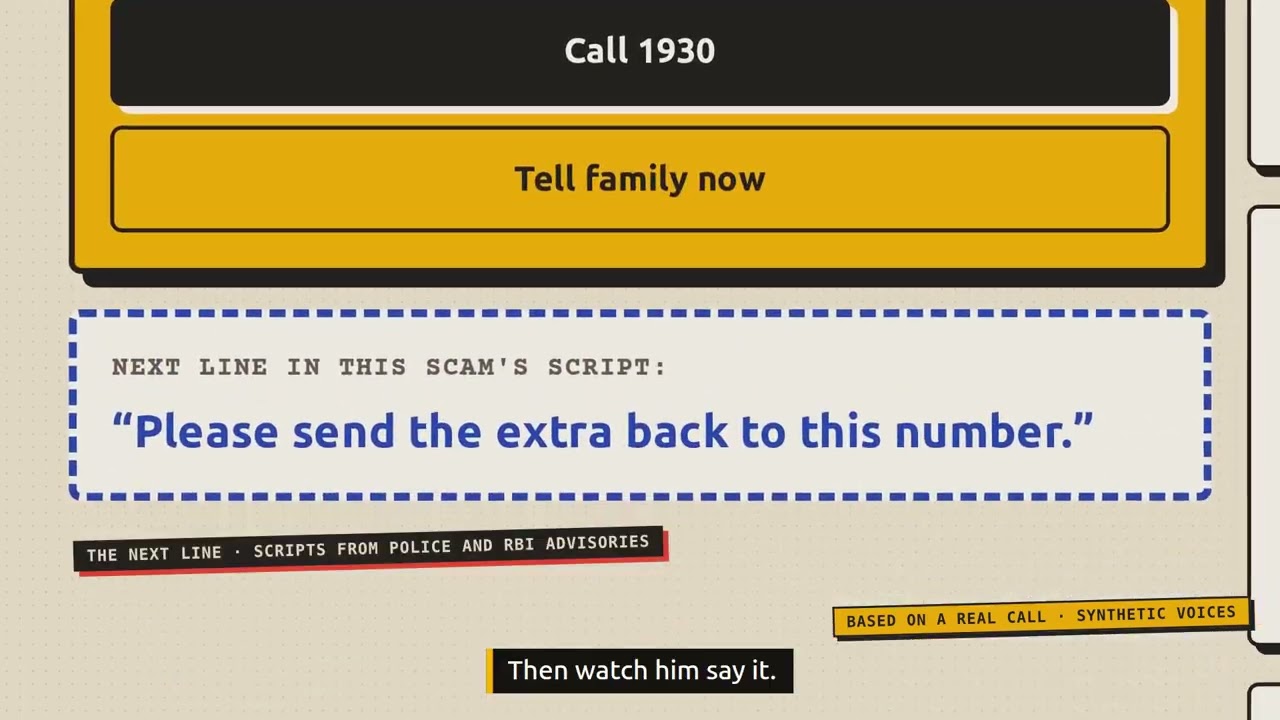
Teesra Kaan ("the third ear") listens to a suspicious call with you and turns the scammer's own script against him. Try it: https://teesrakaan.aryangorde.com (on a phone or laptop). The demo calls replay Muse Spark's real answers. Live listening runs on the laptop, because it uses the paid APIs; on the public page, anything you type into "check before you pay" except its example is checked by the keyword stand-in, and the page says so. In 2024, Indians lost ₹1,935.51 crore to "digital arrest" calls alone (Ministry of Home Affairs, in Parliament). A warning often loses to fear. In September 2026, a retired doctor in Rajkot sent ₹58.5 lakh to "digital arrest" callers even after her own bank warned her. But every one of these calls follows the same script, and Teesra Kaan is built on that. - During the call: open the page on a second phone or laptop, next to the call on speaker. - Muse Voice Transcribe writes the call down live, in Hindi, Marathi and English, and keeps the two voices apart. - After each thing the caller says, Muse Spark answers 13 fixed yes/no questions about the caller ("claims to be police?", "says don't tell your family?", "asks for an OTP?"), quoting his exact words for every yes. - A quote the caller never said is thrown away. Fixed rules, not the model, raise an amber or red warning in your language, showing his words. - The next line: the page then shows the caller's next line before he says it, taken from ten scam scripts written from police, RBI and DoT advisories. When he says it, the line is ticked off with his own words. That is proof, to a frightened person, that the "officer" is reading from a script. - One phone, after the call: check before you pay. Type or say what the caller said. It names the scam and shows the rest of its script. The Rajkot doctor had six days between her first call and the payment. - Tell family in one tap. "Don't tell anyone" is the scam's weapon. When the call ends, a ready report goes to 1930 and cybercrime.gov.in, or to ReportFraud.ftc.gov in the US. Does it work? It was tested once, on Nov 1, on a test set fixed before any result existed: - 132 real US impersonation robocalls recorded by the FTC, and 16 sales robocalls; - 18 Indian scam calls and 15 genuine calls that only sound scary, written from police and RBI advisories in Hindi, Marathi and English, spoken in synthetic voices (not people); - 9 of those scam calls rewritten so that not one keyword is left. It is compared with keyword lists, and with Muse Spark asked plainly "is this a scam?". Results, with 95% ranges: - Indian scam calls (synthetic voices): warned on 18/18 (82–100%), red on 17/18. False alarms on the 15 genuine calls: 0 red, 0 amber. - Rewritten with no keyword left: warned on 9/9 (70–100%). The keyword lists caught 0/9. - FTC robocalls: warned on 131/132 (96–100%), red on none, because these calls say "press 1" and stop before any ask for money. Muse Spark alone went red on all 132, and on all 16 sales robocalls. - Median time from the first scam move to the warning: 22 s; warned before the money ask on 7/16. - The next line came true 5/8 (31–86%), a median 5 s before the caller said it. On the FTC robocalls, 0 of the 43 shown came true: they end at "press 1". - Muse Spark alone warned as often as Teesra Kaan on these sets. What Teesra Kaan adds is the caller's own words as proof, red only at the ask, and the next line. - Every transcript, Muse Spark reply and call outcome from the run is in the repo (evidence/); eval/replay_frozen.py replays the whole test offline, with no key, and checks every number. One call with real voices, outside the test: after the test, my sister and I re-enacted the digital arrest script on an ordinary phone call, recorded by the phone; it opens the video. Muse Voice Transcribe heard it at real-time speed and kept our voices apart. Teesra Kaan turned amber at 0:17, with the next line "Come on a video call." (he said it at 0:38), and red at 0:40, 5 s before he asked for the money. One call is an example, not a measurement. What people said: I phoned 10 people: 5 elderly, 3 middle-aged and 2 Gen Z. Every one of them gets at least one scam call a week, some three or four. One elder lost ₹20,000: the caller used the name of someone he knew, a fake SMS showed ₹45,000 credited instead of the ₹25,000 promised, and the caller asked for the "extra" back. He never reported it, because he thought he would look like a fool. I taught Teesra Kaan that script before the freeze. Written down and played through it, the call turns amber when the caller says he sent too much, shows his next line ("send the extra back to this number") before he says it, and turns red when he does. It's on the page as a demo call. They liked the interface, and said having it in their own language was a sweet addition. By Nov 1 all 10 had used it themselves: the demo calls, "check before you pay" and the tell-family button, the five elders in Hindi (2), Marathi (2) and English (1). Almost everyone understood the warnings on their own; the elders needed a little explanation first. Most said they would keep it open when an unknown number calls. (From Aryan's calls, Oct 31 and Nov 1; no names or places, as they asked.) Honest limits: the Indian test calls so far are synthetic voices reading scripts (the one call with real voices is outside the test), and the sets are small; none of the 10 people I asked had a recording of a real call. Live listening needs a second device, because a phone on a call keeps its own microphone. This project changed after the approved application. I applied with Double Take (reused images in paper figures) and switched to Teesra Kaan on Oct 28. Every commit is from the event. One module, the spending ledger, is adapted from Double Take (Oct 27), and the README says so.