FounderFlo Ops
Built at Meta Global AI Developer Hackathon · Oct 26, 2026 · Remote
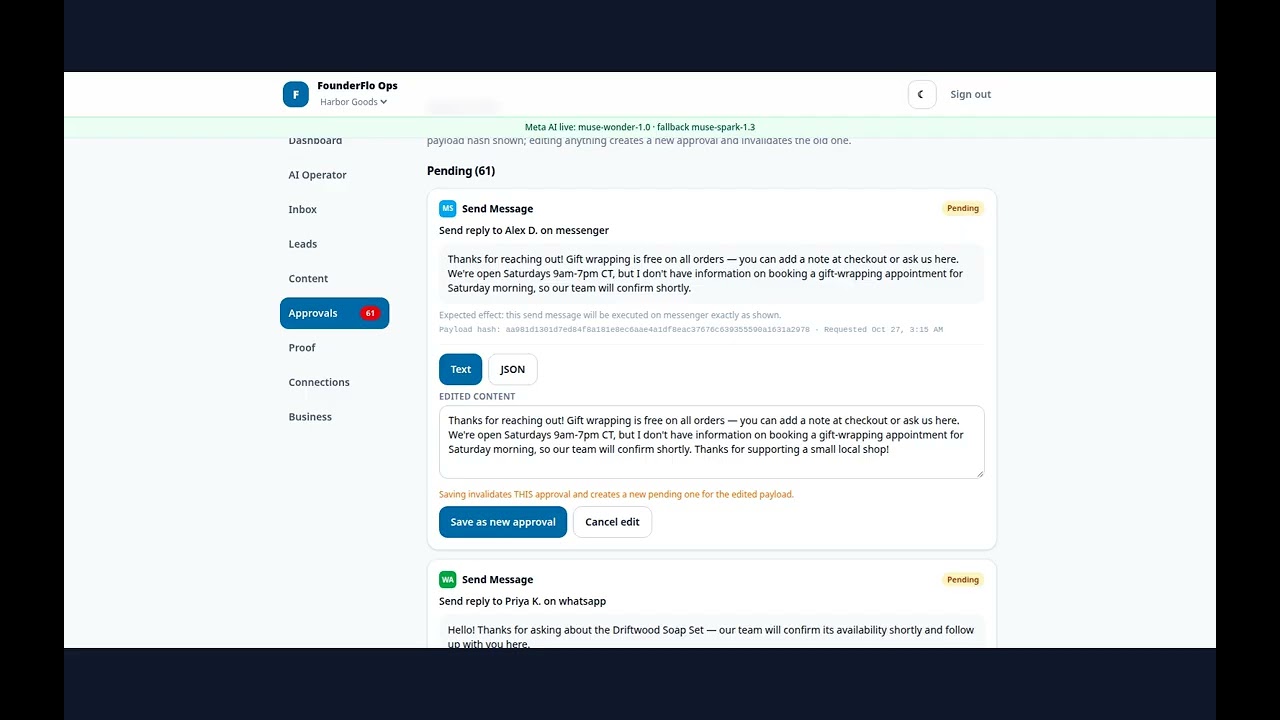
Project: FounderFlo Ops (MetaOps AI) Tagline: The autonomous business operator for the Meta ecosystem, with receipts. Live demo: https://founderflo-ops-production.up.railway.app FounderFlo Ops runs a small business's Meta inbox end to end: it reads Facebook, Instagram, and WhatsApp inquiries, classifies them, drafts replies grounded in the business's own catalog and policies, has every draft independently audited by a second model pass, sends only what the owner approves, and issues a verifiable receipt for everything it did. Automation tools ask for trust; FounderFlo Ops produces evidence. I built FounderFlo Ops from zero to a working, receipted product in 7 days for this hackathon, entirely with Muse on the Meta Model API. Small businesses run sales and support across Facebook, Instagram, Messenger, and WhatsApp, but the work is manual, scattered, and easy to get wrong: missed inquiries, inconsistent answers, no record of what was sent or why. FounderFlo Ops is an autonomous business operator for the Meta ecosystem. From one natural-language objective it plans a permissioned workflow, retrieves and classifies customer inquiries, drafts replies grounded strictly in the business's own catalog and policies, creates lead records, drafts promotional content, and, only after explicit owner approval bound to the exact payload, sends and publishes through its platform adapters (a Graph API adapter for Meta's official APIs, and a clearly labelled sandbox adapter). Muse Wonder (Meta Model API, Responses API) produces structured, schema-validated plans and drafts; Muse Spark handles lower-cost classification. Model output is treated strictly as proposals: a server-side allowlist, a grounded knowledge base, and a human approval gate decide what may execute. Key innovations: - Approval bound to payload hashes, so an approval can never be reused for edited content. - Idempotent execution plus a graded verification ladder (request attempted, provider accepted, provider ID returned, object confirmed, published) that never upgrades an outcome beyond its evidence; ambiguous attempts stay unverified instead of being resent. - Prompt-injection containment for untrusted customer text, demonstrated live in the demo data. - Capability discovery that shows, per account, exactly which operations Meta permissions allow, and why not, when they don't. - An honest demo architecture: a fully functional sandbox adapter and a clearly labelled deterministic fallback planner, so nothing in the demo is faked. Sandbox activity and non-AI planning are identified as such in the UI and in receipts. The entire codebase (API server, PWA, adapters, engine, tests) was written from scratch for FounderFlo Ops during the hackathon; no existing product code is used.