FireFinder
Built at Meta Global AI Developer Hackathon · Oct 26, 2026 · Remote
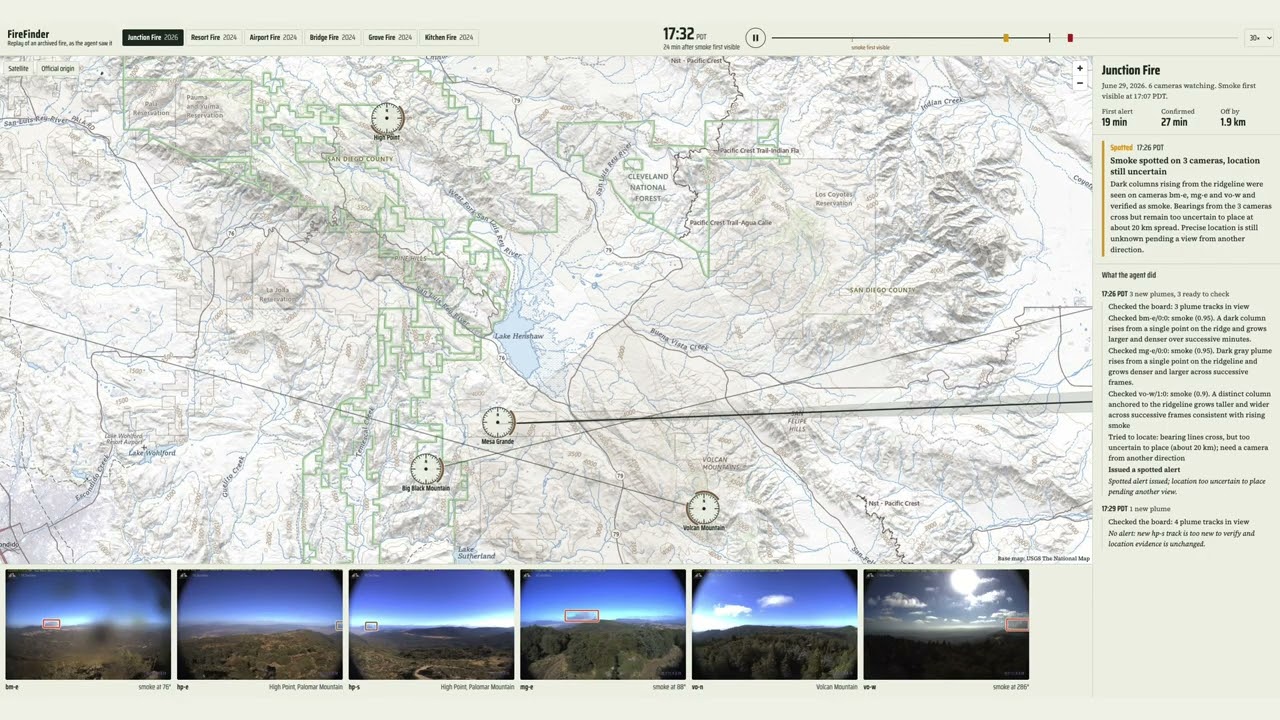
FireFinder: turn any wildfire camera into a fire locator The problem. Over a thousand mountaintop cameras already watch California’s hills, but a camera that sees smoke can’t say where the fire is. Turning a sighting into a location means knowing each camera’s exact heading, tilt and lens, which today requires surveying every mast or training models on years of labelled footage from that network. In the first minutes of a fire, dispatchers often still triangulate by hand. Small counties, tribal lands and other countries have cameras but not the budget for either route. What FireFinder does. It turns existing cameras into calibrated fire locators, with no training data and no surveying: Detect. SAM 3.1 segments and tracks smoke in each camera’s video. Verify. Muse Spark checks each plume’s first frames and rejects cloud, haze and glare. Calibrate. The mountains do it. FireFinder renders the skyline each camera should see from a public terrain model and fits the camera’s heading, tilt and lens to the real ridge line, so every pixel becomes a compass bearing. Triangulate. Bearings from two or more cameras cross at the fire. A robust fit drops cameras that disagree and reports an honest error radius. Dispatch. A Muse Spark agent escalates from spotted to provisional to confirmed. It rechecks doubted cameras and cross-checks NASA and NOAA satellite hotspots. Code verifies every number it writes, and it says so when the evidence is too weak to place a fire. Results. On replays of archived HPWREN footage of six Southern California fires, FireFinder placed the Kitchen Fire 119 m from the official ignition point. It flagged smoke 3 minutes after the official start time and confirmed the location 33 minutes after it. It located the Resort Fire within 1.0 km and the Junction Fire within 1.9 km. It declined to guess on two fires where the camera geometry was weak, and it raised zero false alerts. From a new frame to an alert takes about 15–20 seconds, and a smoke check costs $0.004. On Meta’s open weights. Muse Spark Open matched the hosted model on all five replayed fires, five runs each, with 0 false alarms in 96 hard-negative checks, for $6.64 in total. A 30B Muse Glimmer running on a laptop gave the same smoke verdicts on all 61 test crops. Built with SAM 3.1 and Muse Spark 1.3 via the Meta Model API, Muse Spark Open on Baseten, and Muse Glimmer. Camera imagery: HPWREN, UC San Diego.