KINETICA
Built at Meta Global AI Developer Hackathon · Oct 26, 2026 · Remote
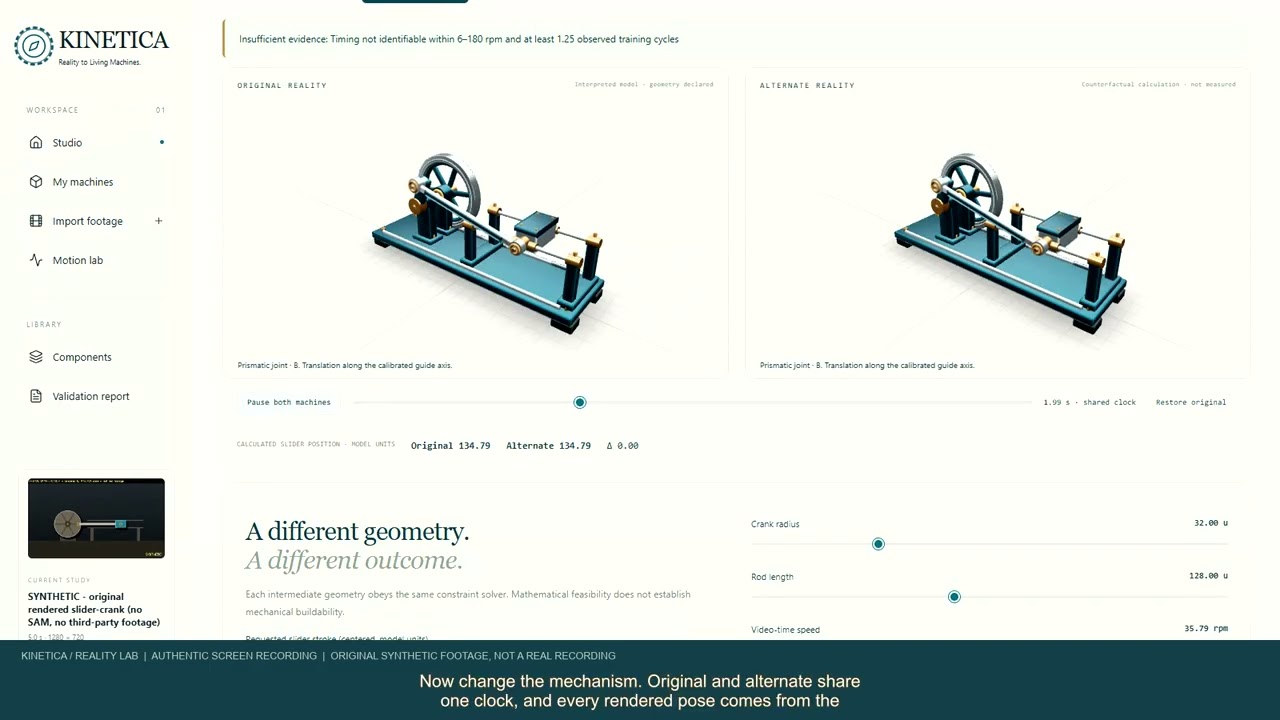
KINETICA Reality Lab turns observed mechanism motion into a mechanical hypothesis that can be inspected, challenged and changed. It connects saved component segmentations to a local engineering studio with an equation-driven slider-crank, human-confirmed component identity and explicit measurement provenance. The five-act loop is Observe → Predict → Reveal → Break Reality → Ask the Machine. Freeze fits only past observations and seals a forecast; Reveal compares it with the same saved observations and with constant and linear baselines. Under-determined or incompatible evidence (too few observed cycles, a known camera cut) is refused instead of scored. Break Reality changes feasible geometry in two synchronized, solver-driven 3D machines. Ask the Machine uses a clearly labeled deterministic mock and requires review before an allowlisted parameter change; live Muse Spark remains unverified after a failed trial. The demo video and public repository use only original material: a synthetic slider-crank clip rendered by KINETICA's own code, labeled synthetic on every frame, with saved geometry derived from its known motion (not SAM output). Its true motion contains a motor speed ripple the model is not told about; freezing after frame 74 with a 20-frame horizon gives model RMSE 7.67 px versus 52.05 constant and 129.82 linear. These synthetic metrics check the pipeline; they are not validation on real footage. Meta SAM 3.1 really ran on a separate third-party clip (Schubkurbelgetriebe (Eitech), Rhetos, CC BY-SA 4.0): 150 boxes and 150 contours, three IDs over 50 frames. That footage and its geometry are kept as documented historical evidence and are not distributed. KINETICA is intended for mechanism education and early engineering analysis. It does not recover arbitrary 3D scenes or certify dimensions, forces or fabrication safety. The release includes reproducible local execution, tests and scientific limitations. Development used AI coding assistance; the repository records engineering checks and authentic evidence separately from simulations.