Course Factory
Built at Meta Global AI Developer Hackathon · Oct 26, 2026 · Remote
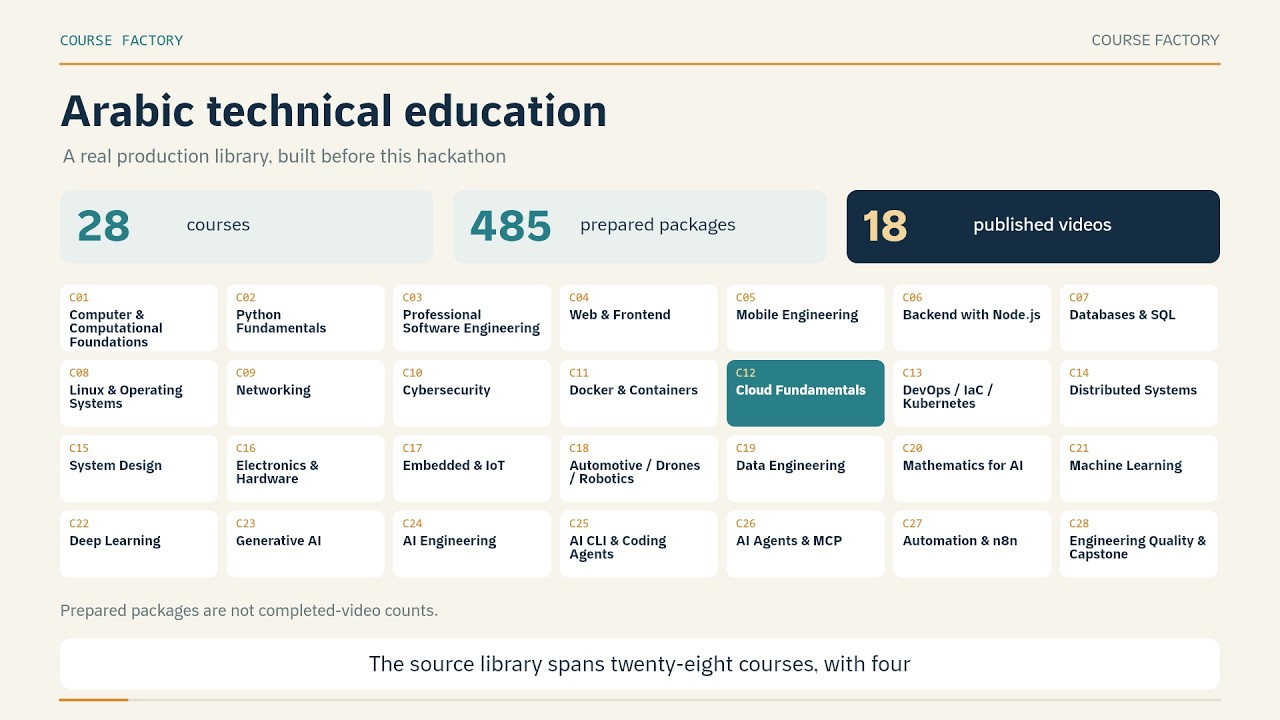
Course Factory is a human-supervised workflow for producing Arabic technical lessons. The existing library spans 28 courses and 485 prepared lesson packages across computing, software, systems, data and AI; the first course has 18 publicly available videos. Prepared packages are not completed-video counts. The repository includes a lesson schema/compiler, execution components, Teaching IDE and production components. Some stages use separate scripts and operator work. The new hackathon contribution addresses a problem in this real workflow: a teaching explanation can contradict its own example or overstate what an experiment proves. Before narration and rendering, the new reviewer compares a draft with supplied material using Muse Spark 1.3, validates exact source quotations and hashes locally, and leaves publication under human review. It includes a JSON review runner, a bounded sample runner and a dashboard showing production context and inspectable evidence. Twelve actual Meta API responses cover newly authored test drafts derived from six lesson contexts: HTTP, Python functions, SQL transactions, idempotency, prompt injection and MCP. Each has a source-derived draft and an intentionally contradictory version. All six source-derived drafts returned no findings; all six contradictory drafts returned findings; all returned quotations passed local reference validation. This is a constructed demonstration, not an independent accuracy benchmark or assessment of the entire library. Built November 2–3, 2026: the reviewer, direct Meta adapter, source/quote contract, JSON and sample runners, dashboard, tests and live receipts. The curriculum, published course videos and earlier engine predate the hackathon and are explicitly identified as prior work. A further unchanged-text evaluation used six existing production/library artifacts with no injected errors. The primary batch yielded five valid zero-finding responses and one malformed-response failure. An explicitly separate diagnostic request returned four findings; assistant checking classified their scope, and the owner judged three displayed proposed changes correct and useful. No review time savings, independent accuracy score or whole-library quality certification is claimed. The failure and feedback are documented in docs/natural-review.md.