Whiteout
Built at Meta Global AI Developer Hackathon · Oct 26, 2026 · Remote
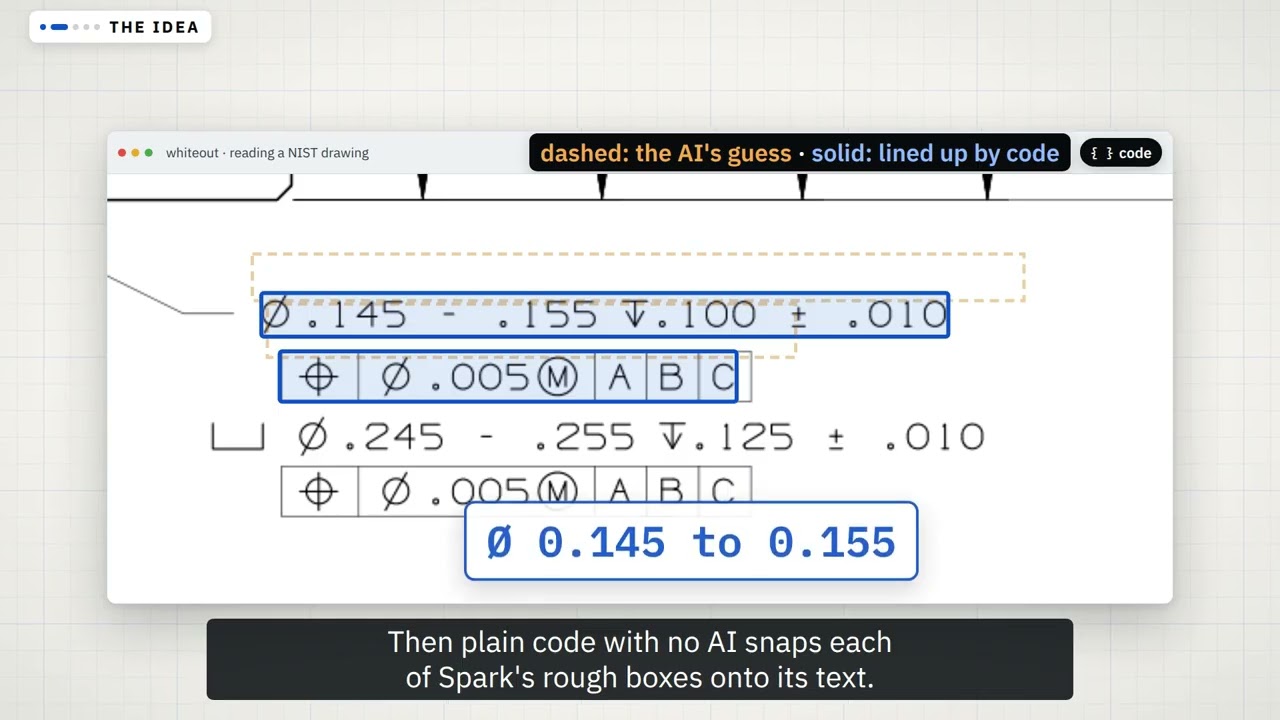
Whiteout helps an aerospace inspector catch what was left off a drawing's checklist, because a size that is missed is never checked on a part that will fly. Muse Spark, Meta's model, lists each size, tolerance (how far a size may vary) and note it finds on the drawing, and Whiteout paints over the text it found, so a person can see what is left on the page and check it. On 67 public sheets (NIST, 1960s Apollo scans, US military standards and 25 synthetic Cadsy CAD sheets), Whiteout found 96.9% of 1,679 requirements, while a free text reader (Tesseract with a dimension pattern) found 16.6%. The answer keys were fixed before the first run, written by hand or taken from NIST's and Cadsy's official lists. First article inspection under AS9102, the aerospace standard, is what a supplier completes before shipping the first part of a new design or revision. Each requirement gets a numbered circle, called a balloon, and a line on Form 3, and one with no balloon gets no line, which leaves the report incomplete. A drawing can carry 50 to 500 of these requirements, and ballooning software vendors estimate 2 to 8 hours per drawing by hand (Net-Inspect; GroundControl). Plain code moves each box Spark returns onto the printed text and recomputes its limits. Whiteout fills Form 3 and starts Forms 1 and 2 from the title block, as one spreadsheet. A person checks both the list and what is left on the white page, then signs. I built Whiteout alone during the hackathon, Oct 27 to Nov 4 2026. Its code and documents are new. What the demo shows The live app opens three samples instantly, including a 1960s Apollo Lunar Module bracket. You see numbered balloons beside the Form 3 table, then open the Whiteout check, press "Replay the erase" and watch the found text disappear from the page. On the Apollo sheet, a box labelled "missed on the first read" marks the note the first read skipped. Buttons download the AS9102 forms and a ballooned PDF. A live upload of a three-sheet NIST drawing with 76 requirements took 3 minutes 43 seconds end to end before a person's review. Measured results On the 67 sheets above, 74% of the items Whiteout listed matched a key item. The others include pieces of larger key items and notes the keys left out on purpose, and a person can remove any unwanted line. To test the white page, I hid 144 extra requirements in 12 public drawings (10 real, 2 synthetic) as faint, tiny, small, rotated, plain or on-a-line text. Whiteout missed 5, and 4 of those were still printed on the white page. On my own revision B of a NIST drawing (3 values changed, 1 dimension removed, 1 note added), Whiteout reported exactly those changes and 3 requirements its first report had not listed, so only 7 of its 78 requirements need measuring again, and recorded results carry forward. So that drawings need not go to an outside service, Muse Glimmer, Meta's open-weight model, can read them on the shop's own GPU. Tuned on Spark's reads of other drawings, it found 232 of 240 requirements on 6 test sheets left out of training (Spark found 234). It was much slower, at a median 20 minutes a sheet on one rented NVIDIA L4. Live app: https://whiteout-955819688070.us-central1.run.app Backup link: https://whiteout-backup-955819688070.us-east1.run.app Demo video: https://youtu.be/PvWf2exZlzE Code: https://github.com/nnm2602/whiteout