Cicada
Built at Meta Global AI Developer Hackathon · Oct 26, 2026 · Remote
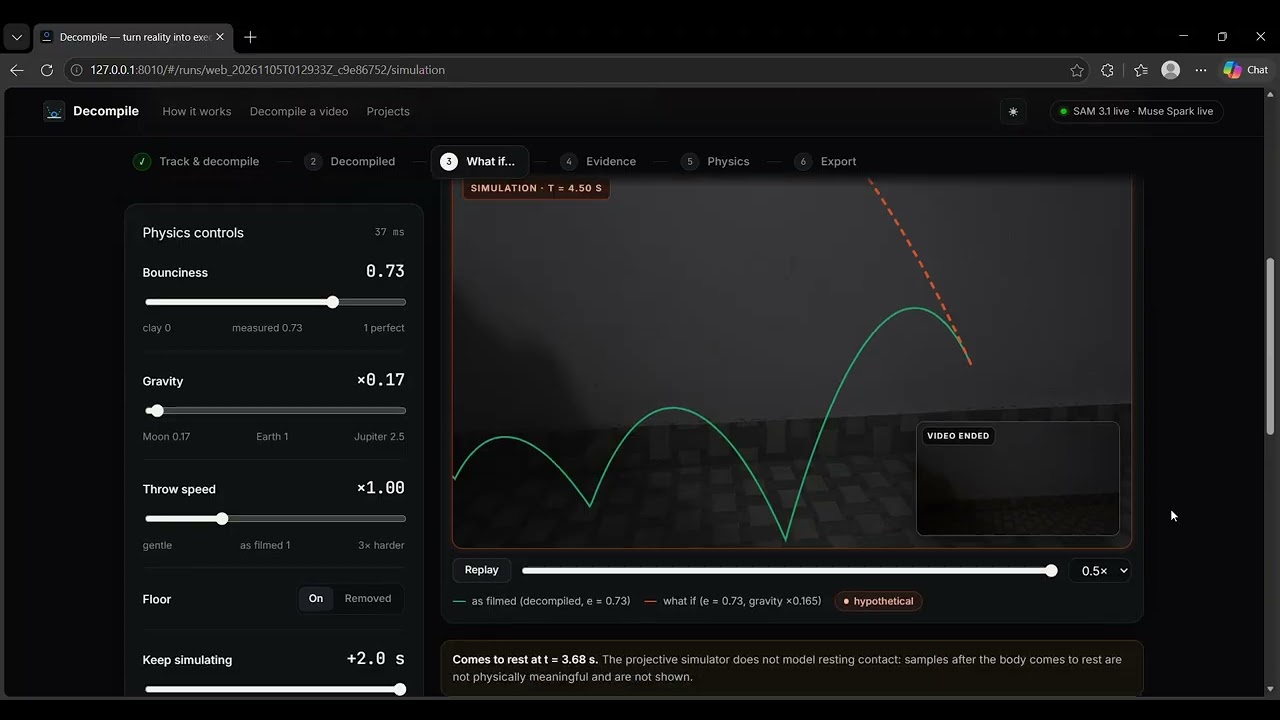
Decompile: turn reality into executable physics AI can describe a video. Decompile recovers the physics that produced it, as code you can run, test and rewrite. Upload a phone video of a bouncing ball: 1. Meta SAM 3.1 (Meta Model API) segments and tracks the object in every frame. 2. Decompile measures it. A sub-pixel outline fit gives each frame's centre, apparent size and uncertainty. Frames it can't measure honestly are flagged, never invented. 3. A perspective-aware physics fit recovers gravity, the bounce time and the coefficient of restitution. It's checked by model comparison and an adequacy gate. 4. The result is decompiled into a runnable Python program that reproduces the motion exactly. 5. It predicts. Fitted on the first bounce only, the program predicted frames it never saw to within 6–8 px, and called the next bounce within 33 ms (one frame). On a second video, the error was 7 ms. A third clip that didn't fit the physics was refused, not faked. 6. Meta Muse Spark reviews every fit like a physicist: it explains the numbers, sanity-checks the implied 6.9 cm ball, and critiques weak evidence. It also turns plain-English questions ("What if this happened on the Moon?", "no floor", "throw it twice as hard") into program edits. A deterministic simulator plays out each alternate reality beside the real footage, as a code diff. Muse Spark honestly refuses what the program can't represent, like wind. Real result from a 2.5 s phone video, with a live SAM call costing $0.015: bounciness 0.68, fit error 0.73 px, next bounce predicted within one frame. Built with: Meta SAM 3.1, Meta Muse Spark, Python (NumPy, SciPy, OpenCV, FFmpeg), FastAPI, React/TypeScript. Paid API calls show their cost and need confirmation, and the project has 1,100+ offline tests.