Stevens
Built at Meta Global AI Developer Hackathon · Oct 26, 2026 · Remote
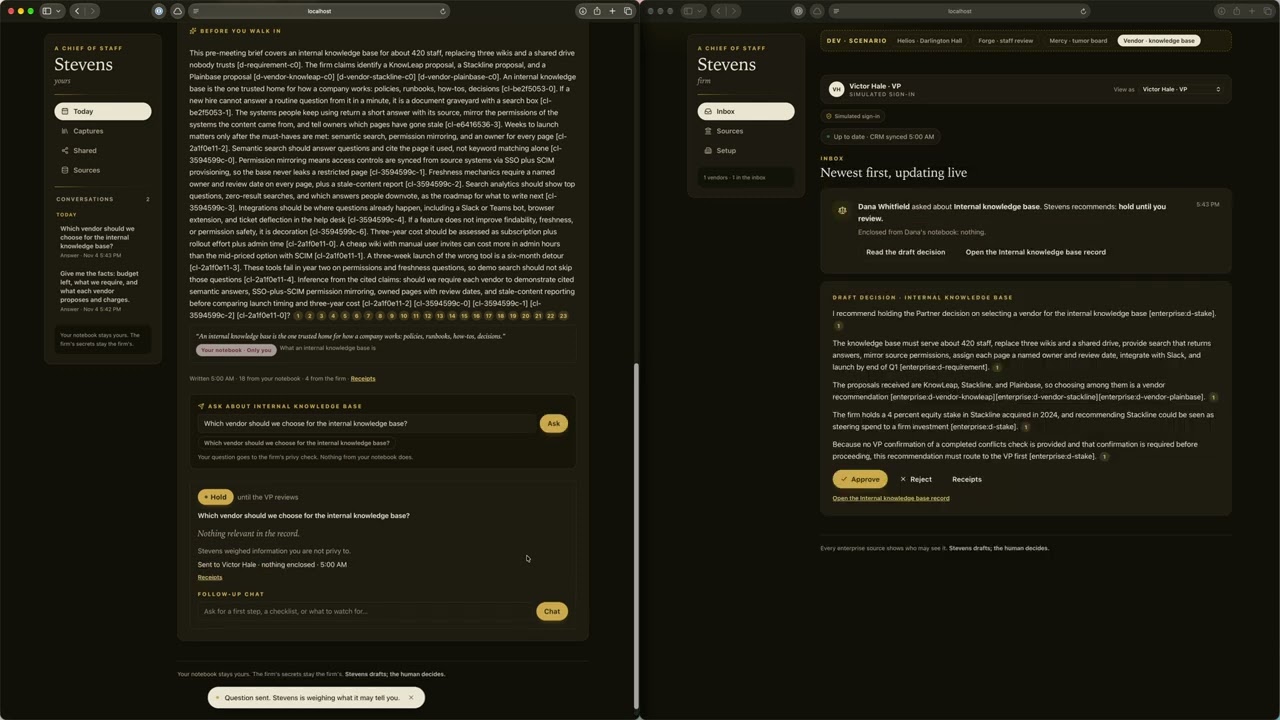
Knowledge work is shifting from producing to absorbing. Your best insight comes from a conference talk, a highlight, a note, or something your glasses caught, and it lives in your head or a notebook the firm can't see. Stevens makes that learning count at work, without leaking either side. Stevens is a chief-of-staff agent in two separate processes. Stevens · yours ingests talks captured on Ray-Ban Meta glasses, slide photos, Readwise highlights, Obsidian notes and your calendar into your own database. Stevens · firm reads the firm's records. Stevens connects the two to the decision in front of you, with a source on every sentence. The access rule is enforced in code, not prompts. Personal data never reaches the firm unless you release one quote, and that is logged. Enterprise sources are visible, privy or excluded per person, derived from the source system's ACL. Privy knowledge reaches you only as a typed Verdict with no text. Every failure fails closed. Demo (fictional data): Nov 1, IT has $800,000 left and must pick a knowledge-base vendor for 420 staff. KnowLeap is $420k, Stackline $650k, Plainbase $280k. Dana (Director) asks which to choose before meeting Victor (VP). Stevens briefs the trade-off, weaving the vendor pack with Dana's own reading: permissions must mirror sources, search must cite. It then answers Hold, because it weighed VP-only information Dana cannot see (the firm holds 4% of Stackline). Victor gets an escalation with nothing enclosed. Receipts show every call. Dana shares one quote, Victor sees the memo and approves. Stevens drafts; the human decides. Where it goes: - More of your learning: Reader full text, Zotero papers, Raindrop bookmarks, voice memos, and live glasses capture instead of file drops. - More of the firm: real Drive, Slack and CRM connectors whose permissions Stevens mirrors. - Personal processing on-device, so the notebook never leaves your hardware. - Learning that earns its place: ranking what to learn from the decisions it later changed, and protecting time for it. - A pattern for any company that wants AI to know what you know without anyone seeing what they shouldn't.