SyncDigit
Built at Meta Global AI Developer Hackathon · Oct 26, 2026 · Remote
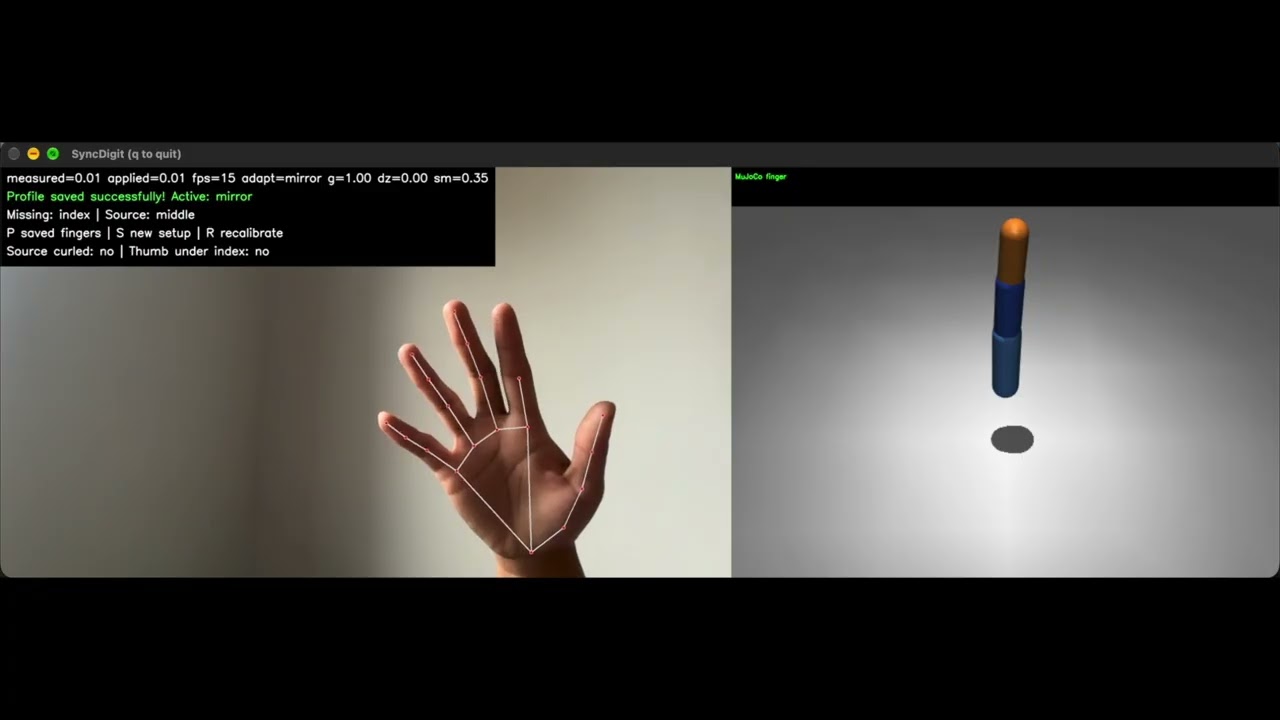
SyncDigit explores an assistive finger for people with congenital hand differences, including syndactyly and symbrachydactyly, where a finger may be incomplete or missing. The concept is an appendage that attaches at the base of the incomplete finger and moves with the fingers next to it: adjustment in concert, not independent intelligent movement. This submission is a simulation prototype, not a physical device. The user chooses which finger is missing and which adjacent finger will drive it, then captures three poses: open, closed as far as comfortable, and a relaxed partial curl. Muse Spark 1.3, via the Meta Model API, selects a bounded calibration profile from those measurements (mirror, gentle_range, or full_range). The profile is saved per finger. During use, MediaPipe tracks the hand from the webcam each frame. A Python controller maps, smooths, and limits the motion, and a MuJoCo simulation displays the three-segment finger, driven kinematically by setting joint positions directly. For a missing index finger, a pointing gesture combines source-finger curl with thumb position, letting the simulated finger straighten to point. Other fingers mirror and calibrate only. The webcam stands in for the micro-cameras that would sit on the side of a real appendage to watch neighboring fingers. Physical attachment, gripping under load, and clinical usefulness all require further development and evaluation. The AI here is a calibration and supervision aid. It is not trained for, or clinically validated for, assistive movement.