Team LagoonFront
Built at Meta Global AI Developer Hackathon · Oct 26, 2026 · Remote
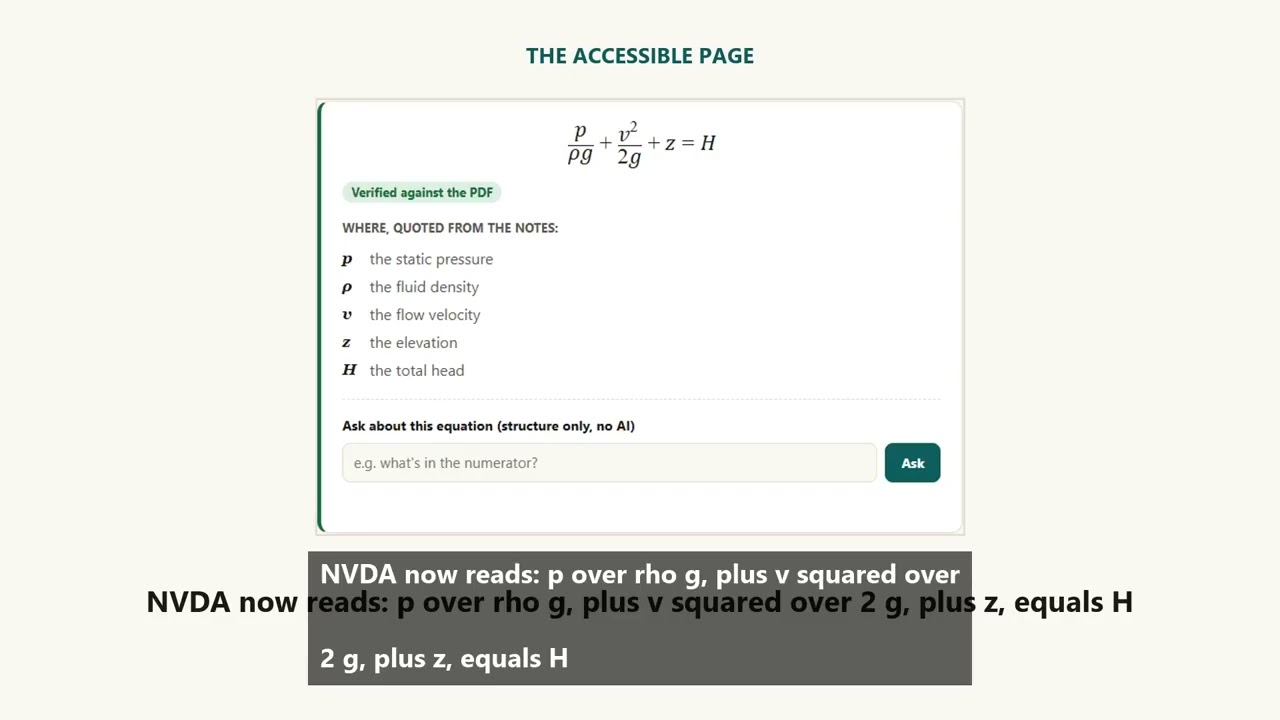
# Legible Blind engineering students often cannot access the equations in their lecture PDFs: screen readers announce them as "graphic" or garble their mathematical notation. AI can interpret equations from images, but even a highly accurate model can silently misread a symbol. For a blind student who cannot visually inspect the original, that error becomes incorrect information they have no reliable way to detect. Legible turns engineering lecture PDFs into screen-reader-accessible documents, treating mathematical accessibility as a verification problem rather than just a recognition problem. Meta's Muse Spark interprets each equation image and produces a LaTeX transcription. Legible independently compares this transcription against the characters, positions and structural information stored inside the PDF using a deterministic, non-AI verification process. When they disagree, Muse Spark receives the exact discrepancy and attempts one evidence-guided correction. Equations that pass verification are published; those that cannot be verified are withheld rather than silently presented as correct. Every decision, including discrepancies and repair attempts, is recorded in an auditable verification report. Verified equations become MathML that NVDA with MathCAT can read and navigate term by term. A symbol glossary uses definitions quoted directly from the student's notes. Students can also ask structural questions such as "what's in the denominator?", answered from the verified mathematical structure without generative AI. Scanned and handwritten pages are supported at a separate trust level: their equations are read but explicitly labelled as unverified against the source. **Evaluation:** Across 152 equations from two real CC-BY lecture-note sets, Legible published zero incorrect equations and caught all 303 deliberately injected errors. It also caught three naturally occurring, meaning-changing Muse Spark misreadings: a mathematical norm was transcribed as two ordinary vertical bars, changing how a screen reader would interpret it. We openly report the coverage trade-off: 23.7% of correct equations were withheld because the verifier could not establish agreement. Legible verifies fidelity to the PDF's stored representation, not the mathematical correctness or intended meaning of the author's original equation. **Technology:** Built entirely during the hackathon, Legible uses Muse Spark (muse-spark-1.3) through the Meta Model API for mathematical interpretation, evidence-guided correction, visual comparison and scanned-page equation detection.