Schokolade
Built at Meta Global AI Developer Hackathon · Oct 26, 2026 · Remote
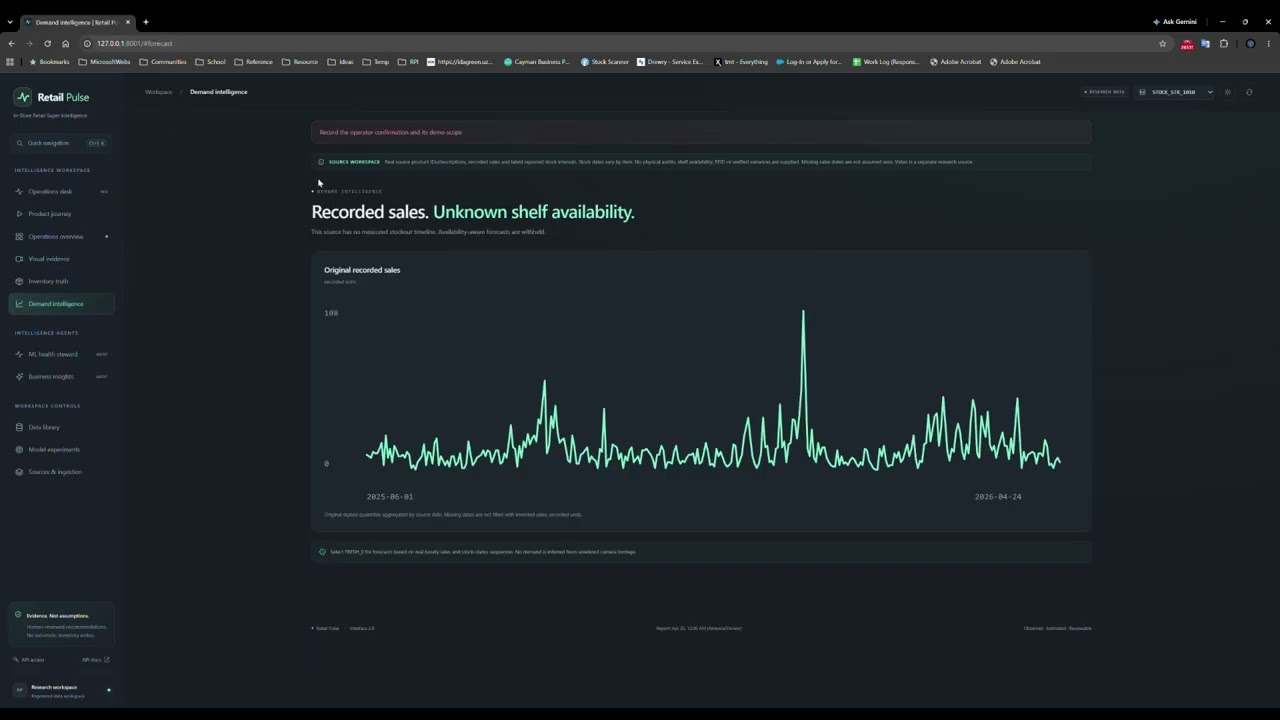
Retail Pulse connects what happens on a retail shelf to what operations, supply-chain, and demand-planning teams should do next. Retail systems capture different fragments of reality: cameras show product interactions, checkout systems record sales, and inventory systems report balances. When those signals disagree, teams must decide whether to replenish, investigate, or revise their plans. I built Retail Pulse to make that decision traceable—from evidence to action. Using real public retail footage, Meta Muse interprets customer interactions and proposes product movements. SAM adds object localization that managers can inspect alongside the video. When two Muse readings disagree on quantity, the application holds the proposal for human review instead of silently changing inventory. A persistent workflow then connects reviewed counts, simulated checkout, replenishment, and shelf verification. Each action leaves an audit trail. Separately, real historical sales records replay through an event workflow, update shadow inventory, and surface supply-chain exceptions. Muse retrieves operational evidence through tools to explain priorities and next steps. Demand planning uses real sales histories. Muse proposes bounded forecasting experiments, while code trains and evaluates the candidates. In a separate seven-day evaluation across 74 FreshRetailNet product histories, validation selected a seasonal baseline that achieved 17.98% WAPE, compared with 23.59% for a trailing-28-day mean. This is a working research prototype with 144 automated tests passed at validation. Footage and source records are real; cross-dataset product mappings and operator actions are explicitly labeled demo scenarios. The sales feed is historical replay, not a connected merchant system. For “Build for Your World,” my focus is practical: help retail companies turn scattered signals into accountable operational decisions.