Jermaine Dennis
Built at Meta Global AI Developer Hackathon · Oct 26, 2026 · Remote
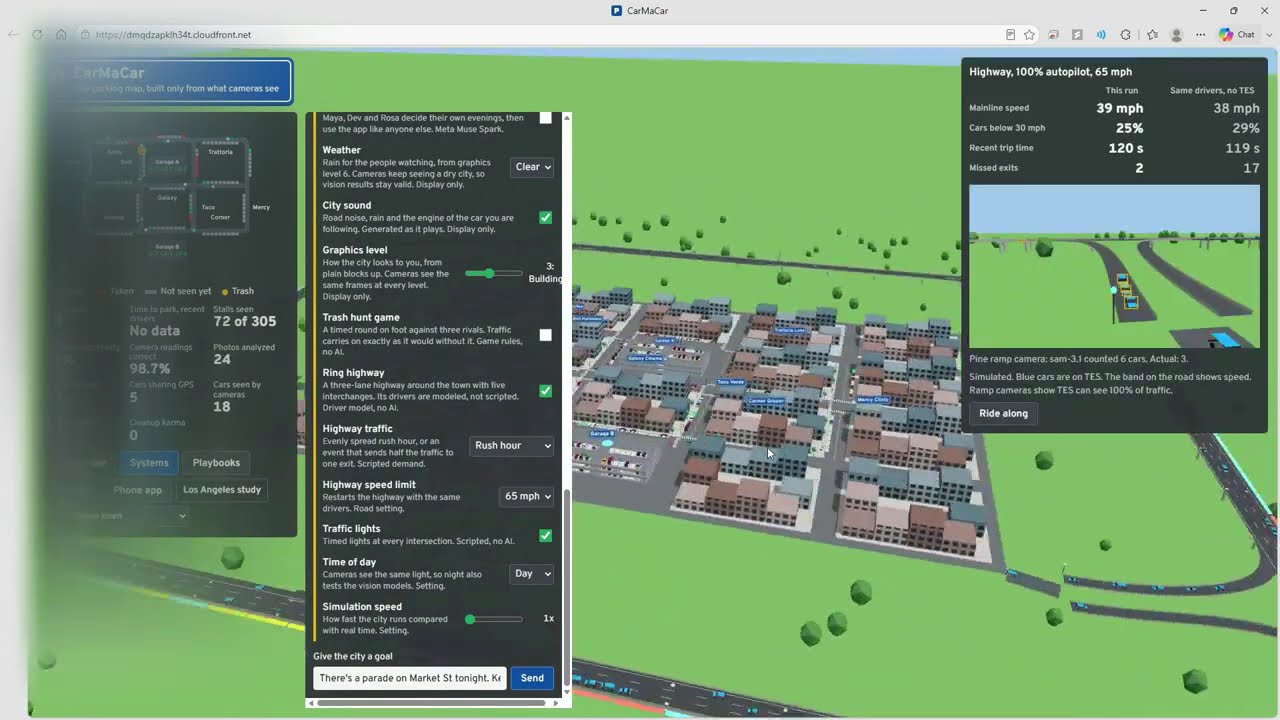
Live demo: https://dmqdzapklh34t.cloudfront.net CarMaCar turns ordinary car and garage cameras into a live map of a city's parking, then uses Meta's AI to send each driver straight to a space, on a route that accounts for everyone else. The test bed is a browser city where cars have real cameras that render real frames. Those frames go to a separate platform, which reads them with SAM 3.1. The simulator never tells the platform what is parked where, so the map can only come from pixels. In the demo a car takes a reserved stall, the map still says free, a camera sees it, and Muse Spark moves the driver before they arrive. On top of the map sits a Traffic Efficiency System that plots routes and stalls for connected cars, with self-routed, guided and autopilot drivers, smart traffic lights, multi-level garages with their own cameras, and a dashboard where every production and simulation system can be switched off. Results are from simulation and labeled that way. It also runs on a real place. From OpenStreetMap data, the same system runs on real downtown Los Angeles in 3D, and SAM read its parking correctly 98% of the time in a test run, with no retuning. Muse Spark can also build a real city from a single request. It chose Midtown Manhattan from one sentence, and code built it from OpenStreetMap data, with about 8,000 real buildings. At city scale, the Muse Lab goes further. On Los Angeles's real road network, with 2.4 million commuters modeled from Census data, Muse Spark writes routing algorithms, tests them in simulation and learns from the scores. In simulation, against a tough mix of drivers and on commuters it never saw, its best algorithm with 60% of drivers cut average rush-hour trips from 30.8 to 28.9 minutes and total delay by 24%. My hand-tuned routing lost that same test. Nobody told Muse my routing had a flaw.