Solo - Sohail Mughal
Built at Meta Global AI Developer Hackathon · Oct 26, 2026 · Remote
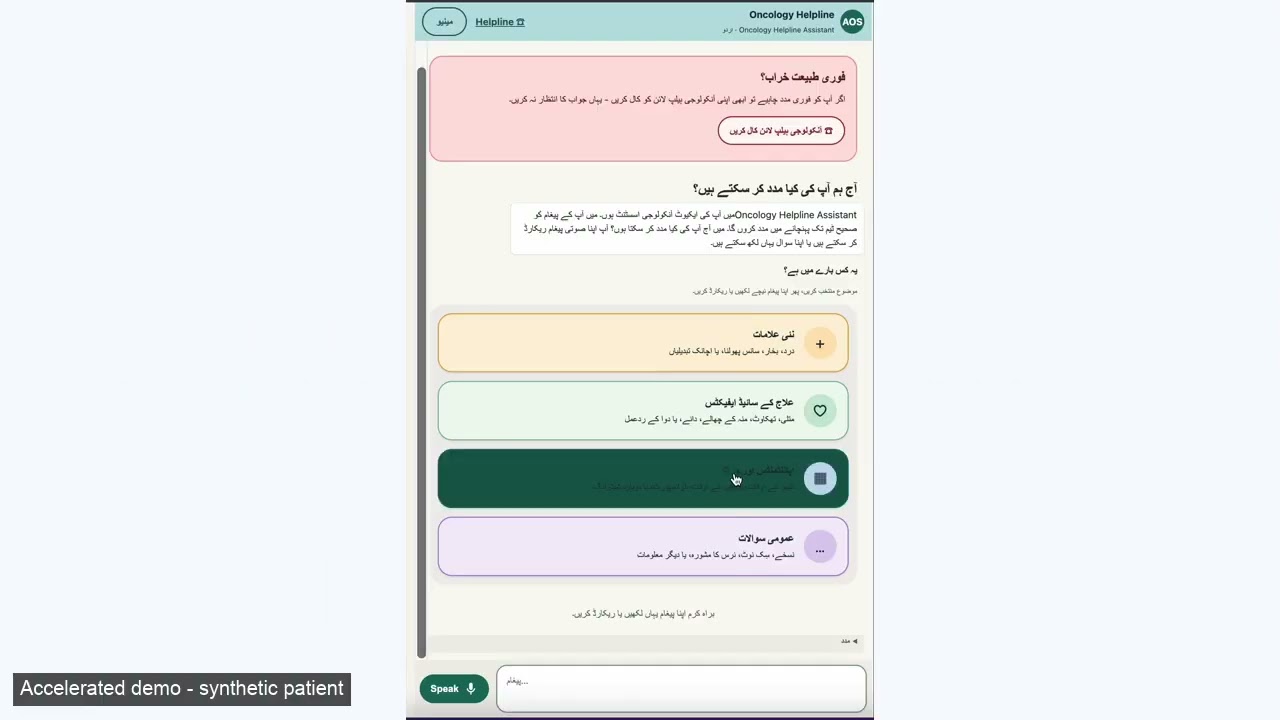
Here is submission-ready wording grounded in what AOS actually demonstrates. The ratings below are suggestions—choose the ones that reflect your experience. Project Description Under 3,000 characters AOS—Acute Oncology Support—helps people receiving cancer treatment explain their concerns in their own words and helps the care team understand what needs action. Between appointments, patients may struggle to describe symptoms, communicate across languages or reach the right service. A symptom report can also contain an appointment question, uncertainty or a correction. A long questionnaire can make these conversations harder. AOS turns natural-language messages into a structured, traceable account for human review. It identifies the purpose of a message, extracts patient-reported facts with links to the original wording, asks focused follow-up questions and preserves uncertainty and conflicting statements. Patients can review and correct a summary before consenting to a simulated handoff. The nurse interface brings together the presenting concern, recorded facts, unresolved information, original messages and next action. Clinical decisions remain with clinicians. Configured safety triggers interrupt routine conversation and direct patients toward human help. Built as a clinician-led hackathon prototype, AOS combines Meta language models with deterministic validation, persistent conversation state, explicit consent and recovery handling. Separate model roles handle intent, extraction, checking, confirmation, response planning and translation. Code validates their outputs and controls workflow transitions. Development included independent software audits and synthetic regression testing. The final audited candidate passed 1,141 offline tests, with three explicit skips. These checks establish tested software behaviour, not clinical effectiveness or universal language accuracy. AOS is a synthetic-data demonstration, not a clinically validated triage service. Request delivery is simulated. Our goal is to make oncology communication more accessible while giving existing care teams a faithful, actionable account—not to automate clinical decisions.