OpenWeeder
Built at Meta Global AI Developer Hackathon · Oct 26, 2026 · Remote
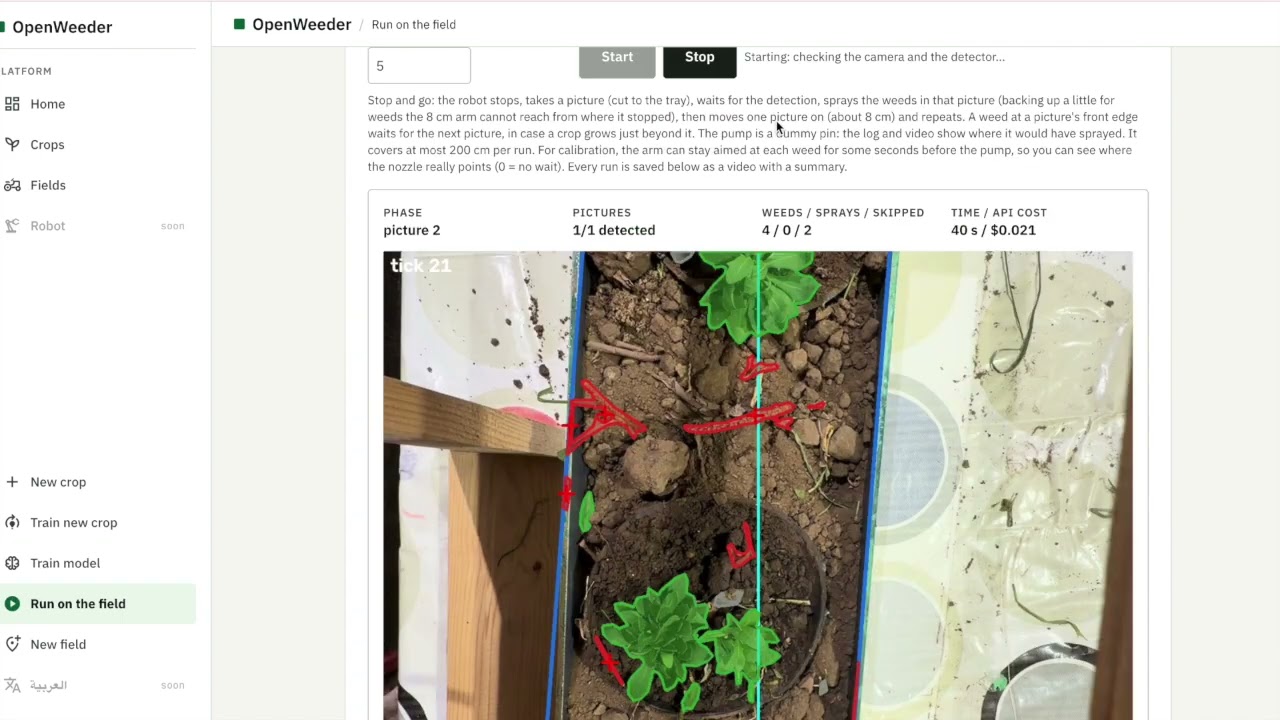
Most farms in the world are smaller than two hectares. Their farmers either weed by hand, which takes 30 to 40 labour-days per hectare, or spray herbicide over the whole field. Precision weeding machines exist, but they cost over a million dollars and rely on years of labelled plant data for each crop, so small farmers can’t use them. OpenWeeder is an open-source precision weeder that gives a small robot that capability for the price of a small computer and a few parts. A farmer creates a crop, uploads 10 photos of their own field, and labels three. SAM 3.1 outlines every plant, and Muse Spark judges crop or weed, with a confidence score. The two models test themselves on the other seven photos, ask the farmer about anything they are unsure of, and write what they learn as a plain-language checklist. One safety rule protects the crop: if the AI is not sure, it never sprays. Only a weed at 0.85 confidence or higher is targeted. The robot (a small car with a Raspberry Pi, a phone or Pi camera, and a servo arm with a nozzle) drives along the row, stops, and sprays only the weeds, with coloured water standing in for the herbicide. It can also record its own video, auto-label the frames with SAM and Spark, and train a small YOLO model from those labels. Status: the full pipeline and the sprayer work on a home-built prototype made in six days. The robot moves in short steps and is slow, and the small YOLO model is still early, so SAM and Spark make the decisions today. Vision: every field the robot labels can help train better small models that run offline on cheap hardware. If farmers share them, every new farm improves the model for everyone, starting in Egypt. Built with: Meta Model API (SAM 3.1, Muse Spark), Python, Raspberry Pi, YOLO, a web platform for field setup.