TIKOCI Open Source RouterOS Tool
Built at Meta Global AI Developer Hackathon · Oct 26, 2026 · Remote
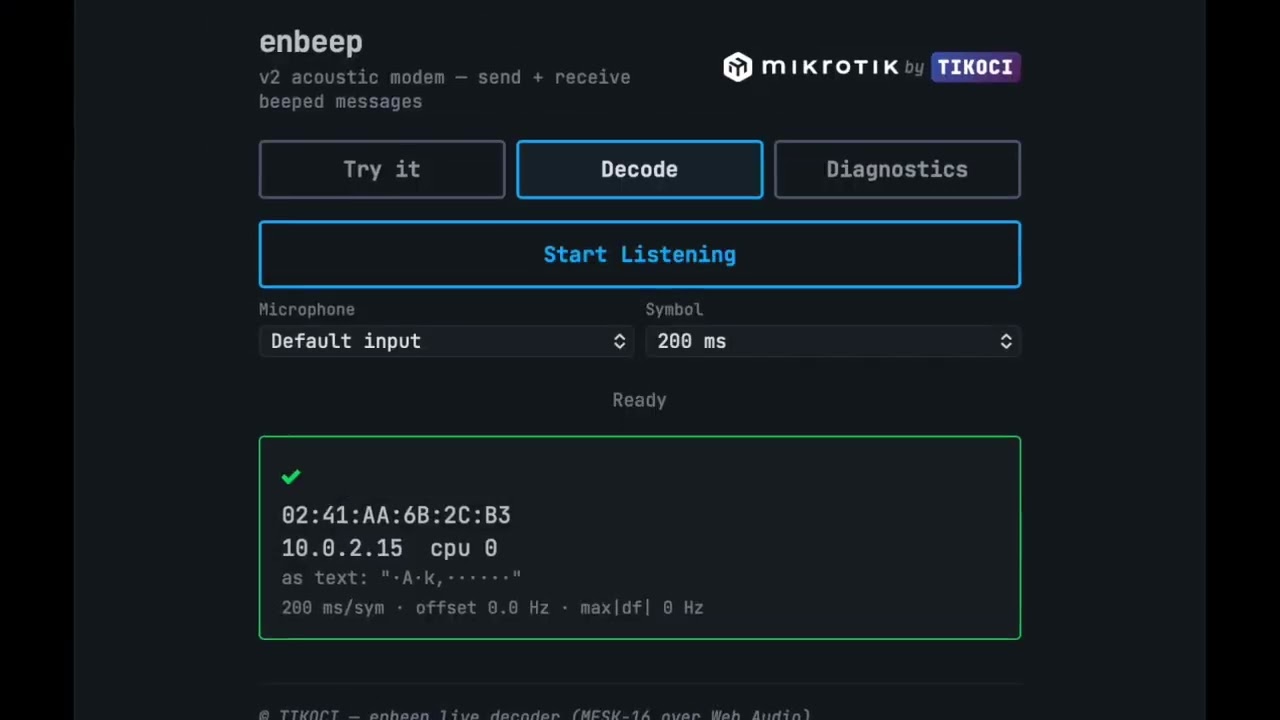
RouterOS-Muse puts an AI coding agent beside a real MikroTik network, with a workspace to learn it, tools to act on it, a disposable twin router to test on, and a browser UI where the owner watches, approves, and sees results. The problem: coding agents can now read a codebase, use tools, and verify their own work. Networks get none of that. The facts that matter live on routers, and owners must re-explain their topology in every chat. A chat reply cannot log into a router, and nothing it learns lasts past the session. The workspace is a folder that outlives every chat. workspace.toml says what the network is. An encrypted device.cdb (the WinBox-compatible registry) holds devices and credentials. devices.toml is a read-only mirror of the non-secret parts for plain file tools. router.toml records per-device intent. Observations, reports, operations, and history make up the rest. "Agents learn their job from a directory": the network template ships AGENTS.md, conventions, checks, and skills, so the agent arrives knowing how this network is run. The agent acts through the TIKOCI RouterOS stack: Rosetta for documentation and command-tree research, Centrs for device access and validating commands before they run, QuickCHR for disposable CHR routers on QEMU, and routeros-skills for workflows. The rule: "Prove it on a twin. Apply it only with permission." Changes are tested on a CHR first, and Muse's approval modes gate anything that touches the real network. A CHR cannot prove radio or physical-port behavior, and the skills say so. The UI is more than a chat box. Devices sit on the left, the conversation in the center, and renders and status on the right. A per-session MCP server gives the agent UI tools. ui_open puts a report, diagram, or agent-built HTML page in a tab. ui_select_device targets a router. ui_add_device opens the credentials dialog, so a router password is typed by the owner and never enters chat or argv. It is real software, not a mockup. It is published on npm (bunx @tikoci/routeros-muse@next start). CI is green and runs lint, a typecheck, 461 tests, and a Playwright browser smoke. The repo has 328 commits in four days. Work is tracked in records/ (177 tasks, 55 decisions). Gaps found in the tools it consumes were fixed upstream, not forked. Two builds show the range. enbeep was Muse's first assignment: a RouterOS :beep script that sends a router's MAC and IP as MFSK-16 tones, and a Web Audio decoder that hears them (tikoci.dev/enbeep). app-t3code, built from inside RouterOS-Muse, packages T3 Code as a RouterOS /app container for x86_64 and ARM64, tested on real CHR VMs. Status: preview. Narrow-window layout and some UX edges are known issues.