RescueLens
Built at Meta Global AI Developer Hackathon · Oct 26, 2026 · Remote
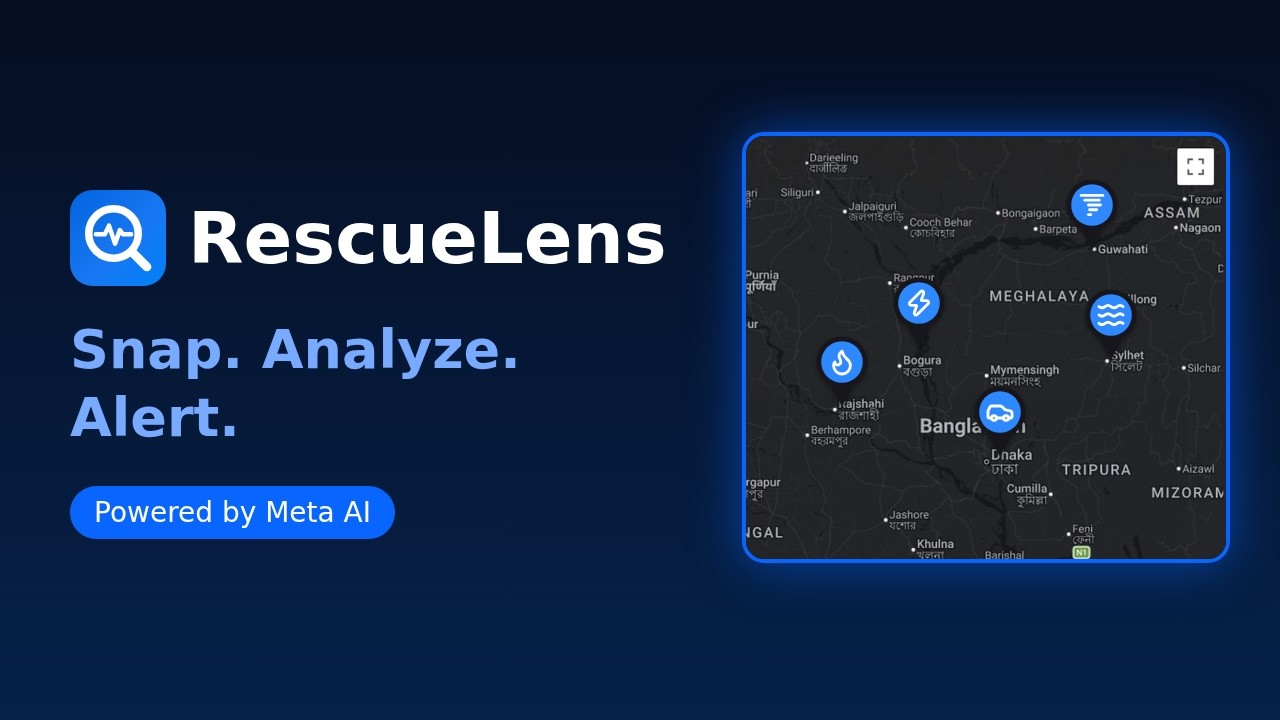
The problem In Bangladesh and many other places, the first people at an accident, fire or flood are ordinary bystanders. They take photos, but those photos rarely reach the right responders fast enough, and nobody can quickly tell how serious the situation is. Minutes are lost to confusion, language barriers and the wrong people being called. What RescueLens does RescueLens turns a bystander's photo or video into a structured, verified, routed emergency report. 1. Report: a user captures a photo or video. GPS metadata is stripped from uploaded media, and nothing is posted until the user reviews and confirms. Similar reports of the same incident are merged so responders see one clear event instead of many duplicates. 2. Understand: Meta AI analyzes the photo or video frames and returns the incident type (14 types), risk level, severity, a confidence score, plain language reasoning, and evidence boxes that show exactly what in the image led to the decision. 3. Update: as the community comments and reacts, Meta AI reads that discussion and can raise or lower the severity, always showing the reason for the change. 4. Translate: a whole post, including its comments and the AI analysis, can be translated across English, Bangla, Hindi, Spanish and Arabic. 5. Alert: Meta AI automatically sends live alerts to nearby users and to organizations matched by incident type. A road crash goes to hospitals, police and ambulance services. A flood goes to NGOs, relief centers and fire services. Every alert explains why it was sent, and its status is tracked live until the incident is resolved. 6. Respond: responders open a sheet with Call, Message and Directions. Calls only go to verified emergency numbers chosen by location, for example 999 in Bangladesh. Product experience 1. A ranked and diversified nearby feed that weighs distance, severity, recency and engagement. 2. A map that opens on your country, with near me, country and world views, a heatmap of hot areas, and filters. 3. Role portals for users, NGOs, help centers, responders, moderators and admins. 4. Facebook style threaded comments, live notifications and toasts. 5. A profile timeline with full edit and delete, plus a trash with restore and permanent delete. 6. Dark and light themes, offline drafts, and an adjustable alert radius. Privacy by design Precise location is visible only to admins, and media metadata is stripped on upload. The public sees what it needs to help, not where a reporter lives. How it is built RescueLens has three clients sharing one backend: a Laravel API, a React web app, and a Flutter app for iOS and Android. Meta AI runs through the Meta Model API Responses endpoint, following Meta's official documentation: Muse Spark 1.3 for vision, reasoning and translation, and SAM 3.1 for segmentation evidence boxes. The Llama API is available as an alternative provider. The repository includes 51 passing backend tests, setup through Docker or a script, demo accounts for judges, and a judging guide so the project can be evaluated quickly. Why it matters RescueLens connects the people who see an emergency with the people who can act on it, in their own language, with evidence and reasoning they can trust. The goal is simple: faster, better informed emergency response where minutes matter.