FlowTopo
Built at Meta Global AI Developer Hackathon · Oct 26, 2026 · Remote
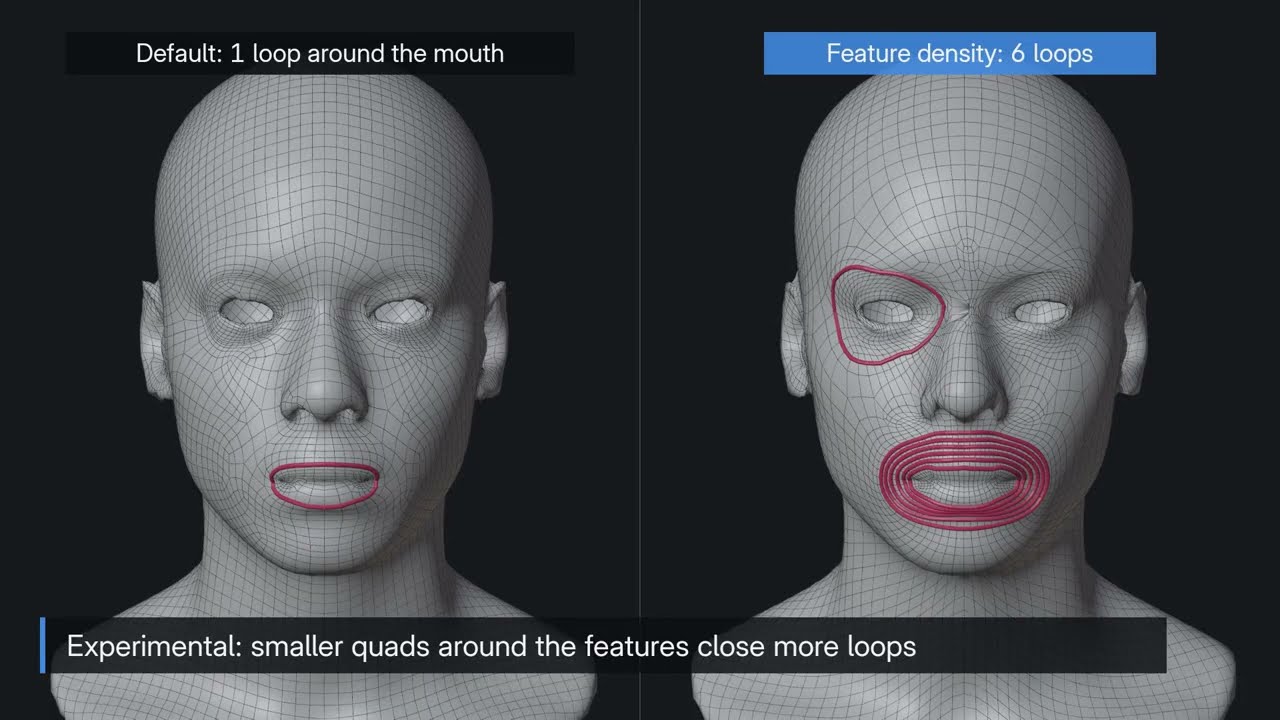
AI 3D generators and scanners now produce huge numbers of meshes, but they come out as triangle soup and can't be animated. Automatic remeshers turn them into even quad grids, and that is not enough either. Animation needs edge loops in the right places: rings around the eyes and mouth, and loops around limbs. Today a character artist draws those by hand, which takes hours for a single head. FlowTopo does it in about a minute for under 10 cents of API calls. FlowTopo is a Blender add-on that places those loops automatically. It renders the mesh from several angles. Muse Spark looks at the renders and decides which features need loops, what kind and how many, and gives a reason for each. SAM 3.1 finds each feature on the plain grey renders. FlowTopo projects the masks back onto the mesh, builds a distance field per feature and cuts exact guide rings into the mesh. A geodesic Voronoi split stops the rings of neighbouring features from crossing. QRemeshify (QuadWild) then builds quads that follow those rings. At the end Muse Spark reviews the wireframe, scores it and can propose a new ring plan. FlowTopo runs it and keeps it only if the eyes-and-mouth score improves. How we measured it: for every feature we count how many quad edges near it run along a ring or along a spoke, within 15 degrees. A random grid scores 33 percent. On 8 test meshes with eyes and mouth (a scan, three artist heads, three full bodies, Suzanne), the eyes-and-mouth score was 42.5 percent for FlowTopo, 36.0 percent for QRemeshify without guides and 34.5 percent for Blender's QuadriFlow. All three get the same relax clean-up afterwards. On eyes and mouth FlowTopo beats both remeshers on all 8 meshes; on all features together it wins on 8 of 9. On the 6 meshes that ship with an artist's hand-made topology, FlowTopo closes about 70 percent of the gap between plain auto-remeshing and the artist, and scores above the artist on 3 of them. The main limitation: FlowTopo usually gets one closed edge loop around each eye and the mouth, where artists place ten or more. An experimental feature density setting makes the quads smaller around the features before remeshing. On the realistic head it raised the closed loops around the mouth from 1 to 6, but it can bunch quads on the nose bridge, so it is off by default.