Perry the Platypus
Built at Meta Global AI Developer Hackathon · Oct 26, 2026 · Remote
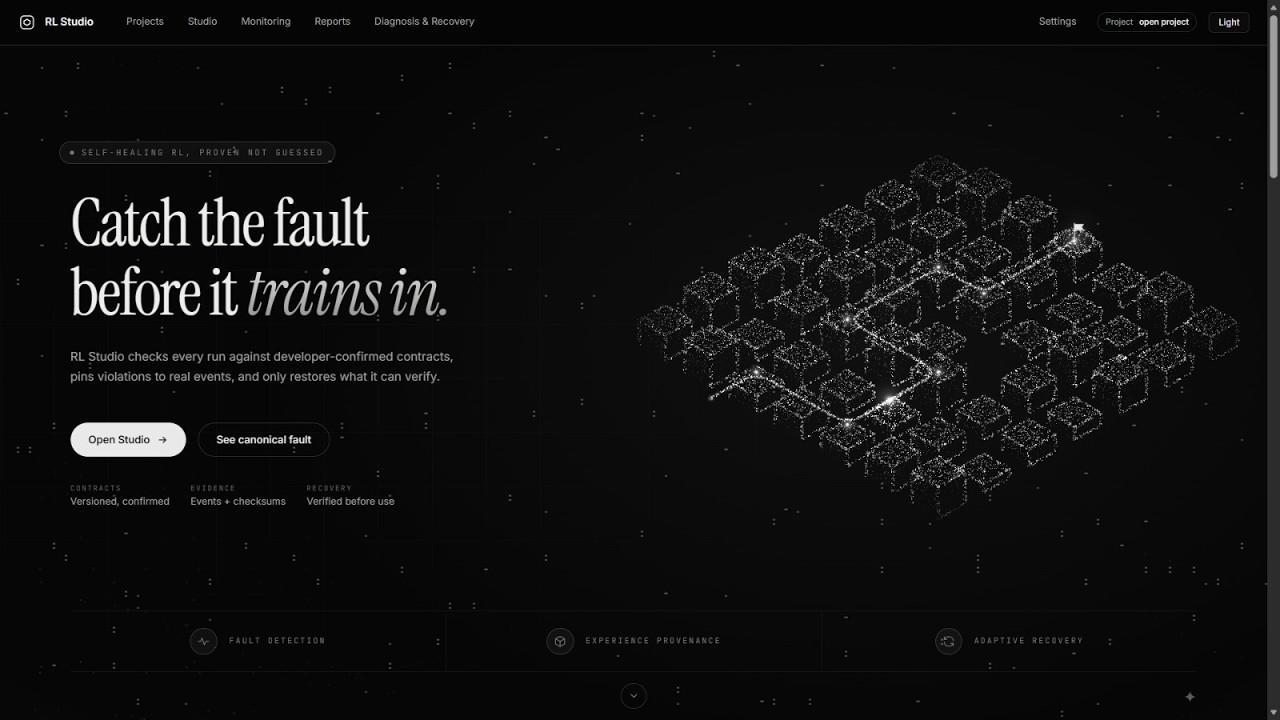
RL Studio is an AI-powered, self-healing Reinforcement Learning platform designed to make RL experimentation more reliable, explainable, and resilient. Traditional RL workflows focus primarily on training agents and monitoring performance. However, when an agent's performance deteriorates, identifying whether the cause is an agent failure, incorrect configuration, reward-function modification, or environment corruption often requires extensive manual debugging. RL Studio addresses this challenge by integrating the complete reinforcement learning lifecycle into one platform: project management, agent and environment configuration, training, monitoring, intent-based verification, failure diagnosis, and recovery. Developers can configure algorithms such as PPO, A2C, DQN, SAC, and TD3 and experiment with environments including CartPole, MountainCar, LunarLander, BipedalWalker, and a custom 2D Warehouse environment. Controlled fault injection enables the reproduction of failures such as reward scaling and observation corruption. A key capability is Intent-to-Verification, where developers express expected training outcomes in natural language. AI translates these expectations into structured requirements, which are reviewed and confirmed before a deterministic verification engine evaluates them against persisted training evidence. When a confirmed requirement fails, RL Studio can create an evidence-linked incident. Its diagnosis and recovery workflow helps investigate potential root causes and recommends strategies such as checkpoint restoration, invalid experience removal, and fresh experience collection. The platform also incorporates provenance tracking, checkpoint integrity information, training history, and auditable recovery workflows. By combining Meta AI-powered reasoning with deterministic verification and controlled recovery, RL Studio aims to move reinforcement learning beyond training and monitoring towards systems that can understand failures and guide their own recovery.