Bridge-lab
Built at Meta Global AI Developer Hackathon · Oct 26, 2026 · Remote
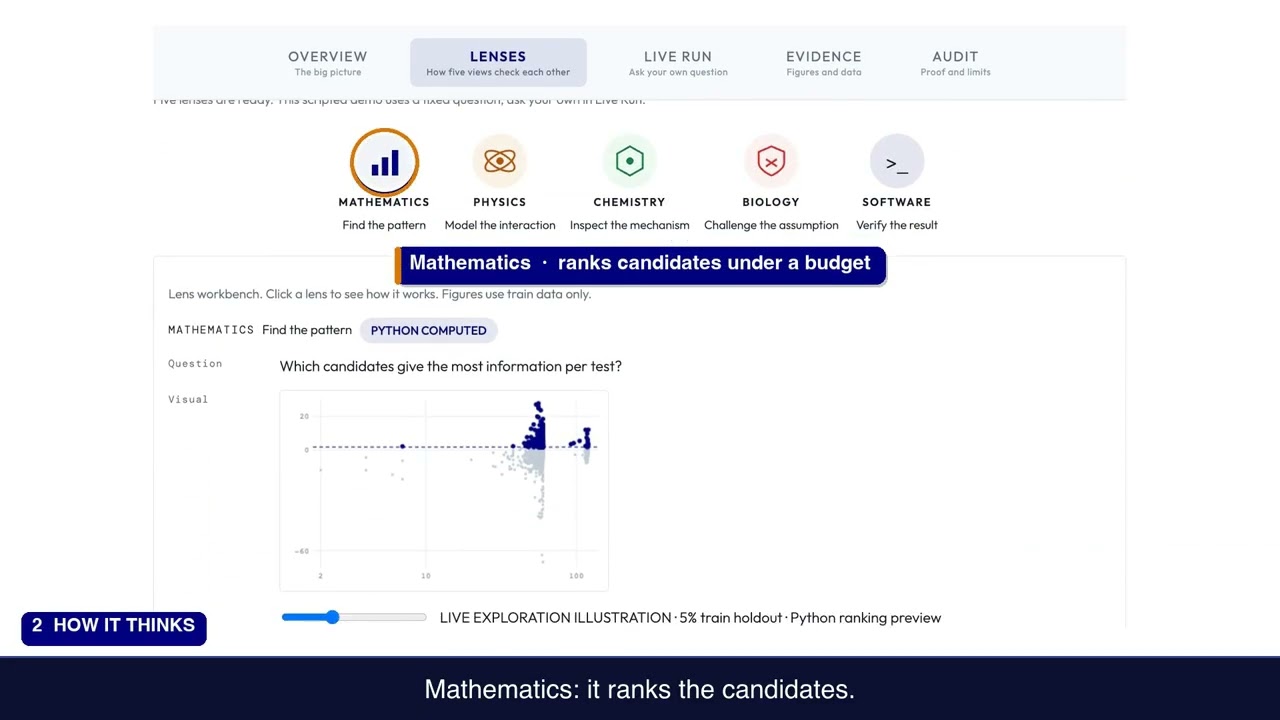
BRIDGE LAB began with a personal observation. When a family member was in intensive care, I watched doctors from multiple specialties gather around one patient. Each doctor saw a different part of the problem, challenged assumptions, and contributed to a shared decision. I kept asking: why can’t scientific research work more like this? BRIDGE LAB is a cross-disciplinary research lab built around that idea. It takes one scientific question and expands it through multiple lenses: mathematics, physics, chemistry, biology, and computation. Each lens reframes the problem, proposes methods, challenges assumptions, and identifies connections that a single discipline may miss. The goal is not to ask an AI agent for one answer. It is to create a structured research conversation in which different perspectives generate new hypotheses and support more informed decisions. A human review gate lets the researcher read the perspectives, add direction, preserve useful ideas, and decide which connection deserves deeper investigation. Our live demo uses a cell-based drug-combination screening problem derived from the public NCI-ALMANAC dataset. The Transfer Judge selects from an allowlisted set of methods, and Python executes the selected method on training data. Critic and Reporter agents are called only when an execution result exists. If the evidence is insufficient, the system reports an inconclusive result instead of overstating a conclusion. BRIDGE LAB also separates live exploration from sealed comparison. Live runs do not read held-out outcomes and therefore cannot claim final predictive performance. A sealed comparison is reported separately with its data provenance and audit record. For the sealed comparison, we evaluated the pipeline against a single-call baseline under the same fixed budgets. The BRIDGE LAB pipeline produced valid selections and achieved precision values of 0.6070, 0.5769, and 0.5034 at 5%, 10%, and 20% budgets. The baseline failed to produce a valid selection in its runs, so we do not claim a numerical performance advantage. Instead, we report the comparison transparently: BRIDGE LAB generated an auditable result, while the baseline could not complete the required selection task. BRIDGE LAB is not simply a tool for choosing the next experiment. It brings multiple scientific perspectives to one problem, expands what the question could become, and helps researchers turn connections into testable directions.