Klinklang
Built at Meta Global AI Developer Hackathon · Oct 26, 2026 · Remote
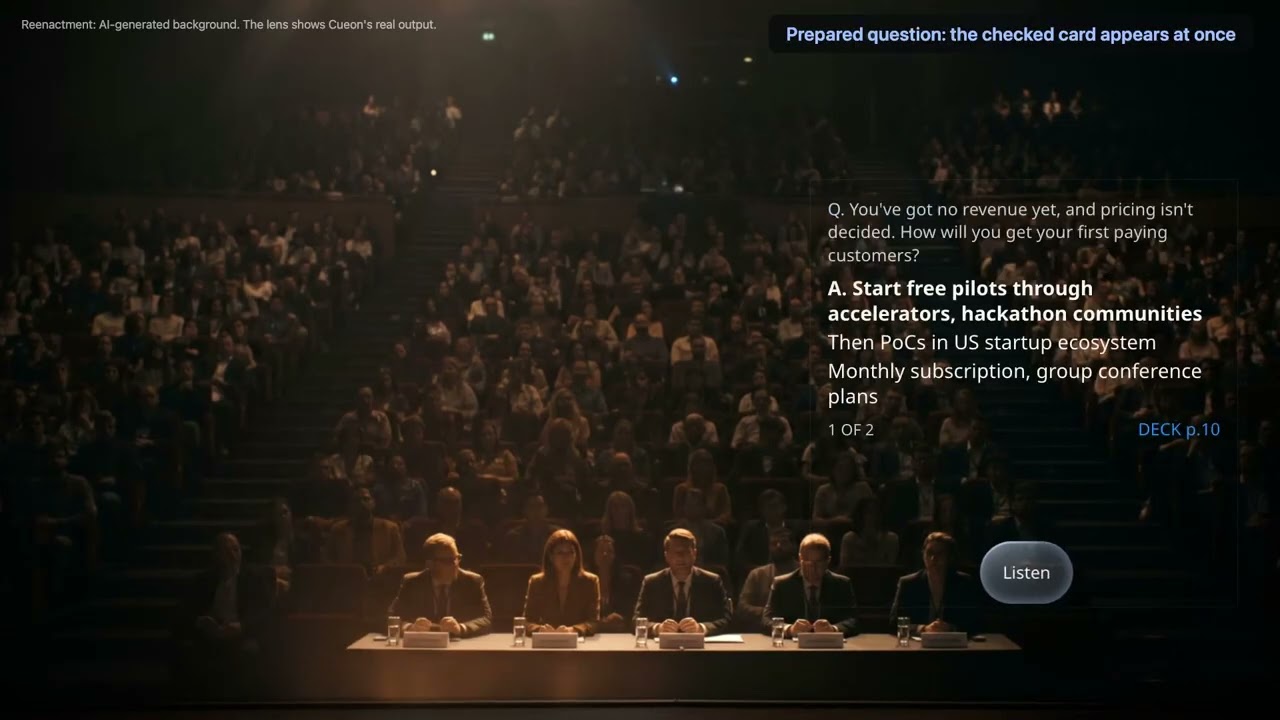
At my startup's IR pitch, I'd prepared everything. I knew the product and I knew the numbers. Then an investor asked a hard question, my mind went white, and I felt I got across maybe 10% of what I'd prepared. The work wasn't the problem. Getting it out of my head in front of that room was. So I built Cueon. You wear Meta Ray-Ban Display, someone asks a question, and an answer from your own material appears on your lens, with the page it came from. You glance at it and answer in your own words. It works in two stages. Before the talk, you upload your deck, business plan, technical docs and data. A Prep Agent on Muse Spark works out what investors, technical judges and the audience are likely to ask, and writes a cue card for each question. A card can't be saved until every number on it is found on the page it cites and a judge model has checked each claim against that page. A reviewer sends vague answers back for another draft. If your material can't back up an answer, the question is flagged, so you find out the night before and not on stage. During Q&A, Muse Voice Transcribe hears when the question ends. If it's one you prepared for, the checked card appears right away, unchanged. If it's new, the closest card shows while Muse Spark writes one from all of your material, and that card is labelled as live. If your material has nothing to support an answer, the lens says so and suggests how to reason through it. It won't make up a number. Cueon also helps before the questions start: while you present, it shows each slide's key points, follows your slides from what you say, and tells you if you skipped a point. I talked to about 30 people in my university startup club and at startup meetups, and about 20 computer science master's and PhD students who present at conferences. Many described the same freeze. Most told me they'd use this, though the startup group's catch was that they don't have the glasses yet. That's intent, not revenue: there are no paying users so far, and pricing isn't decided. Where it stands: it runs end to end with the real models, on Cueon's Ray-Ban Display web app. I'm in Korea, where the glasses aren't sold, so it has only run in Meta's simulator and hasn't been tested on a real device. Prepared cards appear within a second of the question ending. New questions take longer, so a stalling line and, when one is close, the nearest prepared card hold the lens until the new card arrives. Making that faster is the next thing I want to fix. Next come pilots through accelerators and hackathon communities, and PoCs with US founders who already own the glasses.