sstmade
Built at Meta Global AI Developer Hackathon · Oct 26, 2026 · Remote
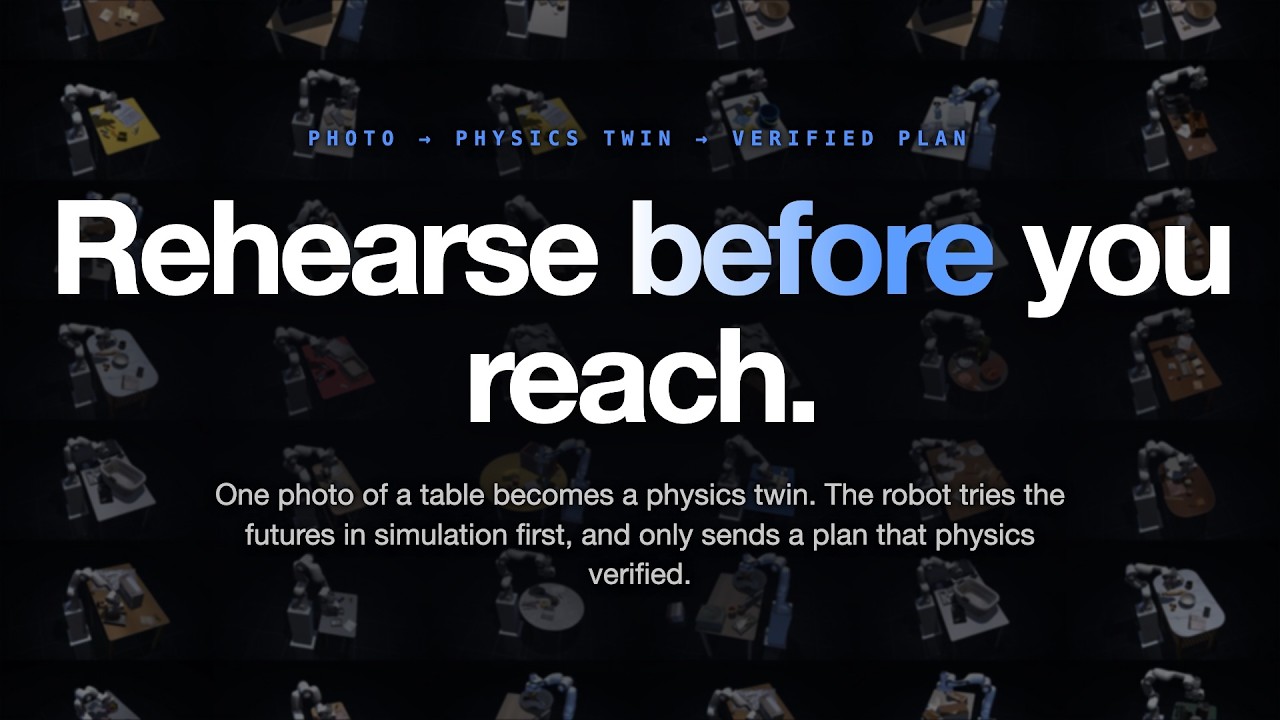
The home-robot era has a bottleneck, and it isn't the hardware. It's the gap between the lab and the real world: your kitchen, your desk, your living room, every home that's different from every other. Robots learn in labs: one tidy setup, repeated ten thousand times. Homes are endless, messy and all different, and a mistake there breaks real things. Every robot demo you've seen was rehearsed somewhere safe. Your table never was. Words make it harder. "Clean this up" means something different on every table. "Make room for my laptop" isn't an object at all, it's a space. A model can guess; a robot can't afford to. Our insight: rehearse before you reach. The first time a robot moves in your home shouldn't really be the first time. Rehearsal is the missing layer between AI models and robots in homes. One photo of your table becomes a physics twin. Meta's models make that possible on day one, for any table: Muse Spark understands the scene, SAM 3.1 cuts out every object to the pixel, SAM 3D rebuilds each one in 3D. Eyes, understanding and a world, from a single photo. You say what you want in your own words. Muse Spark turns it into goals physics can check, writes down what it assumed, asks when you were vague and refuses when it should. Then the robot lives that moment many times in simulation, where nothing can break. Physics kills every future that collides, tips or misses. Only a plan that passed is sent. If none passes, nothing is sent, and you're told why. On my own desk, I said "move the water bottle". It asked: which one? Its first plan would have tipped the bottle, so physics rejected it before the arm ever moved. When I asked it to pour water on my keyboard, it said no, and explained why. On 50 AI-generated test tables, Rehearsal simulated 5,624 futures and rejected 5,149. It finished the job on 24, found no safe plan on 12 and sent nothing, asked or refused or found the rest already done, and got 1 wrong. 19 of the 24 used labelled planner extensions, disclosed in the repo. All robot motion is simulated. Why now: until recently, turning a real table into a simulator took a lab, a scanner and a ruler. Meta's models turned that into one phone photo and a few cents. That is what makes rehearsing every home thinkable. Here is the part no lab can copy. Every rehearsal, passed or rejected, is a complete physical lesson: what the person meant, how the arm moved, what physics said, and why it failed. Labs can't collect that; they don't have your table. We're building toward the world's largest dataset of real homes, real requests and verified physical outcomes, gathered one table at a time, failures included. No policy has been trained on it yet; today it's 50 tables. But that is what home robots could learn from. You can try it now: pick one of the 50 test tables, or upload a photo of your own and watch Meta's models build its twin live. A blueprint for the real world, one table at a time. Your table. Rehearsed first.