SAMgo
Built at Meta Global AI Developer Hackathon · Oct 26, 2026 · Remote
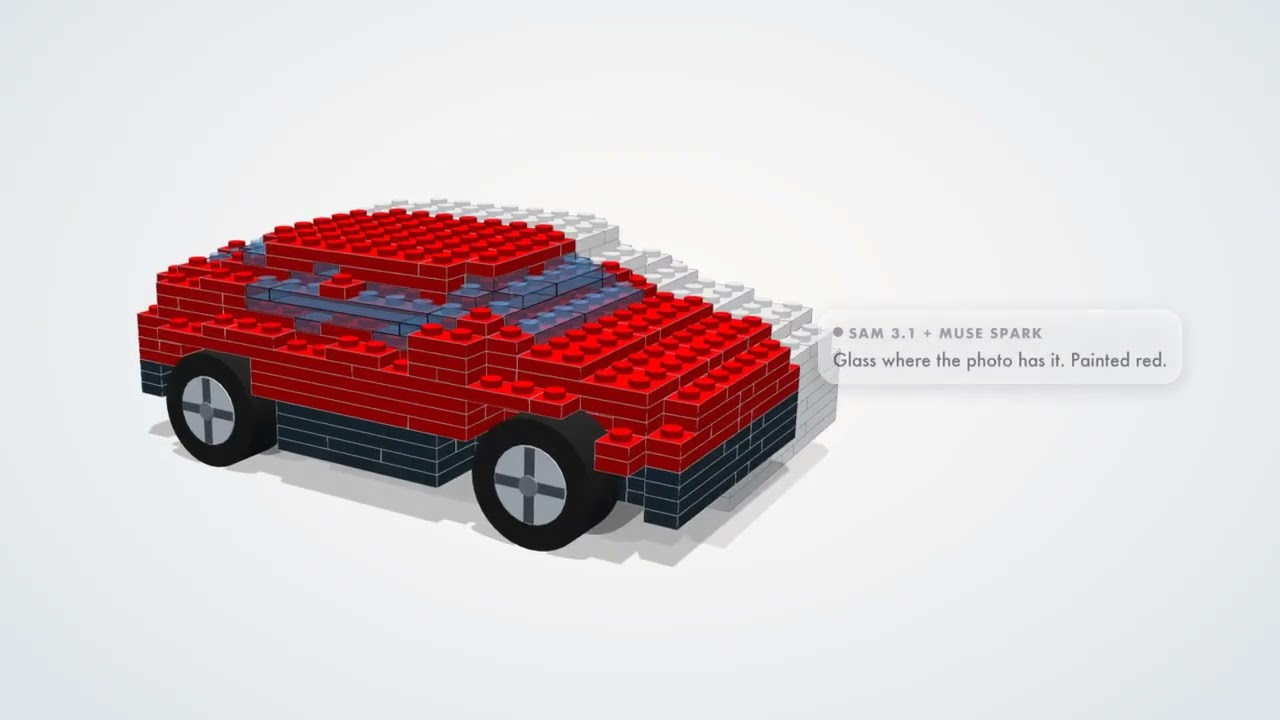
SAMgo takes a photo of any object, and creates a real physically buildable Lego model. That means if you take a photo of an airplane or a car, SAMgo doesn't just copy the shape, it understands what working parts are necessary to build the model in the real world. So, if you have a photo of a car, SAMgo will build working axles and for a plane, it builds working flaps and ailerons. SAMgo builds with real Lego pieces that you can order today so you can have a working build tomorrow. SAMgo also generates a manual and walks you through the build step by step. This is the work of a verifier: any build that SAMgo makes must pass a verification step to ensure it is physically possible to build and that it stands up as a valid construction. The build order is certified step by step, and the full-scale version of the same car is a valid 140,493-piece model. To achieve this, we taught Muse Glimmer how to build mechanisms like flaps, rotors, axles, etc. with valid parts. We fine-tuned a LoRA with about 15,000 examples that our verifier guaranteed were valid builds. The examples use generic shapes and generic skills (put wheels on a body, hinge an edge, set a rotor into a face, put blades on a turntable) and never name an object. About half are "mistake -> checker feedback -> fix" examples. Each of Glimmer's answers went through the verification check that it works in the real world: every part is a real catalogue element, nothing overlaps, every piece is held by studs, axles pass only through holes, mechanisms swing or spin clear, and the model stands under an exact force balance. If something fails, the checker tells Glimmer exactly what is wrong ("this clip holds nothing") and Glimmer fixes its own answer. Because it learned skills rather than objects, it built a 747's engine fans, a helicopter's rotors and a Cessna's propeller and ailerons without ever seeing those objects in training. SAMgo pushes the frontier by moving AI from making things that look right to making things that work right. This is especially a problem in a field like manufacturing: taking known parts and working out how they fit together into something that functions, in an order that holds at every step. Today that work is done by hand. SAMgo shows a model can do it, with LEGO as a fully verifiable testbed, and the same loop of a model that knows, a model that builds and code that checks every answer is how we see this extending to real CAD parts and real assembly.