CircuitProof
Built at Meta Global AI Developer Hackathon · Oct 26, 2026 · Remote
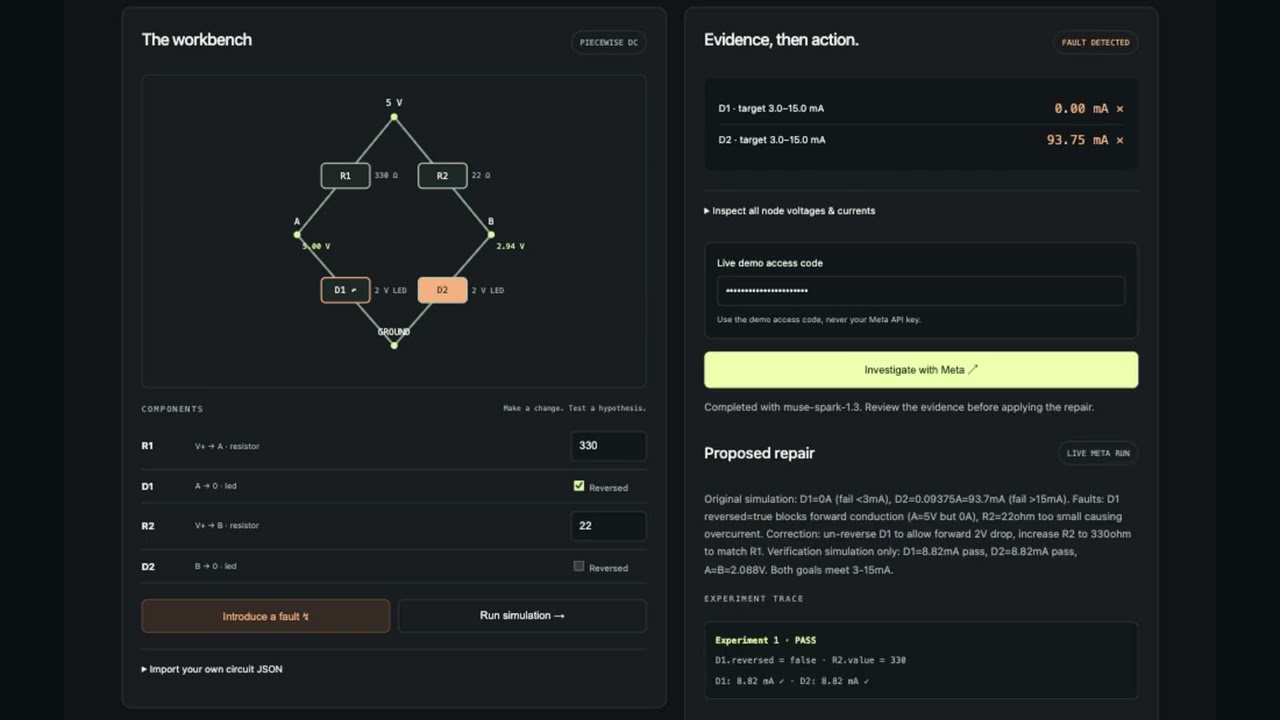
CircuitProof uses Meta’s Muse Spark to investigate circuit faults, test repairs, and verify the results before applying a change. Circuit debugging often involves trial and error: a suggested fix may sound plausible without actually restoring the intended behavior. I built CircuitProof to make each repair testable, with calculated evidence showing what changed and whether every target was met. Users choose from five circuit examples or import a custom circuit with measurement targets. Muse Spark calls experiment tools to test component changes, inspect voltages and currents, and recommend a correction. The app accepts a repair only when it matches a passing experiment. After the user applies it, the browser independently recalculates the circuit and checks every target again. The demo shows two simultaneous faults: a reversed LED and an undersized resistor. The agent tests a combined repair, and independent verification confirms that both LED currents return to the required range. Users can follow live investigation progress, inspect the experiment trace, compare before-and-after measurements, and export their notebook. I built CircuitProof around the “Push the Frontier” theme. I wanted the AI to go beyond suggesting a fix to test it and show whether it works. Right now, the project verifies repairs in a simplified DC simulator. Testing those repairs on real hardware is the next step.