ShopFloor AI
Built at Meta Global AI Developer Hackathon · Oct 26, 2026 · Remote
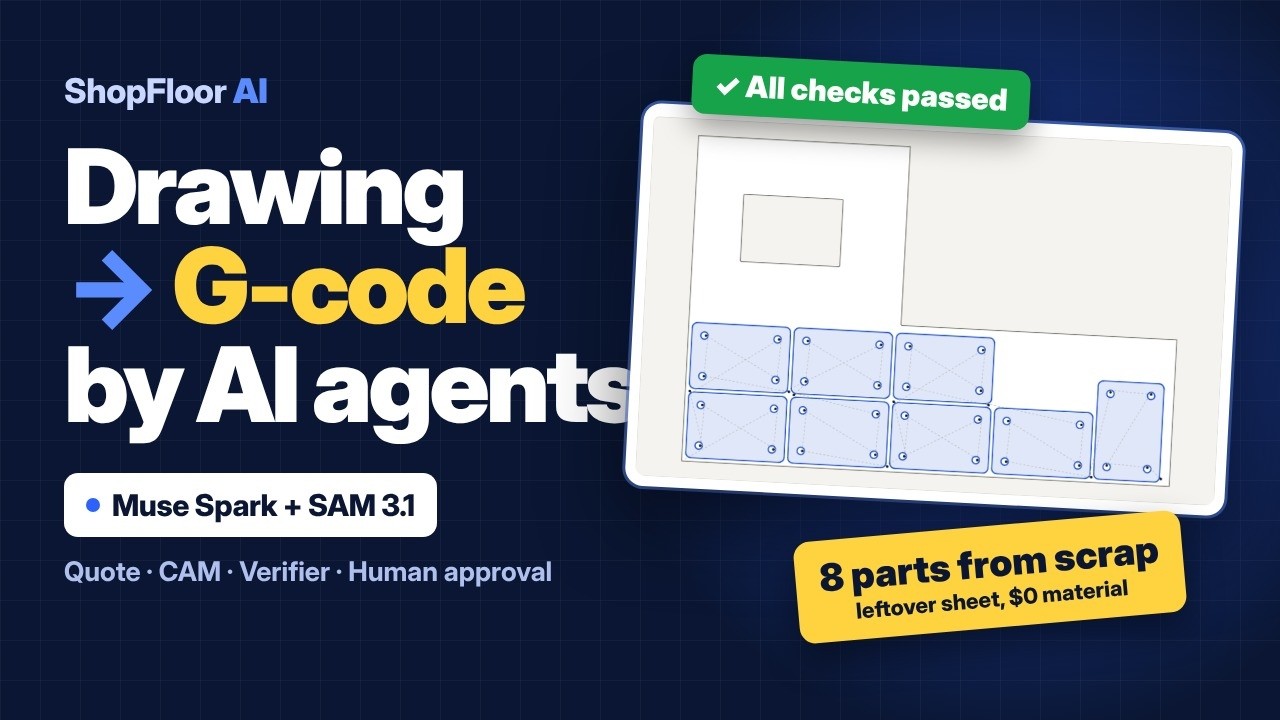
ShopFloor AI takes a customer's drawing to a quote, verified CNC G-code and an operator setup sheet, run by a team of AI agents on Meta's Muse Spark and SAM 3.1, with a person approving the money and the machine moves. THE PROBLEM Small waterjet and laser job shops still do every step by hand: read the drawing, check whether it can be cut, price it, reply to the customer, program the machine and brief the operator. In my earlier PathForge work (DXF to G-code, validated on 250+ drawings), programming alone took engineers about 50 minutes per part. The bigger cost is everything around it: quoting, back-and-forth questions, and scrap from mistakes. WHAT IT DOES - Drawing Reader: reads DXFs, PDFs and photos. Muse Spark vision reads dimensions and SAM 3.1 traces outlines. Missing information becomes a question for a person, never a guess. - Manufacturability: checks holes, slots, edge clearances and thin sections against the shop's rules and suggests fixes. - Estimator: prices from cut length, pierces, machine time and material, and drafts the quote email. A guard rejects any number that is not in the quote. - CAM Programmer + Verifier: the CAM agent chooses settings, and deterministic tools generate the G-code. An independent Verifier runs 11 checks (bed limits, feeds, holes before outer profile, lead-ins in scrap, no rapids over cut parts) and sends failures back for another attempt. - Offcut Planner: photograph a leftover sheet and enter one width. It fits parts into the real outline and re-quotes with no material cost for those parts. - Shop Knowledge: answers staff questions only from shop settings and uploaded manuals, with citations. A person approves the quote and releases the program. Routing is deterministic code, so no model can skip the Verifier or an approval. HOW I BUILT IT - Python and FastAPI run a state machine with human approval gates. - Agents call tools through a typed registry with per-agent allow-lists. - Tools handle DXF parsing with automatic curve tolerance, nesting, kerf compensation and the post-processor. - A fallback chain (Meta API, then a backup endpoint, then rule-based answers) keeps jobs moving. - Shop settings are editable in the app. It runs in Docker on Render. RESULTS (real Meta API) - 20/20 jobs end to end, median 27.7 s - 54/54 planted G-code errors caught - 10/10 planted design problems flagged - 10/10 invented numbers blocked from quote emails - 3/3 vision cases CHALLENGES Keeping models away from numbers and toolpaths: the model chooses and explains, while code computes and verifies. I also fixed a Verifier bug that compared cuts across sheets, and fitted parts into odd-shaped leftovers. WHAT'S NEXT Pilot with a real shop's machine and speed tables, better nesting, and a customer-messages agent. LIMITS Shop settings are sample values; programs are verified in simulation, not yet run on a machine.