AfterDark
Built at Meta Global AI Developer Hackathon · Oct 26, 2026 · Remote
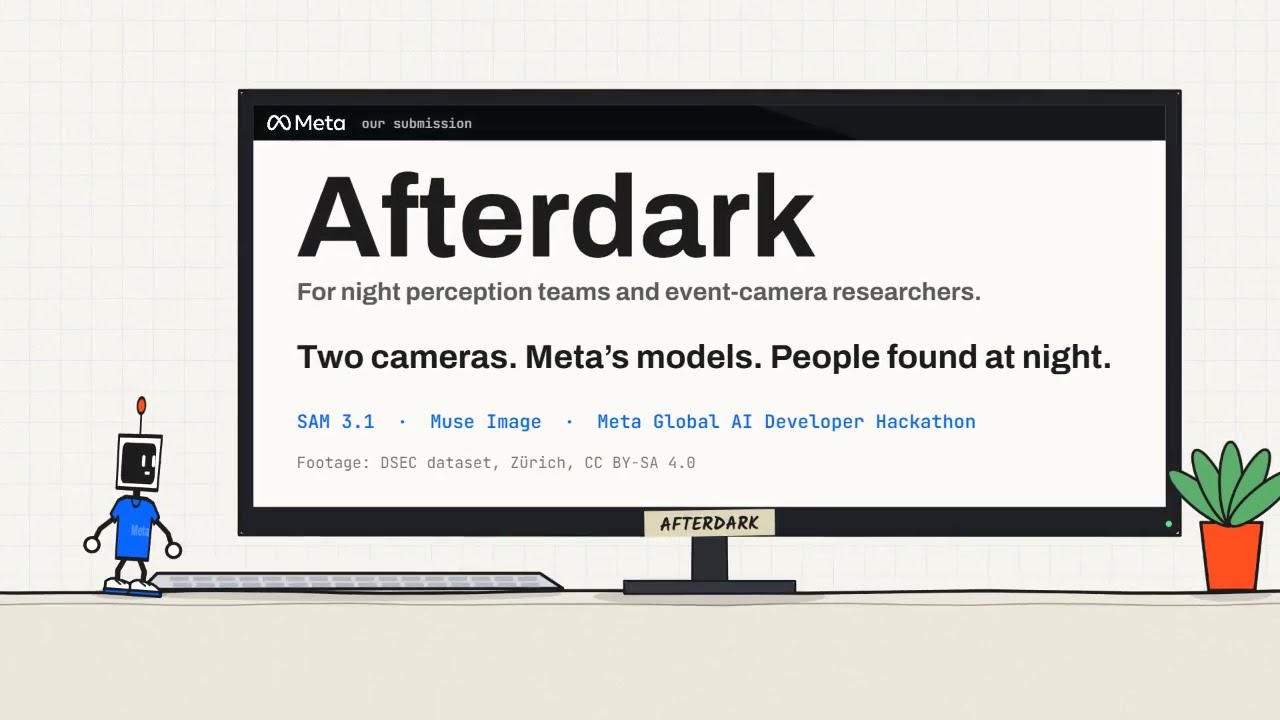
At night, ordinary cameras go blind. A person stepping toward the road can vanish into the dark. Event cameras are a new kind of sensor that keeps seeing. They are brain-inspired, neuromorphic cameras: every pixel works on its own like a cell in the retina, firing a tiny spike the moment brightness changes, stamped to the microsecond, across a huge range of light. The catch is that they produce a cloud of flickers, not pictures, and almost no AI can read them. The usual answer is a whole research pipeline: simulators like ESIM and v2e to fake training data, reconstruction networks like E2VID to turn events back into images, and detectors trained for each dataset. Live demo: https://yazan-o.github.io/afterdark/ Afterdark skips all of that. It hands the event camera straight to Meta's models, with no retraining. On real recorded night drives through Zurich (the DSEC dataset, an ordinary camera and an event camera side by side), SAM 3.1 finds people on both sensors with the same one-word prompt, "person". In our hero example, SAM finds no one in the dark camera frame, and no one after brightening it, but outlines the person in 10 ms of event-camera data. Then Muse Image does something we had not seen before: it paints a readable night street from the event flickers alone, with no camera picture of the scene in the request. Parked cars, lane lines, lamps and houses land where the events put them. Ten paintings per second of driving, played in order, become a video generated from a camera that never takes a picture. Because a beautiful painting can still lie, Afterdark adds an agent. Muse Spark (hosted) or Muse Glimmer (open weights, on our own NVIDIA H200) inspects each painting against both sensors with six tools: scan, look, find, compare, repaint and report. SAM 3.1 supplies the objects, plain arithmetic decides what is missing, and Muse Image repaints only that patch. In the recorded climax the painting left out a tram for seven frames in a row; the agent found it and had it painted back. What we measured: SAM 3.1 outlined 21 of 96 labelled night pedestrians on both sensors. Muse Image placed 274 of 352 cars where the camera saw them, against 135 by chance. Camera-guided repair cut people left out of the paintings from 216 to 12, of 334 sightings. Afterdark is an open, end-to-end tool (export, calibration, segmentation, painting, video, inspection, a browser viewer and 104 tests) that lets anyone see what a neuromorphic camera recorded at night, what a model can find in it, and what a generated picture invented.