Foresight-AI
Built at Meta Global AI Developer Hackathon · Oct 26, 2026 · Remote
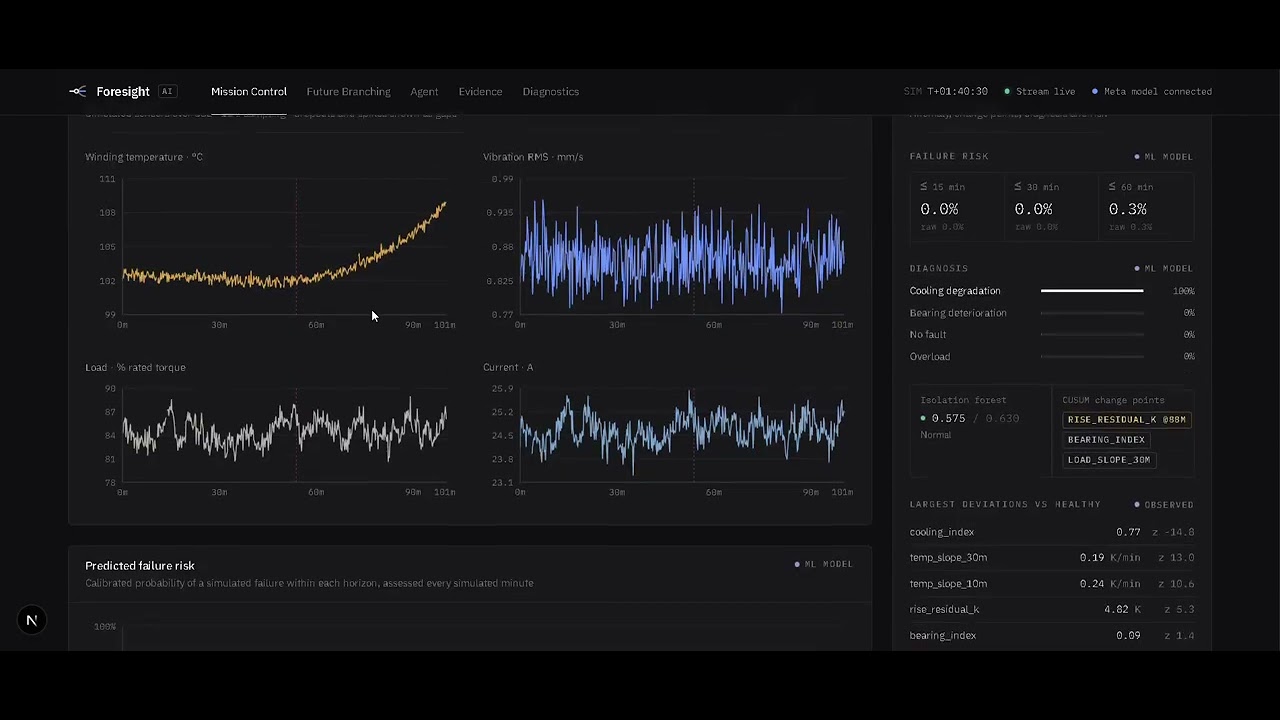
Industrial monitoring usually raises alarms after thresholds are crossed. It rarely answers: if we intervene now, which future is safer? Foresight AI closes that loop on a reproducible digital twin of a VFD-driven TEFC induction motor. The twin emits deterministic telemetry for cooling degradation, bearing deterioration, and overload. Calibrated ML models estimate multi-horizon failure risk and fault class. A Future Branching engine clones the estimated state, applies candidate interventions under matched noise, and scores an explicit economic objective. A deterministic safety verifier, independent of any LLM, can reject unsafe proposals, and it re-simulates each proposal with its own ensemble and seeds so an action cannot pass on a lucky sample. After a consequential action is accepted, an information gate holds it back when the risk rests on statistically unsupported trends and waiting is safe. A bounded agent calls typed tools for observation, prediction, simulation, and verification. It runs on Meta Muse Spark: Muse Spark 1.3 on the Meta Model API or the open-weights Muse Spark Open on Fireworks AI, selectable per run, with a labelled deterministic planner when no key is set. Consequential actions require human approval. The system is simulation-only and never controls real equipment. Evaluation on held-out simulator seeds reports precision/recall/PR-AUC, detection lead time, calibration (Brier/ECE), closed-loop failure incidence against rule and ML-only baselines, counterfactual calibration against the hidden true process, and agent reliability. A 126-run head-to-head compares the two Muse Spark endpoints across reasoning efforts. The 28-run re-checks on verifier v3 and v4 with the information gate both had zero unsafe picks. On v4, three live runs picked a costlier but safe action (two shutdowns and one 40% derate), and Fireworks invented unknown evidence IDs in hypotheses on 2 of 14 runs. The final submissions still verified. Both models also attacked the verifier as adaptive white-box red-teamers through four policy versions. Each round found a subtler hole: wasteful actions on a healthy machine, near-trip vibration, late inspections, and finally a 1/48 tail-risk derate. Each earlier hole was fixed and re-tested. Visual/SAM inspection is explicitly unavailable until a real camera source exists. The inspect-on-alarm rule still beats Foresight on mean cost, and that result is transparently retained in the report.