Cruyff
Built at Meta Global AI Developer Hackathon · Oct 26, 2026 · Remote
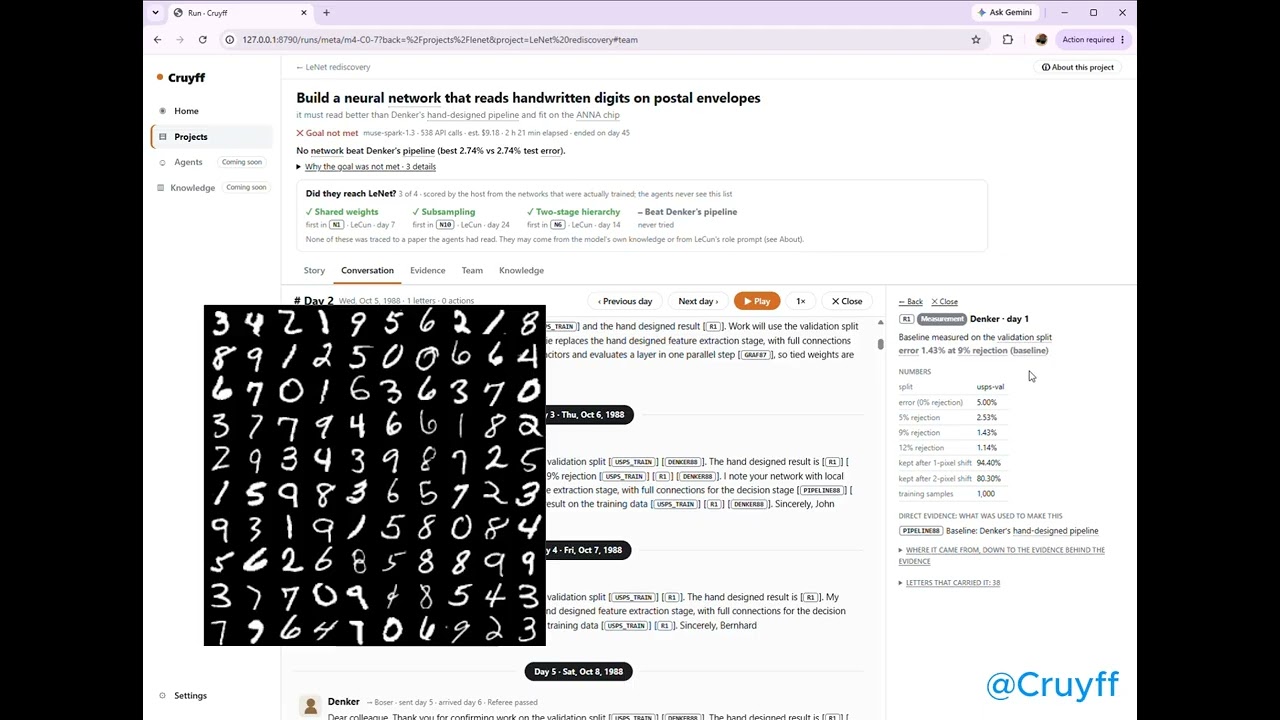
"Quality without results is pointless. Results without quality is boring." — Johan Cruyff Cruyff is a team of AI agents built to do research the way researchers actually do it. Researchers are always moving into new territory. I spent most of my career in computer vision, and when LLMs took off, I had to start from scratch. Learning a new field is one thing. Actually putting it to work is another. Am I heading in the right direction? Is this the right model or algorithm? Is this problem even solvable, or within budget? That’s where senior researchers come in. Their experience gives you the confidence that you’re on the right track. But for junior researchers and early-stage startups, that kind of mentorship is usually out of reach. LLMs already "know" a lot, but they give you answers without showing their work: no sources, no process, no way to check if the results hold up. And research isn’t just about answers. It’s about how an idea took shape, how constraints pushed people to get creative, and whether anyone else can reproduce what you found. So we built something different. Each agent works under real constraints. Each one only knows what it’s allowed to know. Each one is limited in how it can learn more. Together, they recreate the way humans actually do research, so you can learn from the process, not just the result. How it works You give Cruyff a research goal, a team of roles, and the knowledge each role is allowed to have. Muse Spark agents play the team. They read papers, write letters to each other, meet every Monday and propose experiments. A deterministic host program, not an LLM, runs every experiment for real. It trains each proposed network in a sealed sandbox, measures it, and marks each claim Verified or Disproved. Only measured results count. Our flagship project puts this to the test. Can agents limited to 1988 knowledge rediscover LeNet on their own? The team is the real Bell Labs group from October 1988: - Hinton: sends the related papers and prior work - Denker: owns the dataset and the hand-designed baseline to beat - LeCun: designs and trains the networks - Boser: checks whether a network fits the chip, the hardware budget - Bottou: builds new layer types when someone asks for one - Referee: sends back any letter that uses knowledge from after October 1988 You get back a full, replayable record of the research: - every letter, idea and network, with who proposed it and when, - every claim tied to a measurement, - every piece of knowledge traced to where it came from. In our latest 45-day run, the agents found three of LeNet's four key ideas on their own. They also beat Denker's hand-designed pipeline, 2.08% vs 2.74% test error. They never tried subsampling, and you can see exactly where their reasoning stopped.