TAI
Built at Meta Global AI Developer Hackathon · Oct 26, 2026 · Remote
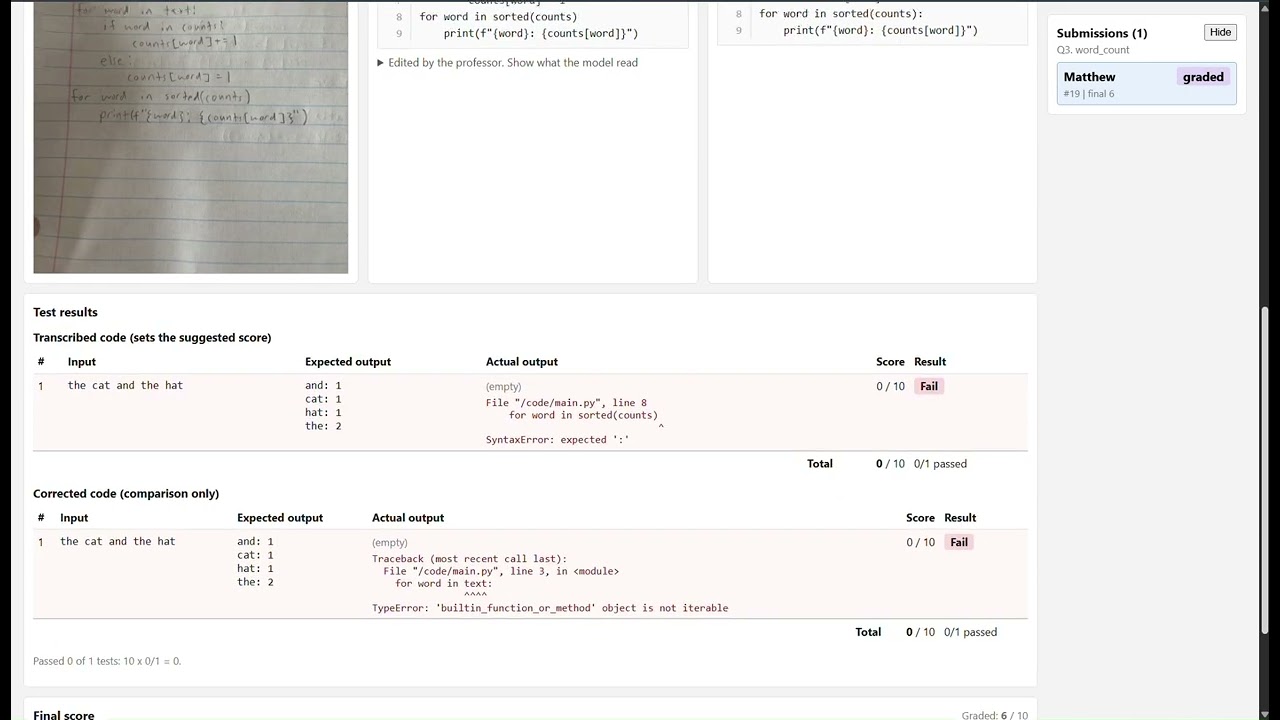
Handwritten Code Grading Assistant In intro programming and systems courses, students write a lot of code by hand: exams, quizzes, in-class exercises. Grading it is slow. A TA reads each page, works out what the program does in their head, and decides whether it's correct, one student at a time. For a class of 40 to 50, one exam question can take hours, and the results are inconsistent because a tired grader skims past a bug that a careful one would catch. This tool lets professors and TAs grade handwritten Python the way they grade typed code: by running it. The professor creates an assignment, adds questions with point values, and writes test cases (input and expected output) for each one. They then photograph each student's answer, either from the desktop or from a phone app built for working through a stack of papers quickly. The photos go into a queue. A background worker transcribes each one with Muse Spark through the Meta Model API, runs static checks for syntax errors and misspelled names, and runs the code against every test case in a locked-down Docker sandbox with no network access. Getting a transcription isn't the hard part. The hard part is trusting it. A student's bug is exactly what's being graded, so the model is told never to quietly fix programming mistakes: a missing colon or a wrong operator stays in the transcription. It flags lines it's unsure about, and the review screen shows the original photo, the transcription with those lines highlighted, and the test results side by side. If the model misread a character, the professor fixes it with one edit and the tests run again, so a student never loses points to a transcription error. A separate "corrected version" shows what the student's code would have done with their mistake fixed, which helps the professor decide on partial credit. The app suggests a score with plain-text reasoning (for example, "Passed 2 of 3 tests"). The professor makes every final decision. Graded work goes into a gradebook with CSV export. This is a grading assistant, not an auto-grader. It takes over the slow, mechanical work of reading and running code so graders can spend their time on judgment.