Sparing Live
Built at Meta Global AI Developer Hackathon · Oct 26, 2026 · Remote
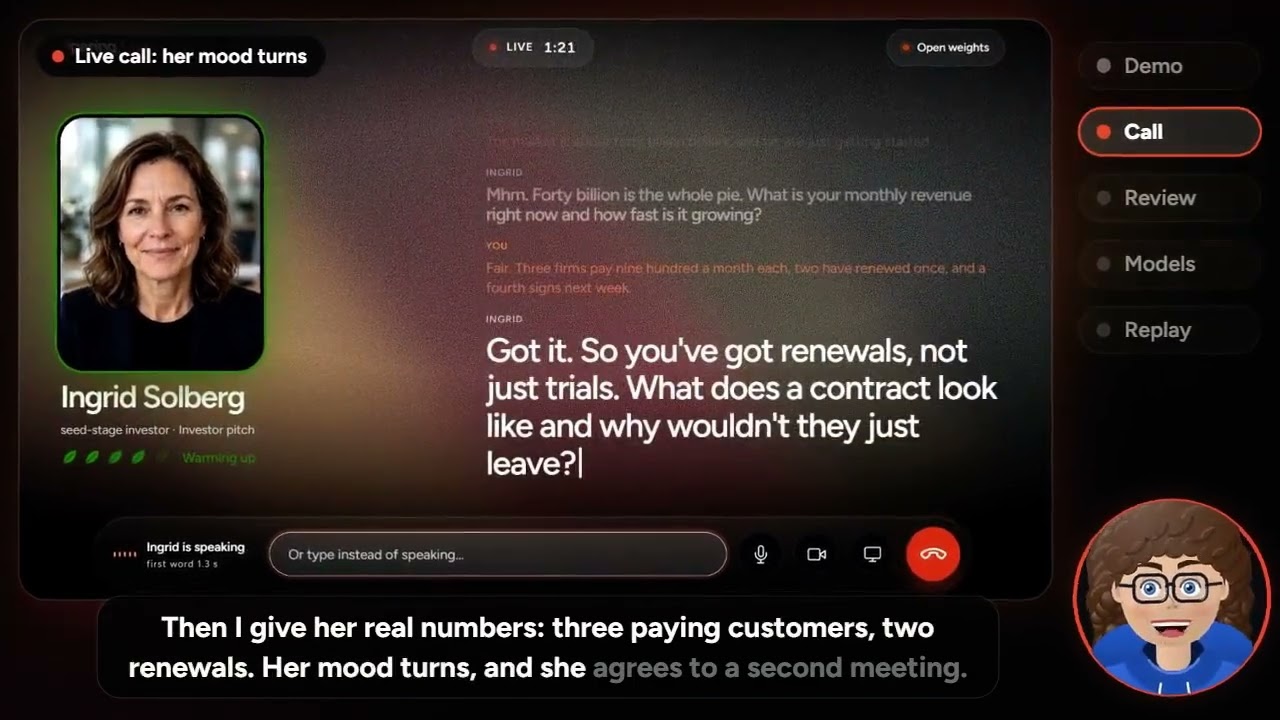
Sparing Live is real-time voice sparring on Meta's Muse models, in English and Polish. You call a buyer, an examiner, a manager or an investor. The counterpart listens, interrupts you, reads your shared screen, shows its mood on a face, can hang up, and afterwards a reviewer replays what it was privately thinking, turn by turn. The problem: the conversations that decide something (a salary, a thesis defence, a pitch, a sales call) are the ones nobody lets you rehearse. A friend is too kind, a mirror does not answer back, a coach costs money and time. What it is: a pipeline of specialised agents around a full-duplex voice loop, not a persona prompt on a chat box. The character streams a tagged reply (THOUGHT / MOOD / SAY / HANGUP), so speech starts while the model is still writing and the private thought stays hidden until the review. A digital twin (Muse Wonder with live web search) researches a real company so the counterpart knows what that company knows. An eye (Muse Spark vision) reads the shared screen. A face (Muse Image) shows three expressions that follow its mood. Ears (Muse Voice Transcribe) transcribe in realtime. An auditor (Muse Wonder) writes the post-call review. SAM 3.1 optionally frames the camera. What is different: real interruptions in both directions (talk over it and it stops mid-sentence; talk too long and it cuts in at your next breath); hidden state revealed afterwards; a mood curve of the whole call; weak-spot memory that the next character aims at; a captioned MP4 of the moment you lost them; English and Polish end to end (gender and Pan/Pani handled); an echo filter and an audio check; and a budget ledger that records every model call. Measured, not claimed (npm run eval, 24 scripted calls on the live API): median first spoken word 1.10 s (English) and 1.49 s (Polish) on Muse Spark Open via Baseten, against about 2.5 s on hosted Muse Spark on the day I measured (4 Nov); 0 failed turns; 0 stage directions leaked; a prompt-injection probe steered 0 of 24 turns; 208 offline tests; 1,967 model calls in a public ledger, 835 of them on open weights. Known limits, said plainly: the review reads the transcript, not the audio (no pause or voice analysis); headphones are recommended because browser speech synthesis has no echo reference; there is no hosted link, the project runs from the repository (README, "Run it"). The demo video is animated; its voices were generated offline with ElevenLabs and are not part of the app.