BioCompiler
Built at Meta Global AI Developer Hackathon · Oct 26, 2026 · Remote
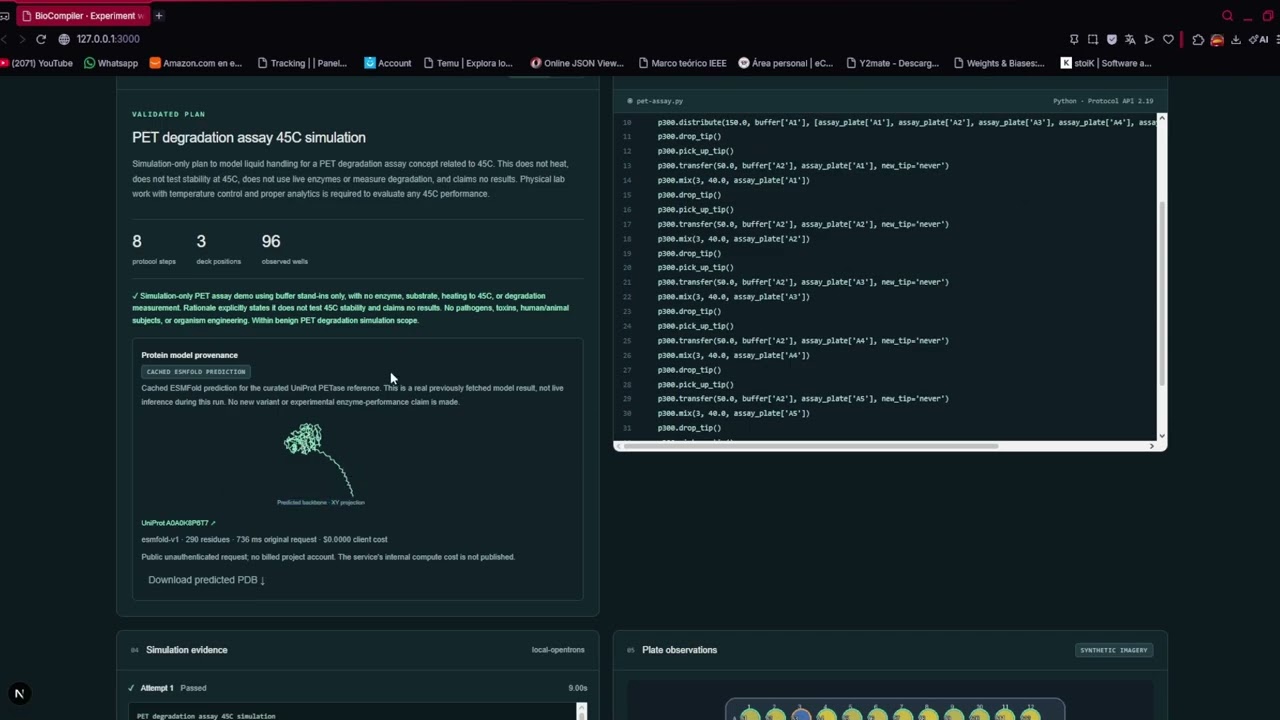
BioCompiler Engine turns a plain-language research goal into a lab-robot protocol that has already passed a real simulator, before anyone touches a pipette. Writing liquid-handling protocols for robots like the Opentrons OT-2 is slow and error-prone. A wrong well name, an incompatible tip or an overfilled well only shows up when the run fails. BioCompiler closes that gap. A researcher types a goal (our demo: a PET-plastic-degrading enzyme assay at 45 °C). Muse Spark, through the Meta API, plans a typed experiment specification. The spec is checked against deck slots, well capacities, pipette ranges and tip compatibility, then compiled into Opentrons Protocol API code. That code runs in the real Opentrons simulator. If it fails, the error goes back to the compiler for a fix, with at most three attempts. SAM 3.1 segments all 96 wells in plate images and tracks colour over time, flagging wells that lag behind for human review. A cached ESMFold prediction shows the reference enzyme’s structure. A fail-closed scope gate refuses off-topic or unsafe requests before any planning happens. Scope, stated plainly: BioCompiler is simulation-only. No physical robot or wet-lab experiment is connected, the plate images are synthetic, and the recorded demo uses offline mock responses. Authenticated Muse Spark and SAM runs, including a full live compile, are recorded separately in the repository.