Hype AI
Built at Meta Global AI Developer Hackathon · Oct 26, 2026 · Remote
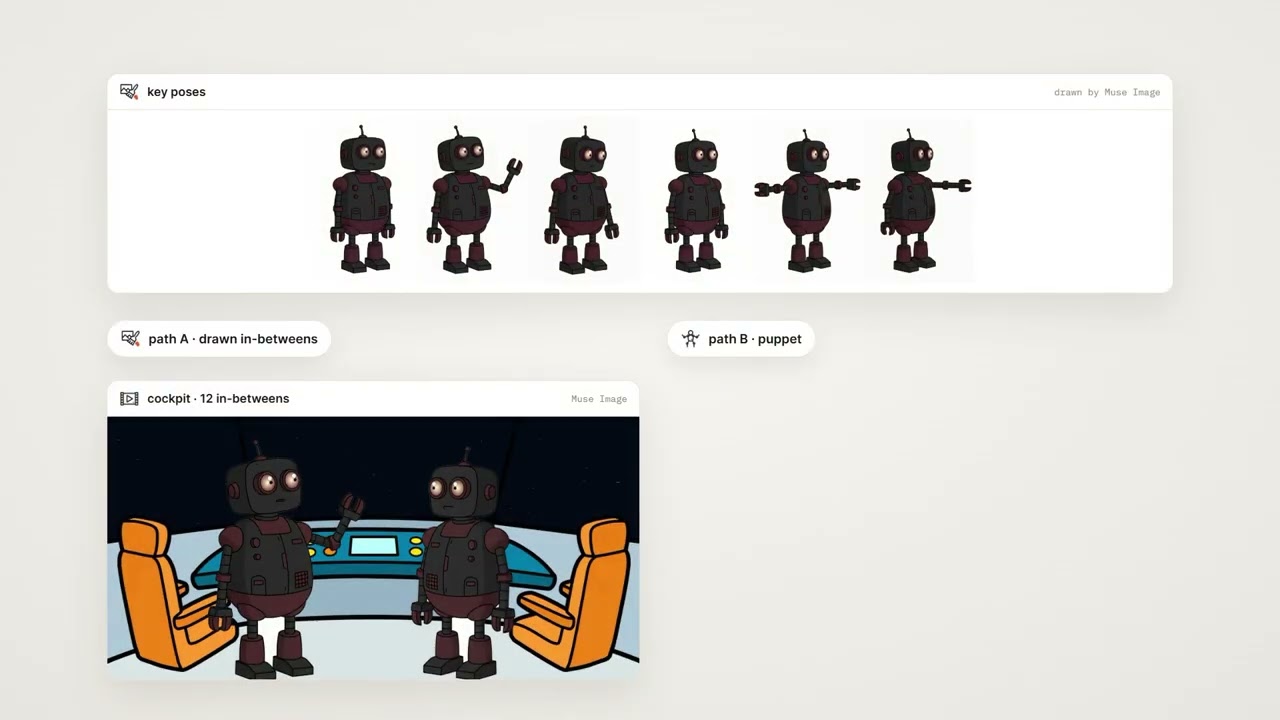
I love watching animation, but making it has always been out of reach for me. Professional tools like Toon Boom Harmony cost money and take hours to learn, and even with them, one person cannot draw, time and voice a whole scene alone. So I built Karagoz: I write the script, and the studio makes the animation. Karagoz is an AI animation studio built on Meta's models. You give it a short script, reference drawings of the characters and a location description. A team of Muse Spark 1.3 agents then makes a finished 2D limited-animation shot: flat color, black outlines, 1920×1080 at 24 fps, with voices, lip-sync and in-betweens. One command, karagoz run, takes it from script to MP4 with no one touching it. There is no video model. Muse Image draws only the key poses, the moments that carry the acting, and the engine decides how every frame between them is made. The agents work like the departments of a real studio. The Director writes the shot list: who speaks, who stands where, who faces whom. Continuity tracks each character from the start of a shot to its end. Layout plans the key poses and describes every in-between. The Timer builds the exposure sheet and anchors each pose to a word in the audio. Muse Image draws the location, and SAM 3.1 finds the chairs, the window and the floor so the engine can measure the room. MMS-TTS records the voices with a timing for every letter. Three rules hold the studio together. Agents write names, the engine writes numbers: "Wonder stands at the left chair, facing Spark" becomes pixels in the coordinate engine, never in a prompt. Time comes from the audio, never from a guess: every pose change lands on a word. Errors go back to whoever made them: when a step fails, the agent that wrote the file gets a retake note naming the step, the file and the field. Between two keys, the engine picks one of two paths. Muse Image can draw each in-between from its neighbouring keys, which works for any character and any move. Or the engine uses a puppet: five reference views are cut into 19 parts with measured pivots and joint limits, the puppet is fitted to each drawn key, and it draws the frames between them with no image calls, so the design cannot drift. If more than 3% of a drawing is left unexplained, that drawing goes back to the image model. Faces are patches, not redrawn frames. Muse Image changes only the mouth or the eyes, the engine cuts out what changed, and eight mouth shapes follow the letter timings. Karagoz measures itself. Every step records its own time, and a second run redraws only what changed. The puppet fit was made about 4× faster (acceptance run 1528 s → 400 s) with bit-identical output: 0 pixels different.