xMemory Hunters
Built at Meta Global AI Developer Hackathon · Oct 26, 2026 · Remote
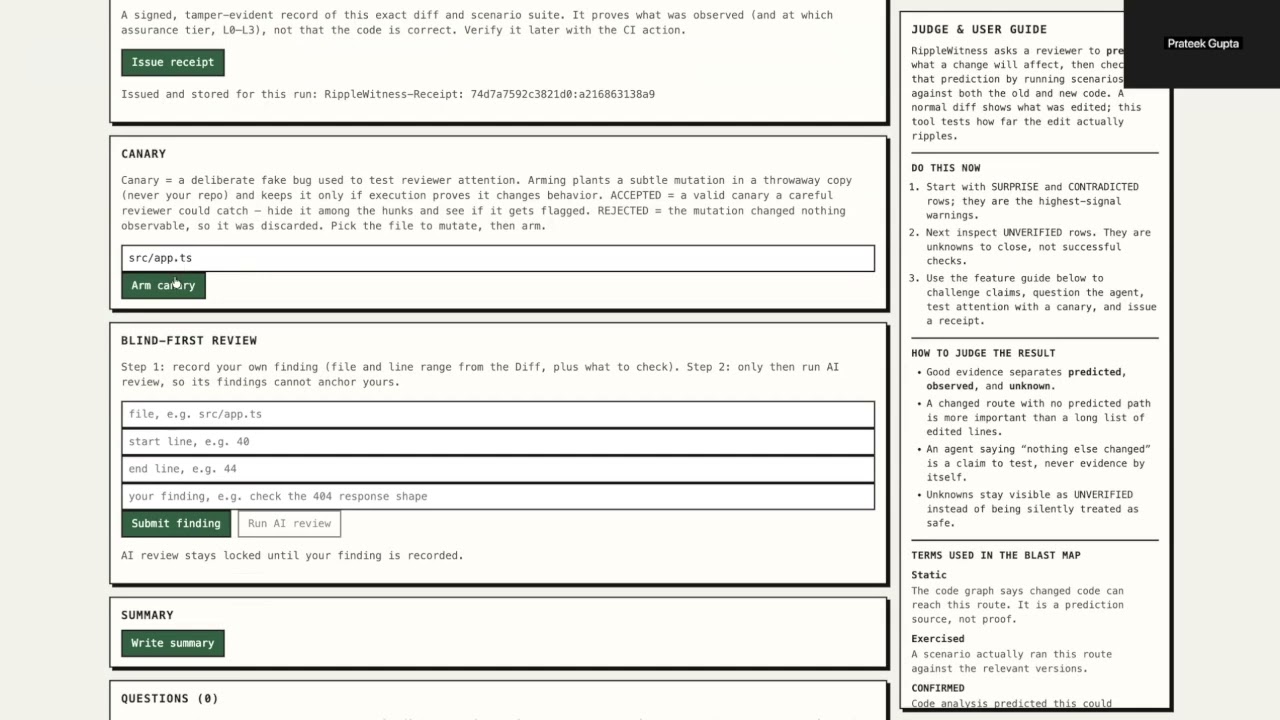
RippleWitness is a project I built to address a growing problem with AI coding agents. They can generate large amounts of code very quickly, but reviewing those changes and ensuring they haven't broken something elsewhere in the application is becoming increasingly difficult. For example, an agent might claim it only changed the checkout functionality, but that change could indirectly affect sales reports through a shared helper, an event bus, or a configuration change. A normal diff won't necessarily reveal these side effects. RippleWitness goes beyond traditional code reviews by combining static impact analysis with differential execution replay. It takes a repository and two versions, builds a static impact graph, and runs the same curated scenarios against both versions to identify what actually behaved differently. It then categorizes routes as CONFIRMED, CLEARED, SURPRISE, or UNVERIFIED, helping reviewers focus on actual changes without overlooking potential risks. One of its key features is the Predict-the-Ripple Gate, where reviewers predict the affected parts of the application before seeing the execution results. Their predictions are then evaluated using precision and recall, with missed changes classified by cause. It also includes a Cross-Examination Engine that extracts claims from AI-generated summaries and verifies them against execution evidence, marking them as SUPPORTED, CONTRADICTED, or UNVERIFIABLE. Contradictions generate evidence-backed questions that can be sent to a read-only agent session. Other features include blind-first AI reviews, Canary Hunks that introduce deliberate mutations in a separate repository copy to test review effectiveness, and tools such as scenario generation, HAR import, and causal ablation to investigate and close coverage gaps. Once a review is complete, RippleWitness generates a tamper-evident receipt tied to the exact diff and scenario suite, which can be verified locally or through CI. It also provides evidence-only PR summaries and plain-language explanations of code changes. An important design decision is that all verdicts, scores, impact statuses, and receipts are computed through deterministic code. The LLM assists with claim extraction, explanations, and question generation, but never decides whether a change is safe or unsafe. The goal is to make code reviews more evidence-driven, catch indirect regressions, expose testing gaps, and reduce blind trust in AI-generated summaries. Instead of trusting what an AI agent says it changed, RippleWitness helps you verify what its changes actually did.