reforge
Built at Meta Global AI Developer Hackathon · Oct 26, 2026 · Remote
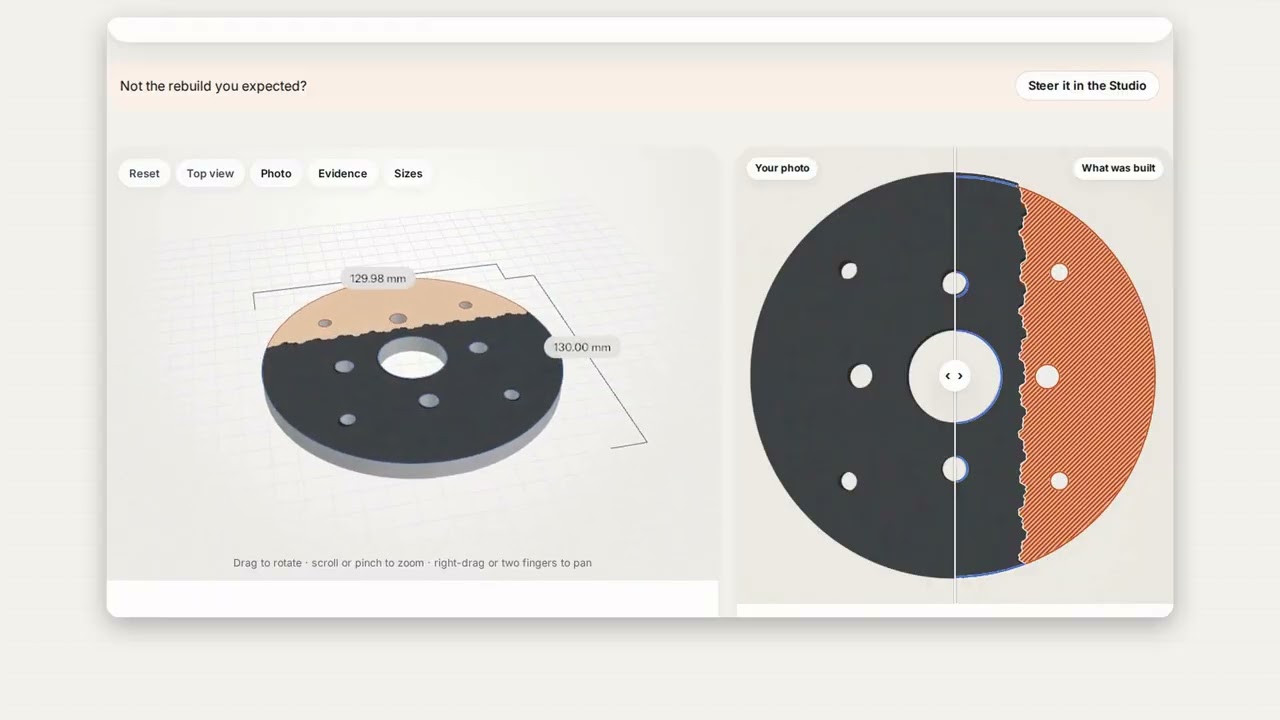
Re-Forge rebuilds broken flat parts from one phone photo. You lay the broken piece on a printed calibration mat and enter its thickness. Re-Forge then measures the surviving outline in true millimetres, and Meta's SAM 3.1 and Muse Spark find the part and read the damage: what the object is, whether it is a flat part, which edges are fractures, and which mirror axis can rebuild the missing piece. Every AI claim is checked against the geometry before anything is rebuilt. The result is a validated, watertight STL for your slicer and an editable OpenSCAD file. Every dimension is labelled measured, rebuilt by symmetry, or uncertain, with a 2σ estimate from the photo's own error budget. It solves the gap between "a small plastic part broke" and "I have a file I can print". Most people have no CAD skills, and generic image-to-3D tools invent geometry without saying which parts are real. Re-Forge refuses what it can't support: 3D objects, varying thickness, a trace that is only part of an object. It tells you why instead of producing a confident-looking but wrong model. It also exports the flat pattern (DXF, SVG at true size) for parts that are cut rather than printed, such as a gasket or a shim. On a real photo of a real gasket, placed on the mat at a known size, it measures within 0.012 mm and traces all nine holes without inventing anything, even when the AI once wrongly called it broken. On a real photo of a broken chain sprocket, it rebuilds the missing half within 0.18 mm live (0.08 mm offline). On a rendered broken flange, it rebuilds the missing side within 0.015 mm and infers the two lost bolt holes within 0.005 mm. On a first real part photographed on the printed mat, the height came out within 0.41 mm of the caliper reading.