Avinash Sharma
Built at Meta Global AI Developer Hackathon · Oct 26, 2026 · Remote
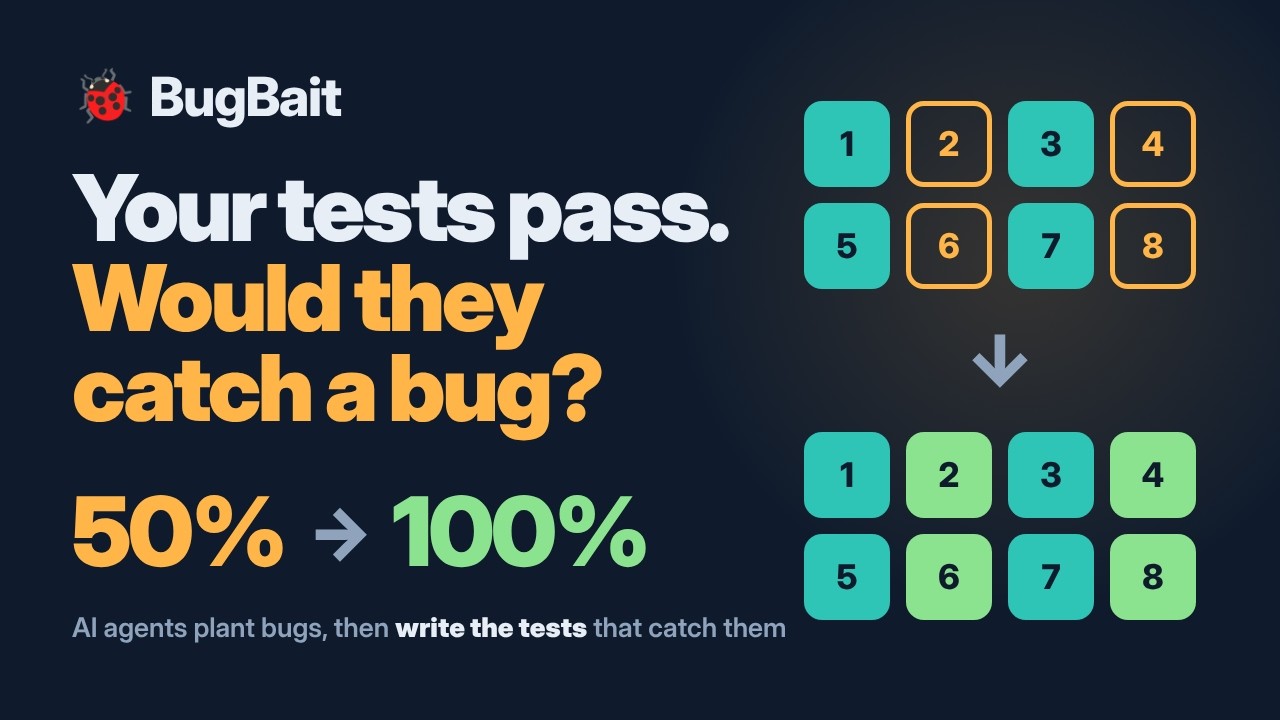
Every team trusts its test suite, but passing tests and high coverage only prove that code ran, not that the tests would catch a bug. Most teams have no idea how many real mistakes their tests would miss until one reaches production. BugBait answers that question with two AI agents powered by Meta’s Muse Spark. The Saboteur studies your code and existing tests, then plants small, realistic bugs: an off-by-one, a flipped condition, a wrong operator, a dropped check. It rates each bug’s realism and filters out artificial ones. Every bug runs against your full test suite in a throwaway sandbox, so your files are never touched. Any bug that gets through is a real gap. The Fixer then writes a test for each gap. BugBait never trusts the AI blindly: a test is kept only if it passes on your original code and fails on the buggy version. If not, the Fixer gets the test output and retries. The result is a before/after score, a ranking of the weakest spots in your code, and verified tests ready to merge. On my own Java Spring Boot e-commerce service, my tests caught only 4 of 8 planted bugs, including a string comparison bug that would let sellers cancel orders they shouldn’t. In 105 seconds, BugBait raised that to 8 of 8 with four verified tests. On inflection, an open-source library with 455 tests, the existing tests caught just 1 of 8; BugBait closed every gap. BugBait works on any GitHub repo or local folder in 10 languages: Python, JavaScript, TypeScript, Go, Java, Rust, Ruby, PHP, C# and Kotlin. It includes a live web dashboard, a command line, one-click pull requests (it forks first, so nobody gets surprise PRs), a GitHub Action that scores every PR, and a pre-commit hook. Either agent can switch to an open-weight model. Coverage tells you what code ran. BugBait tells you what your tests would actually catch.