Abstain Labs
Built at Meta Global AI Developer Hackathon · Oct 26, 2026 · Remote
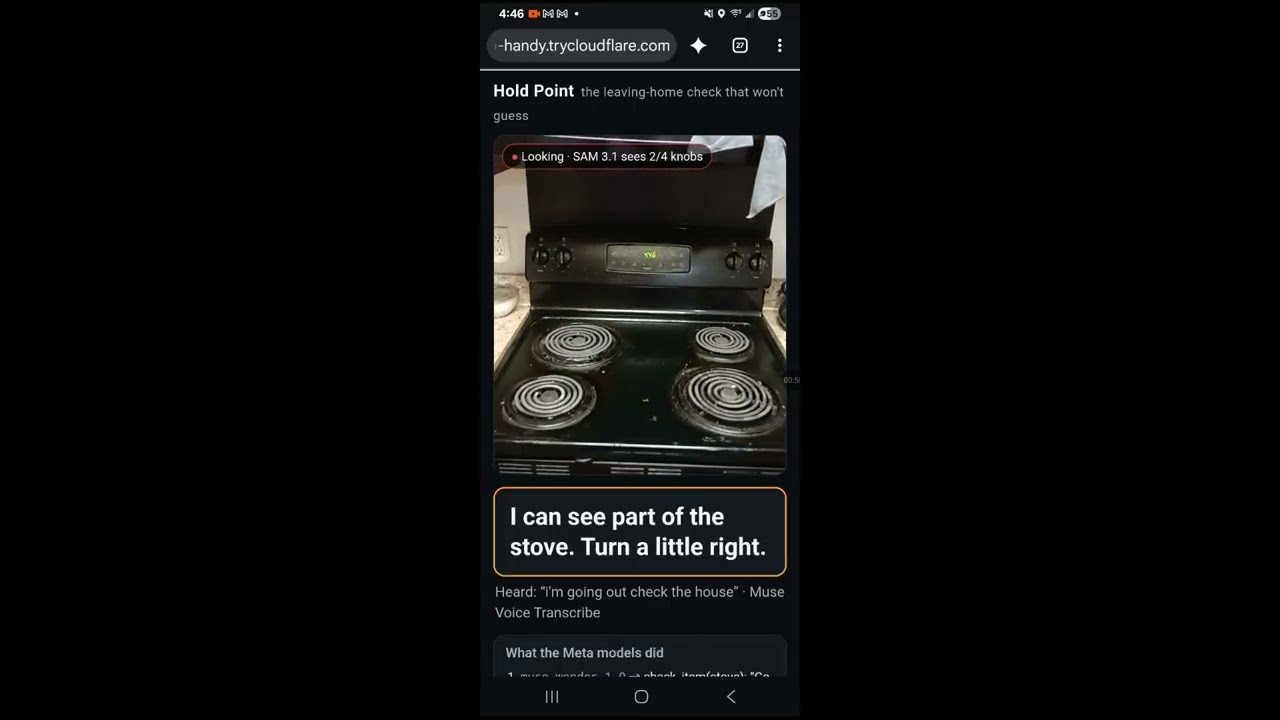
Hold Point is a home assistant designed for Meta smart glasses (demoed on a phone today) that won’t guess, built for blind, low-vision and older people. Most of us leave home with a quick look: stove off, keys in hand. Without sight, every one of those checks is a guess, and if you live alone there’s no one to double-check. Cooking is the leading cause of US home fires, and unattended equipment is the top factor. AI assistants could help, but they guess too. In our tests, plain Muse Spark said “all burners off” 64% of the times a knob was actually on. Say “I’m going out, check the house” and Hold Point guides the camera to the stove. Two Meta models act as independent witnesses. Muse Spark reads each knob. SAM 3.1 finds each knob, and geometry measures its angle against the user’s own all-off setup. A deterministic decision layer, plain code with no AI, says “off” only when both agree over several frames. Otherwise it says what it can’t see and how to move the camera: “I can see part of the stove. Turn a little right.” If a knob is on, it says so, waits for the user to turn it off, and checks again. Once the stove is verified, it says: “You’re all set. Don’t forget your glasses, wallet and keys.” Ask “Where are my keys?” and Hold Point answers from what the camera has seen while you moved around. It gives an exact place when a known landmark was in view; otherwise it says what it saw and that it isn’t sure. It never invents a place. “Guide me to my glasses” walks you there, and it says “found” only when both models agree on a live view. Results: 20 real stove checks plus 80 copies made dark, blurry, far away or glary. Plain Muse Spark was confidently wrong 54% of the time; Hold Point 0%. It answered when it could prove the answer, and otherwise refused with a fix. The honest cost: it refused 9 of the 20 real checks. That’s one stove and one tester, so it shows behaviour, not a guarantee. Everything was built during the event and works live on a phone today, with the camera standing in for smart glasses. All code is on GitHub with 140 tests and the full evaluation.