Cortex Crew
Built at Meta Global AI Developer Hackathon · Oct 26, 2026 · Remote
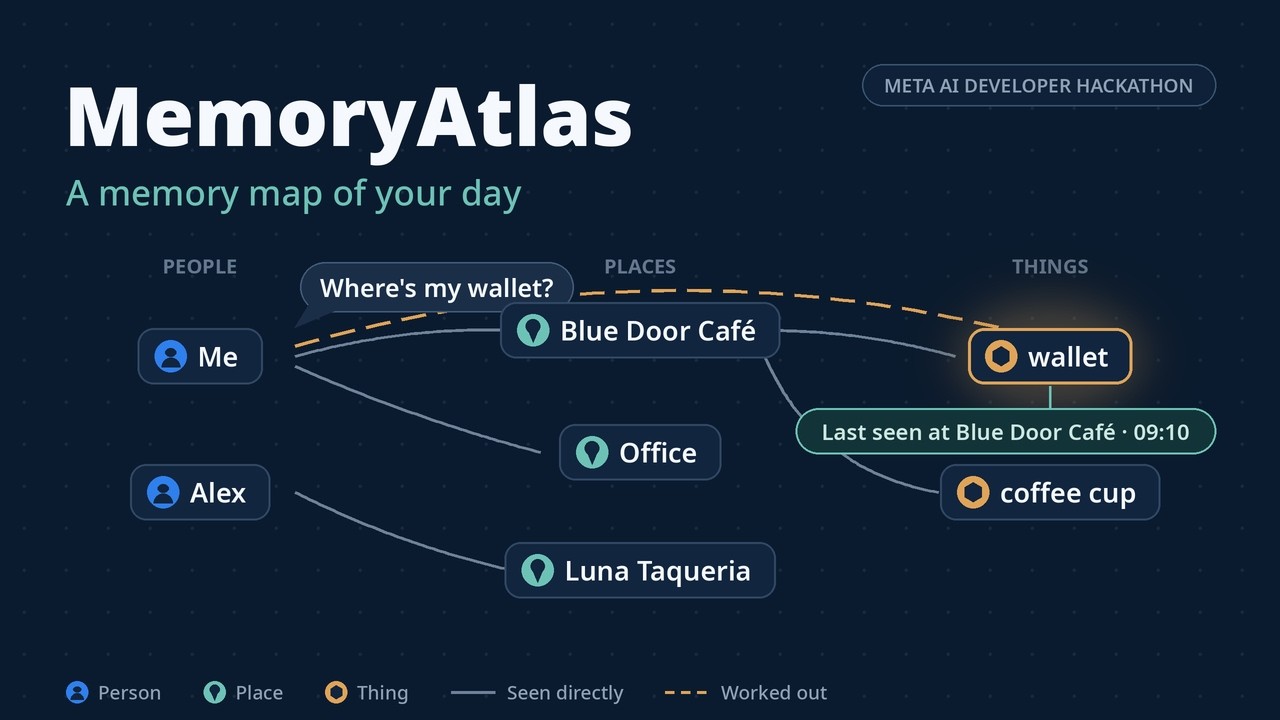
MemoryAtlas - An AI Memory That Knows What to Remember, Why It Remembers, and When to Forget. What if you could search your real-life experiences as easily as you search the internet, without permanently storing the photos, videos, or recordings that captured them? We forget where we placed our belongings, what someone promised during a conversation, or the name of a place we encountered. These memories are fragmented across what we see, hear, and experience. MemoryAtlas turns these fragmented observations into an intelligent, privacy-first episodic memory graph. Using Meta's multimodal AI models, it processes consented photos, video, audio, notes, and calendar information to construct interconnected memories of people, objects, places, conversations, and events. Every memory retains the evidence, temporal context, and permissions supporting it. MemoryAtlas goes beyond conventional AI retrieval in three ways: 1. Reconstructs fragmented experiences: It connects information across different sources to answer questions that no single observation can answer. For example, a conversation mentions a restaurant recommendation without naming it, while a later storefront photo reveals its identity. 2. Maintains self-correcting memories: When new evidence appears, MemoryAtlas updates its conclusions while preserving historical observations. A wallet seen at a café in the morning and in a car that evening is no longer reported as last seen at the café. 3. Enforces verifiable forgetting: When consent is withdrawn or a memory is deleted, deterministic privacy controls remove dependent information from the graph, search indexes, caches, chat history, and exports. Seven automated leak checks and a deletion receipt validate this process. Independently supported memories remain available. Raw images, video, and audio are not permanently stored by our application. Only structured textual information is retained, subject to consent and privacy controls. Measured results: In an internal 40-question evaluation, averaged across three live runs, MemoryAtlas handled 39.7 questions correctly, compared with 24 and 30 for two retrieval baselines using the same underlying model. The evaluation included a rerun after a fix and is not presented as a blind benchmark. Built during the hackathon, MemoryAtlas demonstrates how multimodal AI can become a trustworthy personal memory layer: one that connects experiences, explains its evidence, corrects itself, and respects the right to forget. **Live application:** https://memoryatlas.209-145-49-232.sslip.io