OVN Nexus
Built at Meta Global AI Developer Hackathon · Oct 26, 2026 · Remote
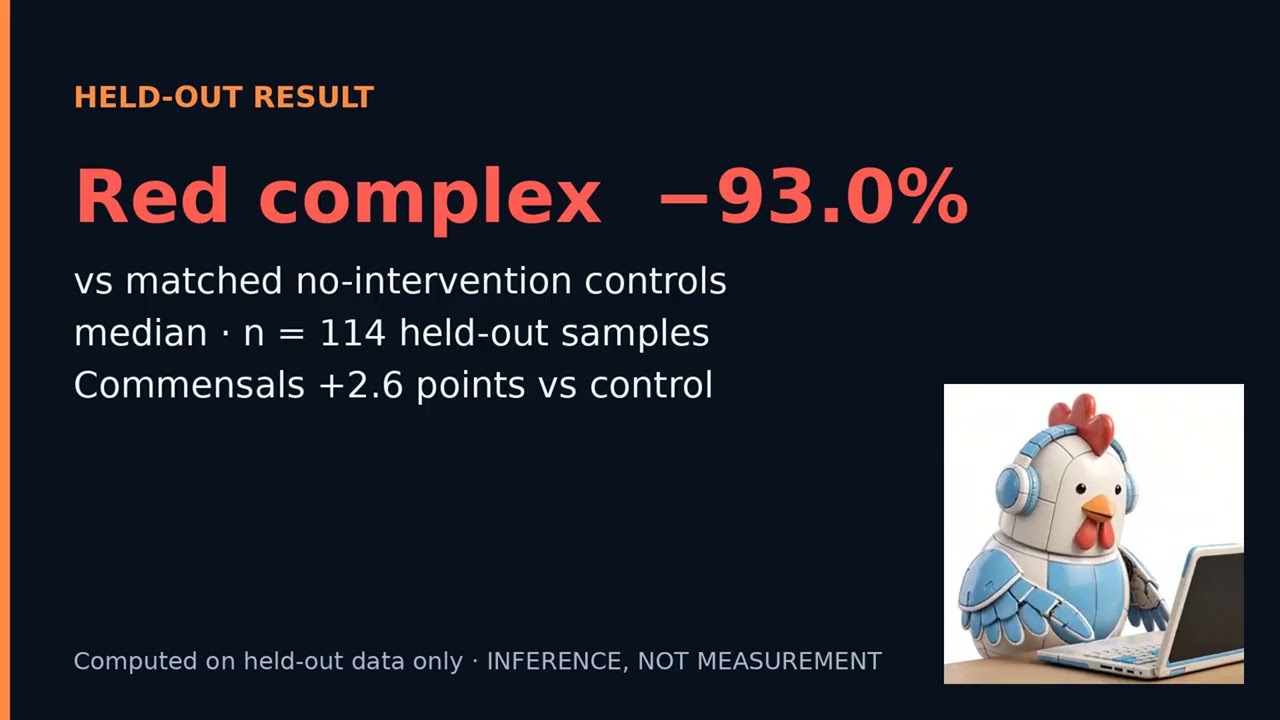
The Bioreactor Cube is a working model of an oral biofilm — the bacterial community that grows on a tooth — built so an intervention can be tested in the model before it is tested in an animal or a person. Tissue engineering and formulation science share a failure mode: the first honest test happens in a living system, months in. The cube replaces that first test with a simulation that carries its own evidence labels. What we built: a mechanistic biofilm simulator (the Fasolati Cube lab, public and MIT-licensed) that turns a static 8-layer oral microbiome schema into a running dynamical system — spatial grid, agents, and a reaction–diffusion chemistry solver — with ABC-SMC calibration, causal counterfactuals, and an interactive local lab. A bounded Meta research agent sits on top: it inspects runs and requests experiments through explicit tools, and every completed run returns numerical checks and reproducible provenance (input, output, and code hashes). The deterministic solver needs no API key; the agent layer is where Meta's models work. Demo A feeds the cube real data: Human Microbiome Project plaque samples (622 samples, 208 participants) mapped onto the cube's 19 taxa — 17 present, 2 reported absent and never filled in. The split was by participant (zero overlap), and the held-out set (116 samples, 42 participants) was sealed with a recorded hash before scoring. On 116 sequestered held-out HMP plaque samples (114 with red complex present in the seeded reconstruction), a single declared phage pulse at the cube's default setting reduced red-complex share by a median 93.0% (IQR 92.9-94.9) against matched no-intervention controls after 60 ticks, with commensal share a median 2.6 percentage points higher than control; computed on held-out data only - inference, not measurement. A flat non-spatial proportional baseline scored 92.6% on the same set, so on the kill metric the cube does not meaningfully differ - its divergence from the baseline is temporal, in Demo B. Demo B runs an intervention pulse at different biofilm succession stages and reads out when the treatment window opens and closes. Fired at succession stages 1-4, the same pulse's effect persists (median red-complex reduction versus control 30 ticks later: 47.5% at stage 1 falling to 26.0% at stage 4); fired at stage 5 or later it does not persist (4.9%, then 0.4% and 0.4%), even though the immediate kill stays ~92-94% at every stage - the window closes when stage-5 entry opens pocket-reservoir immigration and spread for the red complex. Discipline: the proposer never computes the headline number; scoring criteria were locked before the held-out data was opened; every claim is labeled measured, computed, or inferred. Reconstruction is inference, not measurement — the demo says so on screen.