StroboPhone
Built at Meta Global AI Developer Hackathon · Oct 26, 2026 · Remote
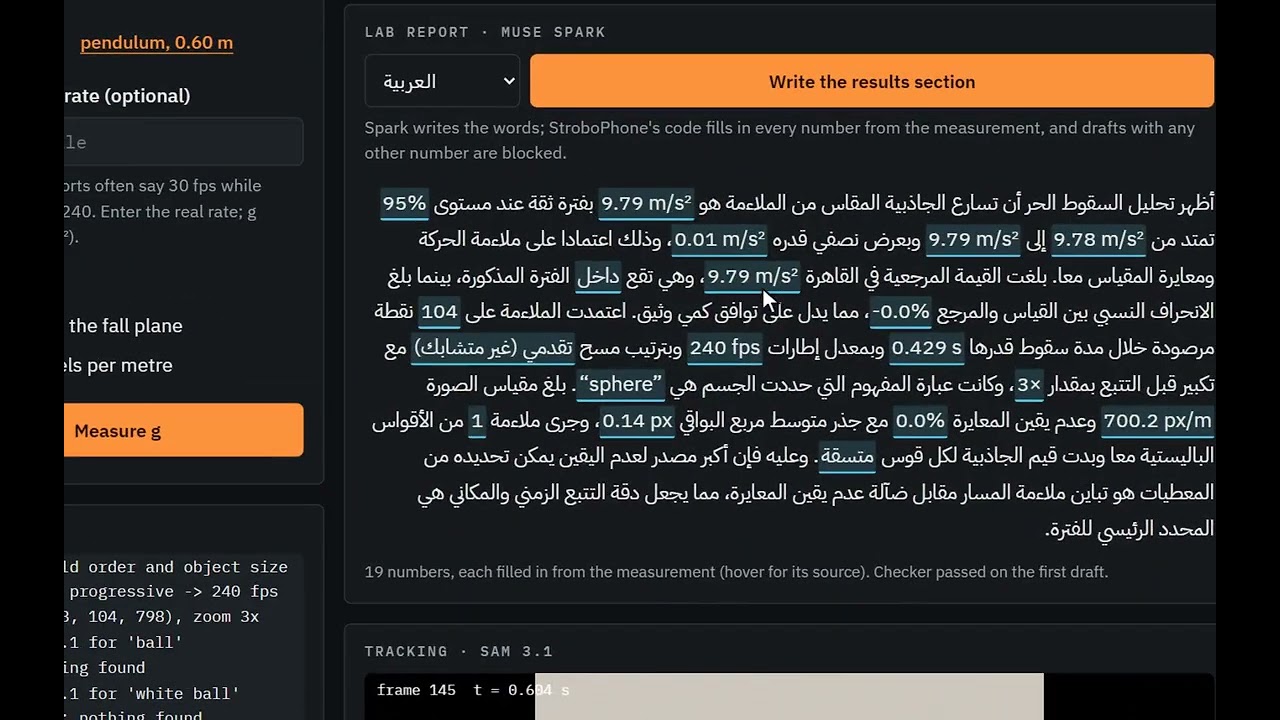
StroboPhone turns a phone video of a physics experiment into a measurement with an honest 95% interval. Measuring g at school normally needs a photogate or ticker timer, which many schools in Egypt don't have. Every student has a phone that films in slow motion. Upload a drop (with an A4 sheet in the frame for scale) or a swinging pendulum (enter only the string length). SAM 3.1 tracks the ball in every frame. Deterministic code then: - fits one parabola across every bounce, or the period with the exact large-amplitude correction; - bootstraps the interval; - flags setups whose arcs disagree. Muse Spark writes the lab report in English or Arabic. Every number in it is filled in by code and traced to its source, and a draft containing a number that can't be traced is blocked. The design comes from a finding. We told Muse Spark that real drop clips were filmed at half their true frame rate. In 54 of 54 answers it still said g ≈ 9.8, and it claimed the ball fell in half the frames it really took, to make the textbook value fit. Measuring the same clips, StroboPhone gave 2.40, close to the 2.45 that physics predicts. The same happened with real pendulum clips. Results on real footage: - 36/36 Apple-π drops measured with no settings; - 0.72 px median tracking error against human masks; - 95% intervals cover 93–97% of the time (simulated drops); - on real 4K pendulum clips (IRIS), g drifts 0.02 m/s² per 10° as the swing dies down, against 0.26 for the textbook formula. The README lists the limits as well. Live demo: https://huggingface.co/spaces/ManuelGamal/strobophone