Jayden Kim
Built at Meta Global AI Developer Hackathon · Oct 26, 2026 · Remote
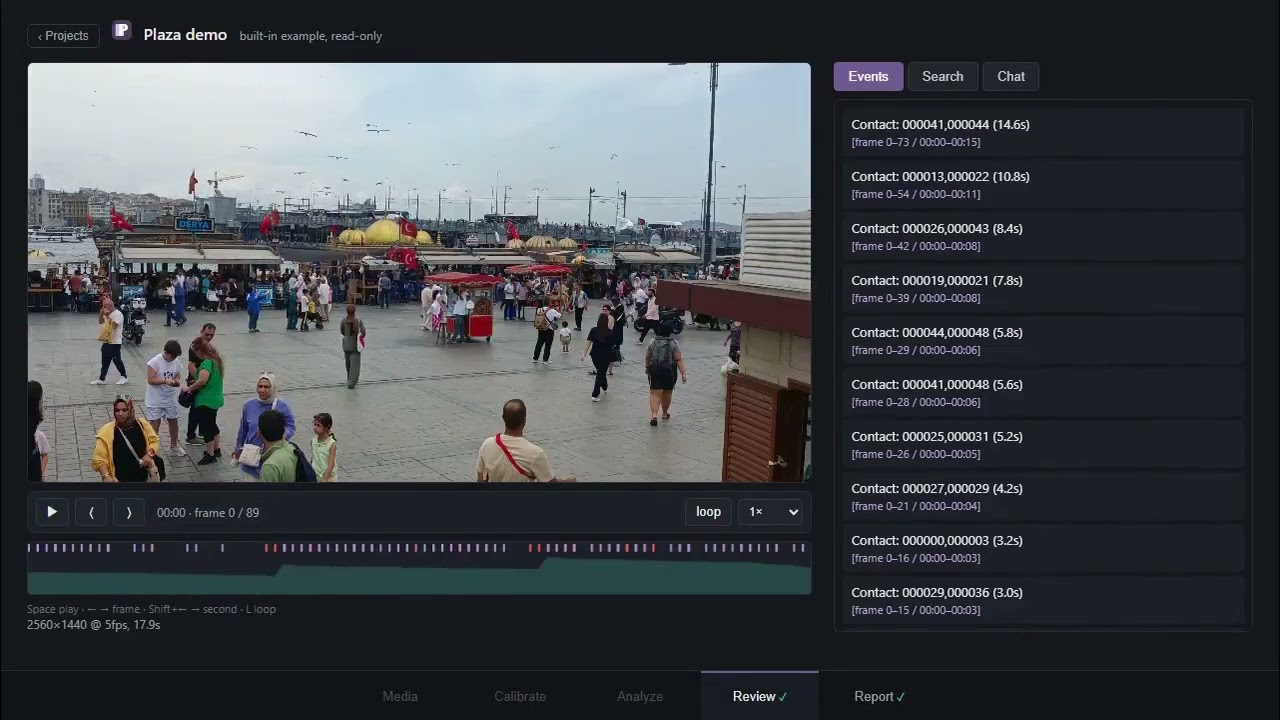
Proxemix turns ordinary video into frame-cited records of how people move, group, and interact. Behavioral researchers, operations teams, retail analysts and investigators all need the same record: who was near whom, for how long, and where crowds formed. Today it is produced by hand, or by annotation software that needs a trained detector and a fixed camera setup. Proxemix reads footage as it is. SAM 3.1 detects and tracks every person, and the frame is subdivided automatically wherever people are too small to detect reliably — more finely in dense areas, not at all where subjects are already large. Each movement path is stored in SQL, and from those paths Proxemix computes proximity, dwell time, density and conversation groups. Every line of output carries the frame it came from, so any finding can be checked against the source footage in one click. It also answers questions. Ask in plain language and Muse Wonder responds strictly from the computed measurements, citing the facts it used; anything it cannot support is withheld before it reaches the screen. And it searches for objects that were never part of the pipeline — a typed concept triggers a fresh SAM pass over the clip's own frames and returns frame-cited hits. On accuracy, stated plainly. Measured against SALSA's hand annotations, Proxemix finds 69% of annotated people. Conversation-group detection scores F1 0.551 working end to end from raw pixels, against 0.721 when true body orientation is supplied — so orientation is the limiting factor, and it is measured rather than assumed. Hours of manual coding become a single pass, for under a dollar of compute per clip.