Nexus Layer
Built at Meta Global AI Developer Hackathon · Oct 26, 2026 · Remote
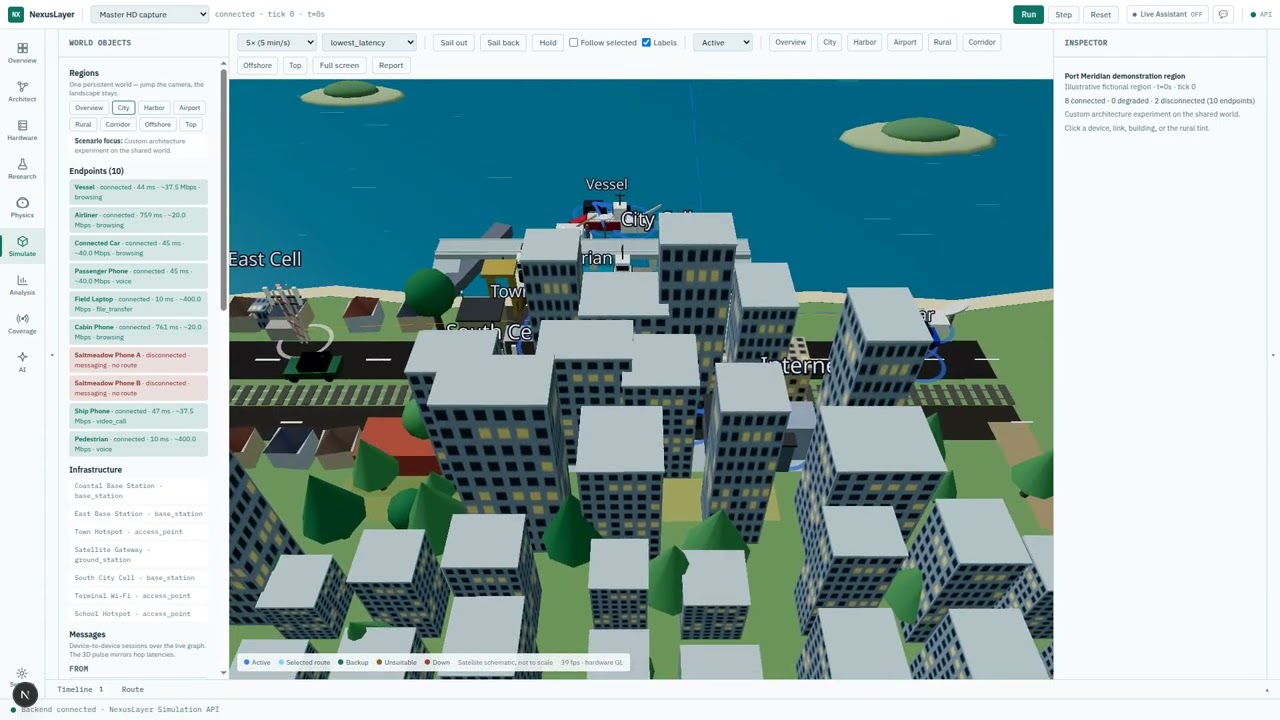
built NexusLayer around one question: What if we could design, simulate, and improve the networks that connect our world before actually deploying the infrastructure? Internet connectivity is still a challenge in many places, especially remote communities, offshore environments, and areas where traditional network infrastructure is difficult or expensive to deploy. At the same time, we have multiple communication technologies, including cellular, satellite, fiber, Wi-Fi, and microwave networks, but designing systems that work together across these technologies is complex. NexusLayer is my attempt to address that problem. It's an AI-assisted network architecture engineering and simulation platform where engineers can design communication networks, configure hardware, simulate network behavior, and investigate new ways of improving connectivity. The platform provides a visual Architecture Studio where engineers can build networks using routers, switches, satellites, towers, gateways, and connected devices. These designs can be explored in an interactive 3D environment containing moving ships, vehicles, aircraft, and other connected systems. The simulation engine evaluates network paths using factors such as latency, bandwidth, reliability, signal conditions, and estimated cost. For example, when a vessel moves beyond cellular coverage, NexusLayer can evaluate satellite connectivity as an alternative and explain the resulting trade-offs. Beyond network simulation, NexusLayer includes hardware engineering, a Physics Lab for exploring communication principles, a research knowledge base, and an AI engineering assistant powered by Meta's models. The AI helps engineers understand network behavior, investigate failures, review research findings, and propose alternative architectures or hardware concepts that can be evaluated through simulation. My long-term goal is to make NexusLayer an engineering environment where we can research and test solutions for places that still struggle with internet access. The current application is a working prototype using simplified engineering models and simulated network measurements. It is not yet connected to real telecommunications infrastructure. Ultimately, I want NexusLayer to help engineers move from an idea to a technically informed network design, evaluate its limitations, and improve it before deployment.