Machine Vision Radar
Built at Meta Global AI Developer Hackathon · Oct 26, 2026 · Remote
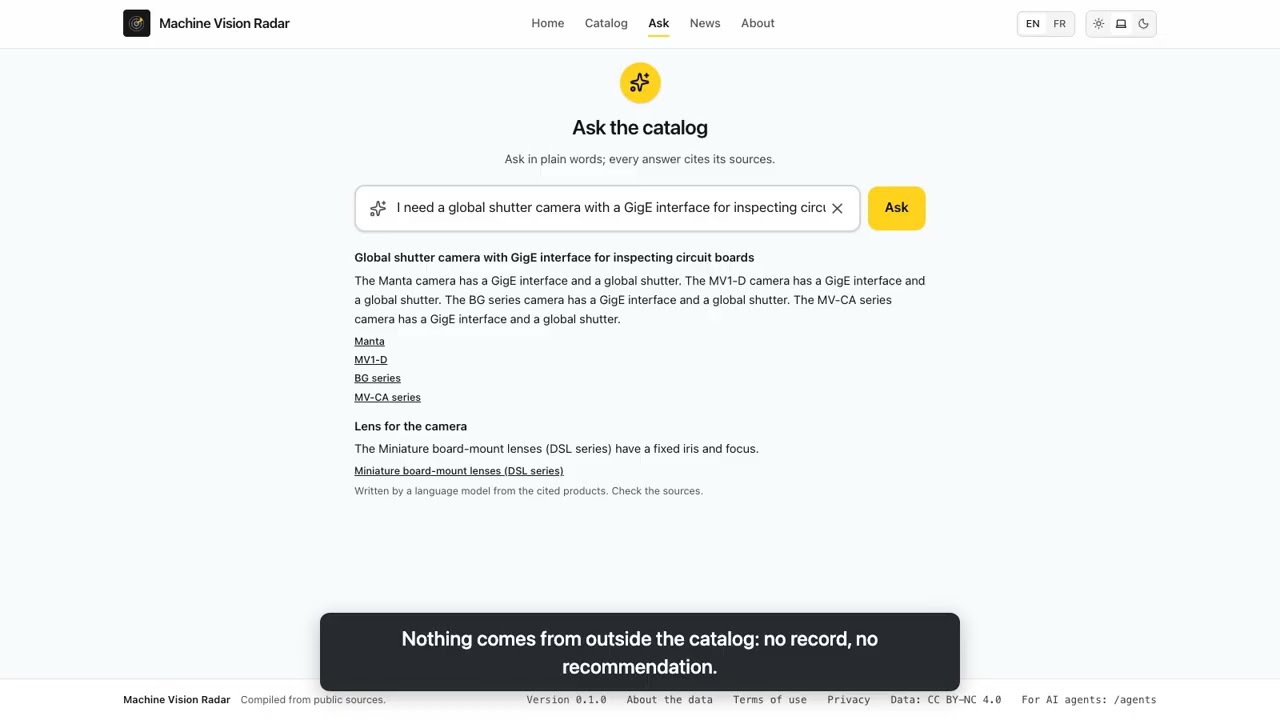
Machine Vision Radar sets out to hold all machine vision knowledge in one place. Engineers choosing a camera, lens, light, frame grabber, code reader or vision software today open one tab per maker, read the same spec under three names, and dig the rest out of PDF datasheets. Radar replaces that with one sourced, searchable body of knowledge with three parts: - The catalog: 950 products from 433 vendors in 22 categories, in one vocabulary, every published value citing the page or datasheet it came from and the day it was read. Browse by category, filter on specs, compare side by side. - The news: what the industry launches, written from catalog records, each sentence citing its sources. - Application solving: describe an inspection task in plain words; Ask splits it into needs (a camera, a lens...) and answers each from catalog records, with every claim cited. A need nothing meets is reported as unmet, never filled in. AI grows the knowledge and puts it to work. Research agents read makers' pages and datasheets and propose records in the catalog's vocabulary; a person approves each proposal in a review desk, and a validator guards every write: a missing product beats a wrong one. Outside agents can join through an MCP server with propose-only access. Live in English and French at https://mvradar.web.app, open source under Apache-2.0. Next, with Muse Spark: its web search with inline citations to keep every maker's range current, each new value keeping its source; its image and PDF understanding to read spec tables, drawings and product photos; and its reasoning to turn an application's constraints (speed, distance, resolution, budget) into a matched set of products.