jairotft
Built at Meta Global AI Developer Hackathon · Oct 26, 2026 · Remote
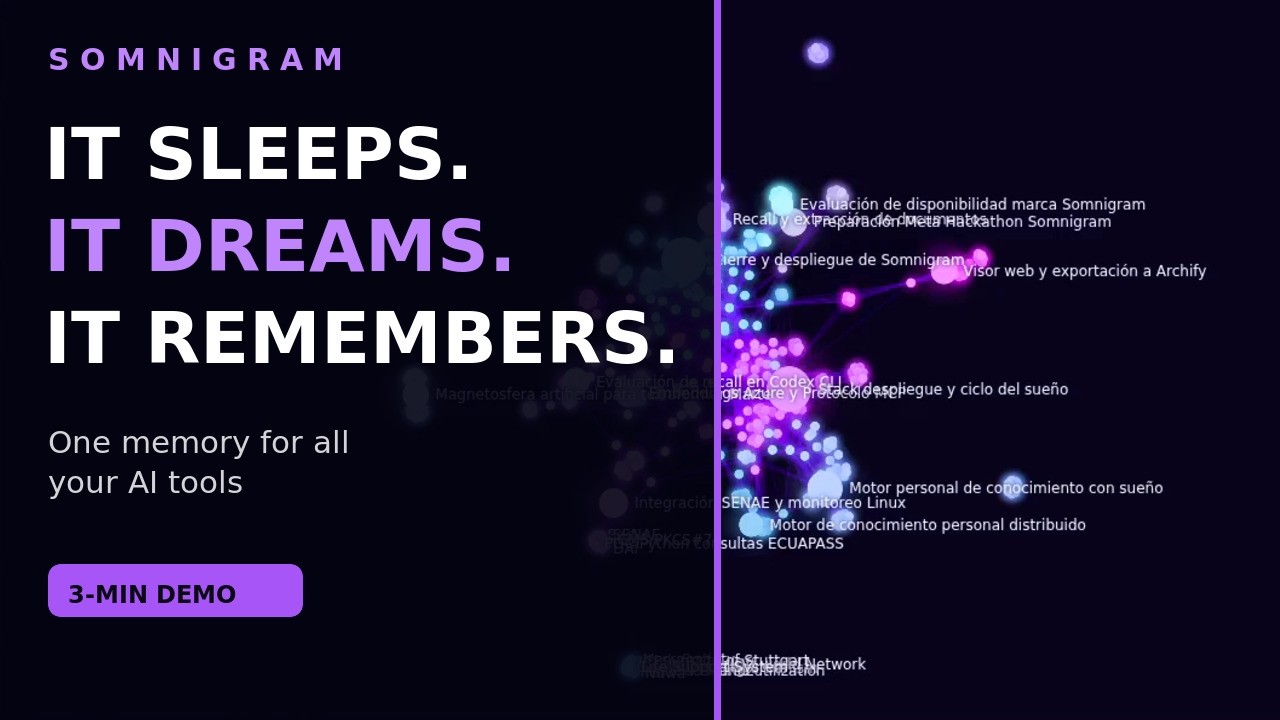
Every new chat can mean explaining your projects, decisions and context again. Somnigram gives you a shared memory across Muse Code, Claude Code, Codex and claude.ai, inspi red by how human memory works. Its fast layer acts as short-term memory: an agent watches a folder on your machine, ingesting new files in seconds. Muse Spark extracts concepts, and embeddings make them immediately recallable. The centerpiece is simulated sleep, reflected in its name: somnia, dreams, plus engram, a memory trace. Sleep consolidates memory every two hours by default, with schedulin g that can be disabled. You can also trigger it through the web "Force sleep" button or the MCP sleep tool. The first pass consumes pending events, deduplicates, resolves and links entities, and prunes. Muse Spark adjudicates uncertain entities. The second pass builds abstraction s through Louvain community detection, creating topics with titles and summaries and linking knowledge across domains. You can watch it dream. Every operation appears as an ordered live event in "What it is dreaming." Counters track nodes created, merges and links created, while the Constel lation graph visibly reorganizes. This is consolidation you can observe. The first measured demo cycle took 2 minutes 19 seconds: 22 merges, 18 communities and 8 topics. Through MCP, assistants retrieve context using hybrid vector, full-text and graph recall, with dates, sources and verbatim quotes. A one-time global instruction prompts rec all at task start; Codex initiated it independently in 14/14 earlier trials. In the live demo, Muse Code saves an idea into the watched folder, and Codex finds it minutes later in another repository without anyone pasting it. Built for the Meta Global AI Developer Hackathon with FastAPI, FastMCP, Postgres and React, Somnigram runs on one VPS you control. Its privacy switch disables external LLM and embedding processing only.