Pip's Classroom
Built at Meta Global AI Developer Hackathon · Oct 26, 2026 · Remote
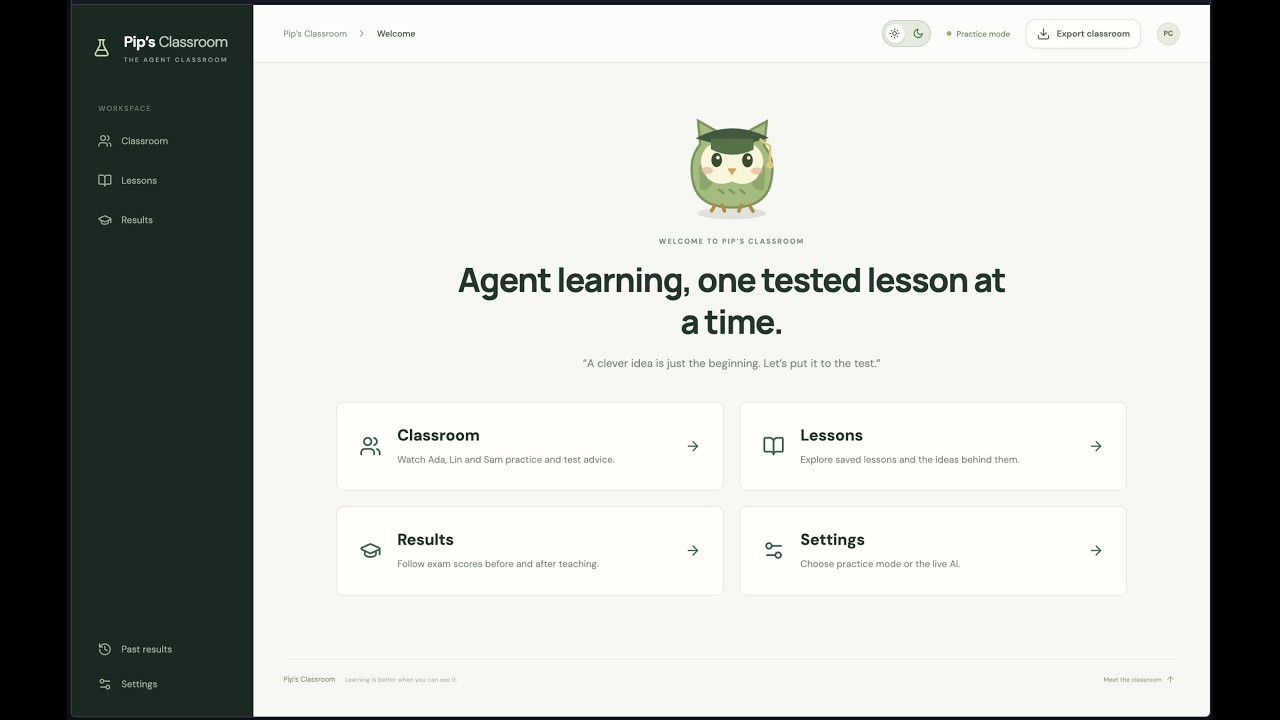
As college students, we have always found that some of our best learning happens when we work together. A classmate might explain something differently, catch a mistake we missed, or share a strategy we had not considered. That made us wonder: if humans learn so much from one another, could AI agents do the same? We built Pip’s Classroom, a collaborative AI learning platform where agents learn from their own mistakes and each other’s experiences to develop better strategies. Instead of solving problems in isolation, three Meta-powered students, Ada, Lin, and Sam, practice independently, build different experiences, and learn from teachers and classmates through a continuous cycle: 1 - Practice: Agents interact with an environment, make decisions, and experience measurable consequences. 2 - Identify weaknesses: An adaptive curriculum tracks each agent’s performance and assigns exercises targeting specific weaknesses. 3 - Collaborate: AI teachers and classmates review recorded decisions and propose strategies based on their own experiences. 4 - Verify: Proposed lessons are tested against existing strategies on targeted and general scenarios. Only those that improve performance without unacceptable regressions are accepted. 5 - Improve: Agents keep verified strategies in versioned memory and apply them to future tasks without retraining the model. What makes Pip’s Classroom different is that agents do not blindly trust each other’s advice. Every proposed lesson must prove its value through independent testing before entering memory, and each accepted strategy is linked to its evidence and verification results, creating a learning history that can be inspected or rolled back. Our prototype uses 2048 as its first environment because its deterministic rules let us measure decisions, reproduce scenarios, and evaluate strategies objectively. We also built a four-condition evaluation framework comparing solo self-review, teacher instruction, adaptive practice, and adaptive practice with peer collaboration, so we can measure whether collaboration adds value beyond individual learning and targeted teaching. The same approach could extend to real-world technical workflows. Imagine AI agents diagnosing a production outage, one specializing in databases, another in infrastructure, and another in application behavior. If the infrastructure agent repeatedly restarts servers during database connection saturation, the database agent could share a better diagnostic strategy from past experience, which could be tested across simulated outages before being applied to new incidents. With major outages sometimes costing organizations over $1 million, preventing even a fraction of repeated mistakes could have significant value. Ultimately, Pip’s Classroom makes collaborative learning a practical capability for AI agents, allowing them to share experience, test what works, and build on verified knowledge instead of repeating the same mistakes.