Vin
Built at Meta Global AI Developer Hackathon · Oct 26, 2026 · Remote
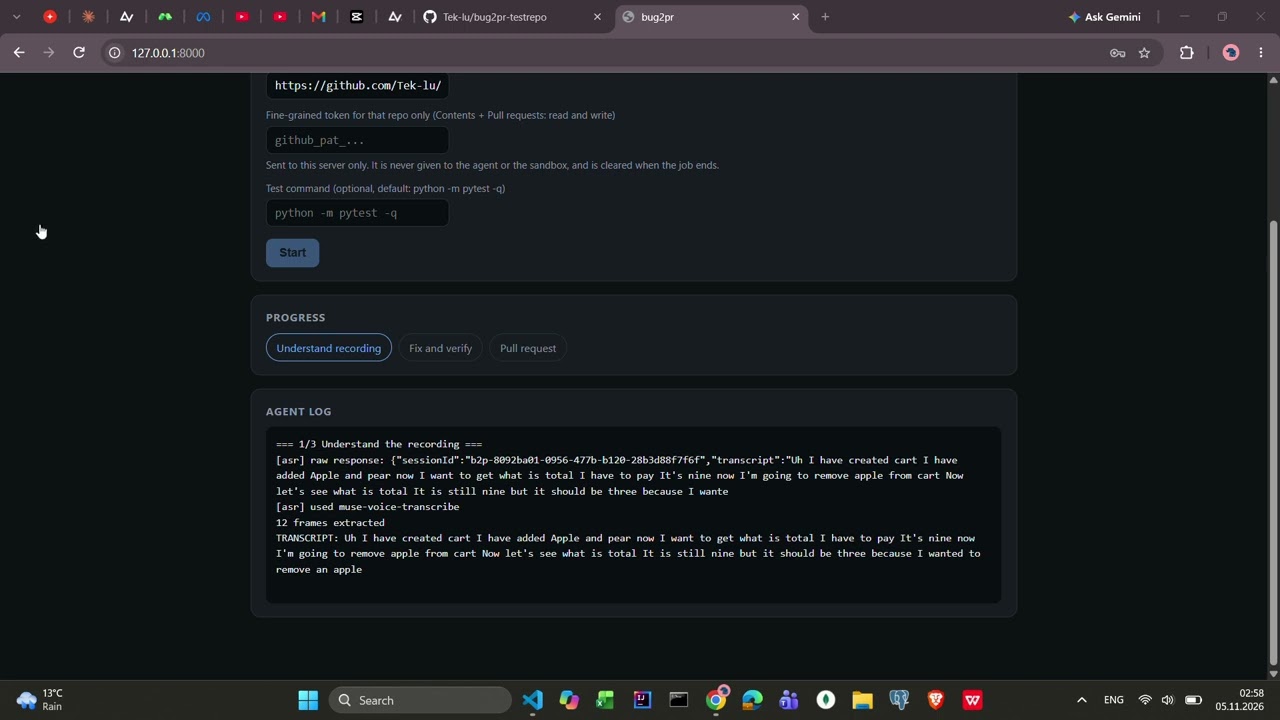
The problem. Bug reports are vague ("the total is wrong"), and developers lose hours reproducing a bug before they can start fixing it. Even when an AI tool proposes a fix, you have to trust it. What bug2pr does. You record your screen while describing the bug out loud, then upload the video and optionally point bug2pr at a GitHub repo. It returns a pull request containing a regression test, a fix, and a description that includes the verification results. How it works. 1. Understand. ffmpeg splits the recording into audio and 12 frames. Muse Voice Transcribe transcribes the narration, and Muse Spark 1.3 reads the transcript together with the frames and writes a structured bug report (symptom, steps to reproduce, expected and actual behavior, suspected area). 2. Fix. A Muse Spark 1.3 tool-calling agent works in a disposable Modal sandbox holding a copy of the repo. It has six tools (list, search, read, edit, write, run tests) and no free shell. It must write a failing test first, then fix the root cause. 3. Verify. The harness, not the model, restores the original buggy code to confirm the new test fails on it. It also checks that the suite passes with the fix and that no existing test was deleted or weakened. 4. Pull request. If every check passes, bug2pr pushes a branch and opens a PR. The user's GitHub token is only used by the server-side clone and PR step. It never enters the sandbox or the agent, and nothing is merged automatically. Meta AI tooling. Muse Spark 1.3 powers both multimodal understanding and the agent loop. Muse Voice Transcribe handles speech-to-text. Muse Wonder can optionally be used to retry runs that fail verification, in a fresh sandbox. Results. I built a benchmark of 12 planted bugs, from one-line errors to multi-file bugs with a hidden second defect. Each bug has hidden tests the agent never sees, so the benchmark catches false positives. bug2pr fixed and verified all 12, with no false positives. Built during the hackathon.Everything in the repository was built Oct 27 to Nov 4, 2026, by a solo developer. The `demo-app/` folder is a small test fixture with a deliberately planted bug, not hackathon work. Limitations. Python/pytest repositories only. Repos that need system libraries or a database need a custom test command. No fork support, and one job runs at a time. Other fields you may see - Tech stack: Python, FastAPI, Modal sandboxes, ffmpeg, GitHub API, Muse Spark 1.3, Muse Voice Transcribe 1.0 - Track: Indie Developer - Problem statement: Build for Your World