CoffeeAndMeta
Built at Meta Global AI Developer Hackathon · Oct 26, 2026 · Remote
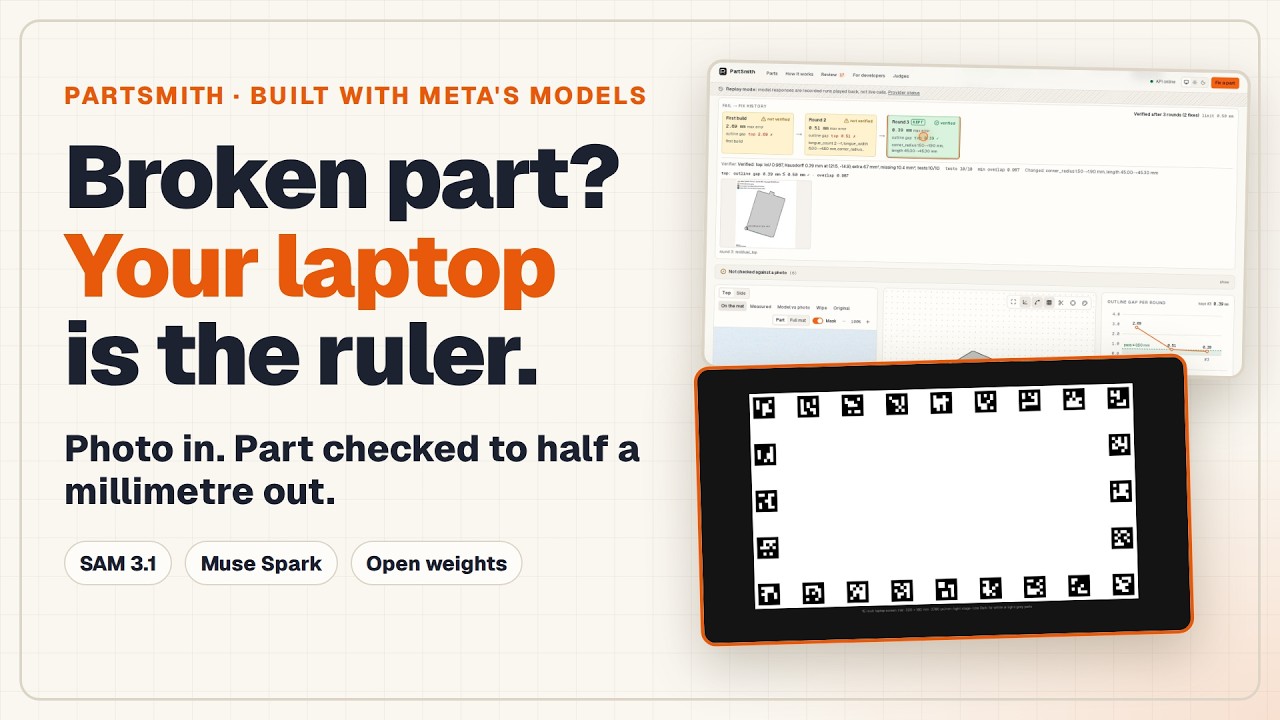
A small plastic part snaps: a remote's battery cover, a cupboard latch, a clip. Nobody sells it, so a working device gets thrown out. A print shop could make one for a few rupees, but it needs an exact file, and that takes a caliper and CAD skills. Half a millimetre off and it won't click shut. PartSmith turns a phone photo of the broken part into that file. Your laptop screen is the ruler. You match a bank card against the screen once, it draws markers at true size, you lay the part on them and take a photo. Code reads the markers for scale, SAM 3.1 outlines the part, and code turns the outline into millimetres. An agent on Muse Spark Open then writes a CadQuery program with named knobs. That's real CAD code, so changing a hole doesn't warp the rest of the part the way stretching a mesh does. The program runs in a sandbox, and a deterministic verifier lays the model over the photo and measures the gap. Over 0.5 mm, the agent reads where it's wrong, edits the program and tries again. Only the verifier can mark a part verified, and every download goes through one export gate. A person can send a part back with pins on the photo, and code measures whether the next round fixed it. In the run in my video, a battery cover went 2.69 mm, 0.51 mm, 0.39 mm and passed. That took 7.4 minutes from photo to file and 24 cents of model calls. The print estimate is about 6 minutes and ₹3 of filament. Verified parts join an open registry with their knobs and verification records. Coding agents can search it over REST and MCP, and the next person with that remote gets a new size in about 0.2 seconds, because the program already exists. Every number below has a file behind it in the repo. A scripted model that lies about passing was blocked 17 times out of 17. 10 of 10 bad photos were caught and 6 of 6 intact parts accepted. On rendered photos with exact ground truth, median error per dimension is 0.1 mm with the full loop and 0.18 mm with a single shot. On 16 public photos of real objects pasted on a rendered mat, it's 0.31 mm against published sizes. Stretching a mesh to fit moves holes by a median of 2.77 mm, and turning a knob moves them 0. 1,018 backend tests pass. Here is what isn't proven yet. I haven't run it on a real phone capture of a broken part, and I haven't printed one, so real parts measured is still 0. The site says so. Verification isn't perfect either: of 16 parts verified in stored runs, 10 were within 0.5 mm on every size. Of the other 6, 3 were off in height, which a top photo can't see, and that's why the side photo and human review exist. Real captures and prints come next. Live site, no sign-in: https://partsmith-52-204-199-249.sslip.io Interactive deck with the real models: https://partsmith-52-204-199-249.sslip.io/deck/index.html