Health App Privacy Explainer
Built at Meta Global AI Developer Hackathon · Oct 26, 2026 · Remote
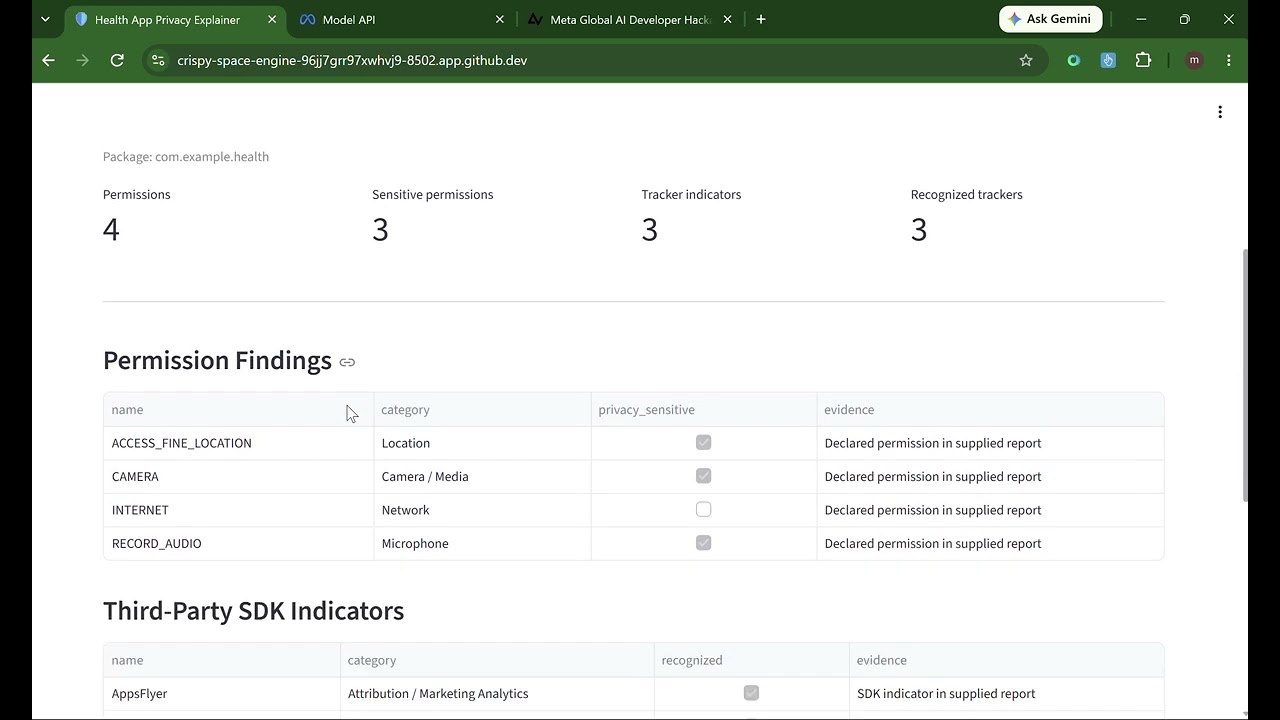
**Health App Privacy Explainer** is an AI-powered cybersecurity prototype that makes privacy and security findings in Android health applications easier to understand. It combines Python-based analysis with Meta's Muse Spark 1.3 to transform technical findings into clear, evidence-aware explanations. **The Problem** Mobile health apps handle sensitive information, including mental health, reproductive health, and medical records. Yet understanding their permissions, third-party SDKs, and potential privacy implications often requires cybersecurity expertise. Traditional security tools provide technical findings that can be difficult for nontechnical users to interpret. **The Solution** I developed an interactive application that processes structured MobSF-style JSON findings using a rule-based Python analyzer. The application: - Extracts Android permissions and third-party SDK indicators. - Identifies privacy-sensitive permissions and recognizes known SDKs. - Presents findings through a Streamlit dashboard. - Uses Meta Muse Spark 1.3 to generate plain-English explanations. - Distinguishes confirmed indicators from unverified possibilities. - Recommends verification steps and supports JSON downloads. **Meta AI Integration** I integrated Muse Spark 1.3 through the Meta Model API using an OpenAI-compatible Python SDK. Rather than automatically treating permissions or SDKs as evidence of misuse, the model explains potential privacy implications, identifies uncertainty, and suggests further verification. This approach avoids unsupported claims about personal data collection or sharing. **Research Foundation** This project builds on my undergraduate cybersecurity research at Kent State University, where I investigated privacy and security indicators in Android health apps, including BetterHelp, BabyCenter, MyChart, and Ovia, using MobSF, manual code review, and Python analysis. For this hackathon, I extended that research by building a JSON-processing pipeline, an interactive dashboard, and Meta Muse Spark integration. **Working Prototype** The prototype was successfully demonstrated using synthetic MobSF-style JSON containing four Android permissions and three third-party SDK indicators. It classified the findings and generated a real privacy explanation using Meta's live Model API. Compatibility with actual MobSF JSON exports remains to be validated. **Future Development and Impact** Future work includes testing real MobSF reports, expanding permission and SDK recognition, improving automated analysis, and evaluating AI explanation accuracy. My goal is to make mobile privacy analysis more transparent and accessible while demonstrating how responsible generative AI can connect cybersecurity research with everyday understanding.