Warp Relay
Built at Meta Global AI Developer Hackathon · Oct 26, 2026 · Remote
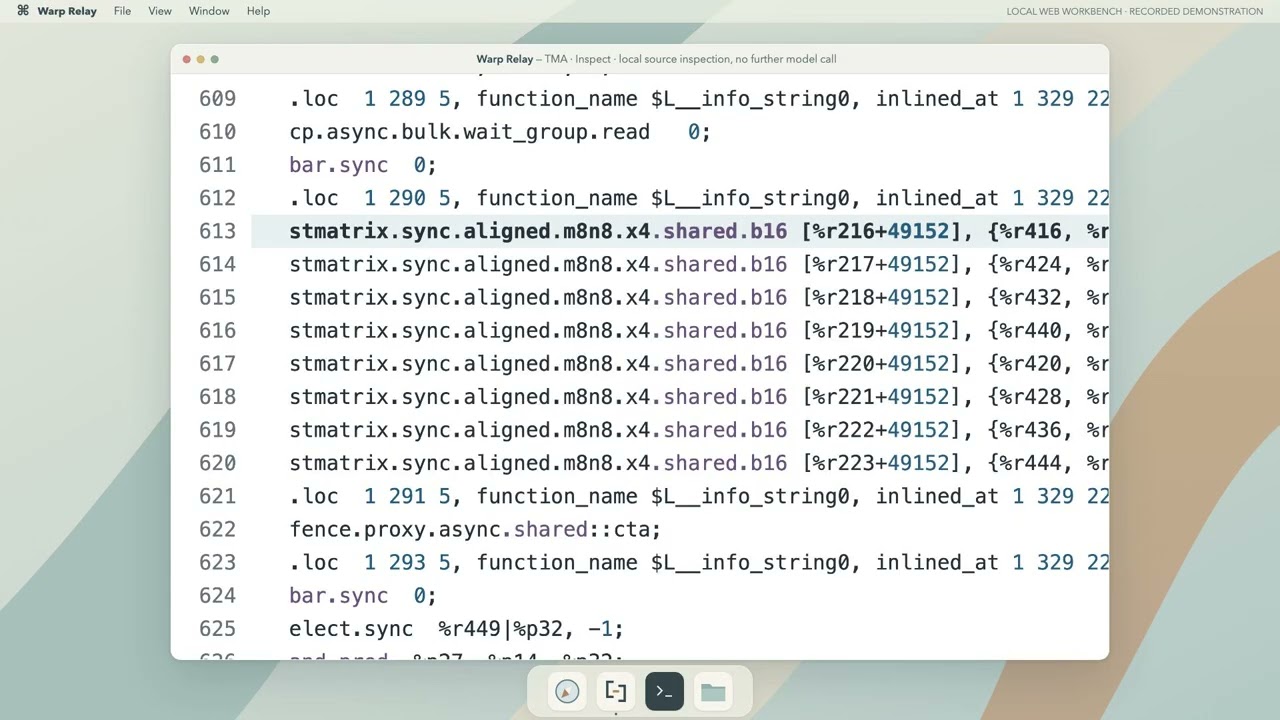
Warp Relay is an investigation workbench for GPU-kernel synchronization edits. It connects a proposed change to the source, assumptions and evidence behind the decision to retain or reject it. A small edit can look harmless in numerical tests. In our saved B200 validation batch 002, a barrier-deletion candidate passed all 39 cases in the uninstrumented numerical suite. A separate Compute Sanitizer racecheck execution of the same edited PTX reported a shared-memory race and failed its own one-case numerical check. These are distinct executions, not a single launch that both passed and raced. The workbench follows that evidence back to the code. Users can load PTX and a fixed contract, start bounded CPU analysis, compare candidate diffs, inspect linked accesses, cancel or retry jobs, and export retained source and raw results. A constrained rule provider proposes individual barrier edits; an admission policy and the pinned SentryWard verifier check each proposal under the same contract. Rejected candidates remain inspectable, and unsupported cases remain inconclusive. Twelve cases provide different investigation paths: eight imported upstream records and four local CPU archives. One real Meta muse-spark-1.3 diagnosis adds a cited hypothesis and source-inspection plan. The workbench exposes its exact input, response, integrity checks and the local inspection that follows it, while keeping the conflicting instruction pair unresolved where the source mapping cannot establish it. Our contribution is the bounded orchestration, admission controls, workbench, Meta auditing, evidence handling and GPU reference harness. SentryWard is pre-existing Apache-2.0 work, pinned and unmodified; upstream kernel licenses and provenance are retained. A fresh native build passed 73 Python tests, alongside UI and browser checks. The saved records can be browsed offline with Python and no GPU or model key. New CPU analyses require the native verifier build. Synchronization acceptance is scoped to the supported model and assumptions; finite numerical tests are not a proof. No measured GPU speedup or model-driven repair is claimed. Built by zzw4257.