SoloDev001
Built at Meta Global AI Developer Hackathon · Oct 26, 2026 · Remote
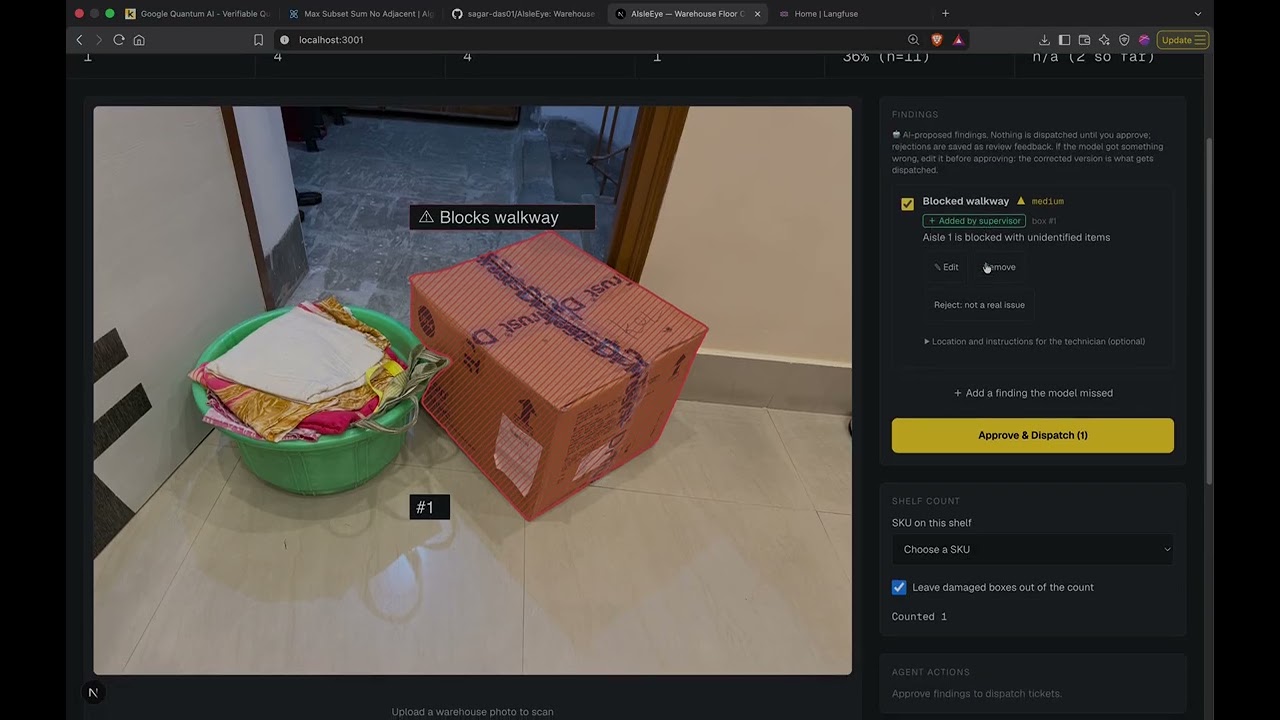
AIsleEye: a warehouse floor copilot that turns one photo into damage and hazard tickets Draft write-up for sharing, about 3,000 words. It describes the repository as it stands today, including the parts that are unfinished. 1. The short version AIsleEye turns a single phone photo of a warehouse aisle or pallet into actionable operations data. A supervisor takes or uploads a photo. The system finds every cardboard box and any floor markings, then inspects each box for physical damage. It also checks whether freight is blocking a pedestrian walkway. The supervisor reviews what it found and approves or rejects each finding. An AI agent then files incident tickets, quarantines damaged inventory, and logs compliance events, all under strict guardrails. In one line: one photo in, tickets and records out, with a human approving every step that changes anything. The project is built around Meta's models, accessed through the Meta Model API: Job Model Find boxes and floor markings, with pixel-accurate masks sam-3.1 (text-prompted segmentation) Judge whether each box is damaged, returning schema-constrained JSON muse-spark-1.3 (vision) Take actions: tickets, inventory, compliance muse-spark-1.3 through a LangChain/LangGraph agent (optionally muse-wonder-1.0) 2. The problem it solves Small and mid-sized warehouses mostly still run on manual floor walks and clipboards. That creates three problems. Damaged freight is found too late Crushed, torn or wet cartons are usually discovered at dispatch, or by the customer. By then the damage may have happened days ago, the cause is untraceable, and the cost is a return, a claim or a lost customer. Spotting damage when the pallet is on the floor lets the warehouse quarantine stock before it ships and fix whatever caused the damage. Blocked walkways are a top safety risk, and audits are slow Pedestrian lanes marked with floor tape get blocked by pallets and boxes all the time. Blocked lanes cause trips, collisions with forklifts, and compliance findings. Audits that catch this are periodic and paper-based, so a hazard can sit unnoticed between audits. Safety and inventory live in separate worlds One walk of the floor produces two sets of manual paperwork. One is a damaged-goods report for inventory. The other is a hazard report for safety. They are written by hand, entered separately, and often inconsistent. AIsleEye collapses all of this into one scan with a human in the loop. A single photo produces a damage finding, a hazard finding, an inventory adjustment, a ticket and a compliance entry. The log of what happened is consistent and auditable, so nobody re-keys the same facts into three systems.