Sidethought
Built at Meta Global AI Developer Hackathon · Oct 26, 2026 · Remote
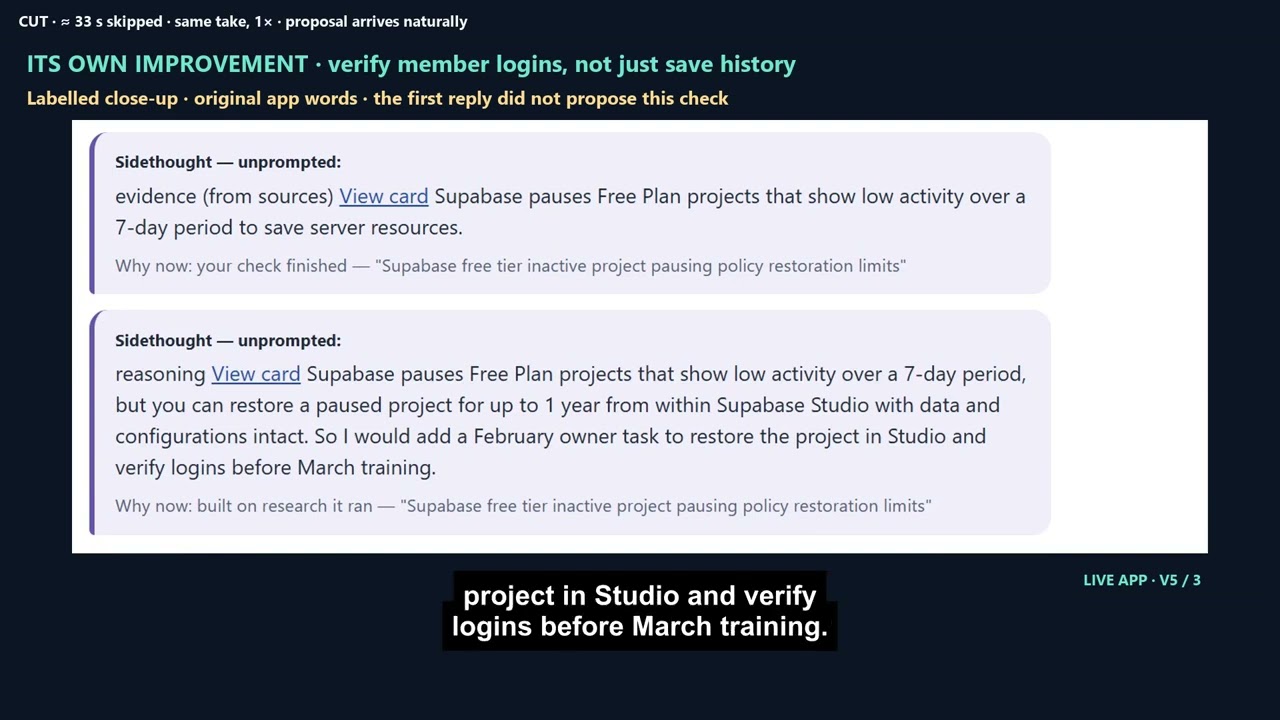
Sidethought turns an idea you can explain into an idea you have genuinely thought through, without you having to do all the questioning yourself. Agent asks independent questions to imitate another person working on the project alongside you. Coding assistants help once you know what to build. The stage before that, working out the idea itself, is still mostly done alone, or with a chat assistant that only answers what it is asked. Sidethought is a second person for that stage. It acts as a thoughtful colleague, not a questionnaire or an agreeable transcriber. You talk through your idea; it thinks alongside you and contributes thoughts of its own. What it does: - It notices what your idea quietly depends on, such as an unchecked assumption or a tension between two of your decisions. - It decides by itself what is worth looking into, and researches it in the background while you keep talking. - When it has something worth saying, it speaks up unprompted with its own suggestion, not only a fact. Each unprompted remark says why it is speaking now. - When you change your mind, it notices which of its earlier thoughts no longer apply, instead of arguing against the old version of your idea. Example, from the live take in our demo video: I describe an idea: a habit tracker for my running club, used from March to June, then idle until spring, on the Supabase free tier so it costs nothing. I ask nothing. Sidethought replies like a colleague: plan for the winter pause and export the data. Then, on its own, it checks the pause rules in Supabase's official documentation and comes back unprompted with its own improvement: "So I would add a February owner task to restore the project in Studio and verify logins before March training." An export saves the history; this checks that members can actually get back in. Then I change my mind: "Actually, we will use the Supabase Pro plan from day one." Sidethought records the Pro decision, marks the free-tier decision as superseded and its free-tier research as applying to an earlier version, and its next remark is about Pro. How it works: Meta's Muse Spark plays five roles: interpreting what you said into plan items, replying, deliberating about what is worth raising, researching, and a final check before anything is said unprompted. A deterministic kernel keeps the project state and decides when a thought may be voiced: models propose, code decides. Research claims count only when their quote is found on the fetched page. Also built: separate named projects; reviewed lessons from one project that can inform another, with attribution; optional read-aloud; over 1,400 automated tests. Limits: it is an early prototype. Voice conversation, research while you are away and handing off a starter repository are planned, not built. Its own ideas do not appear every time: research-backed ideas were spoken in 4 of 7 tuned live test runs, and corrections to the plan were applied in 5 of 7 live tests.